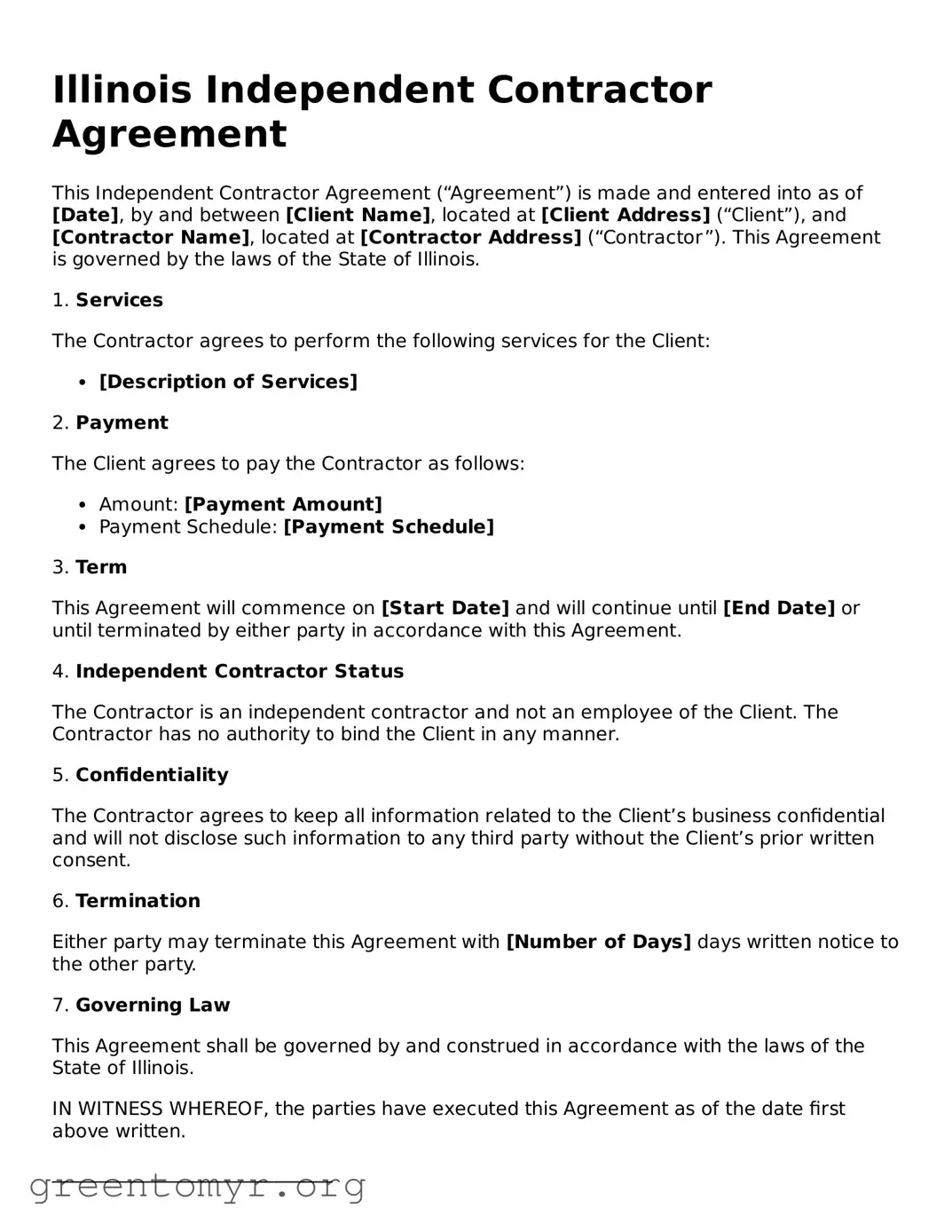
The Illinois Independent Contractor Agreement form serves as a vital document for establishing the relationship between a business and an independent contractor. This agreement outlines the expectations, responsibilities, and rights of both parties, ensuring clarity and mutual understanding. Key components typically include the scope of work, payment terms, and deadlines, which help define the contractor's duties and the compensation they will receive. Additionally, the form addresses confidentiality and intellectual property rights, safeguarding sensitive information and creations developed during the engagement. By detailing the terms of termination and dispute resolution, the agreement provides a framework for addressing potential conflicts. Overall, this document plays a crucial role in protecting both the contractor's interests and the hiring entity, fostering a professional environment built on clear communication and defined parameters.
Illinois Independent Contractor Agreement
This Independent Contractor Agreement (“Agreement”) is made and entered into as of [Date], by and between [Client Name], located at [Client Address] (“Client”), and [Contractor Name], located at [Contractor Address] (“Contractor”). This Agreement is governed by the laws of the State of Illinois.
1. Services
The Contractor agrees to perform the following services for the Client:
2. Payment
The Client agrees to pay the Contractor as follows:
3. Term
This Agreement will commence on [Start Date] and will continue until [End Date] or until terminated by either party in accordance with this Agreement.
4. Independent Contractor Status
The Contractor is an independent contractor and not an employee of the Client. The Contractor has no authority to bind the Client in any manner.
5. Confidentiality
The Contractor agrees to keep all information related to the Client’s business confidential and will not disclose such information to any third party without the Client’s prior written consent.
6. Termination
Either party may terminate this Agreement with [Number of Days] days written notice to the other party.
7. Governing Law
This Agreement shall be governed by and construed in accordance with the laws of the State of Illinois.
IN WITNESS WHEREOF, the parties have executed this Agreement as of the date first above written.
______________________________
Client Signature
[Client Name]
______________________________
Contractor Signature
[Contractor Name]
| Fact Name | Details |
|---|---|
| Definition | An Independent Contractor Agreement outlines the terms between a business and a contractor who provides services. |
| Governing Law | The agreement is governed by the laws of the State of Illinois. |
| Purpose | This form helps clarify the relationship, responsibilities, and expectations of both parties. |
| Compensation | The agreement should specify the payment terms, including rates and payment schedule. |
| Duration | The length of the contract, whether fixed-term or ongoing, should be clearly stated. |
| Termination Clause | It is important to include conditions under which either party may terminate the agreement. |
| Intellectual Property | The agreement may address ownership of work products and intellectual property created during the contract. |
Completing the Illinois Independent Contractor Agreement form is a straightforward process. By following the steps outlined below, you will ensure that all necessary information is accurately provided. This will help facilitate a clear understanding between both parties involved in the agreement.
Once you have completed the form, keep a copy for your records and provide the other party with their copy. This ensures that both sides have a clear understanding of the terms agreed upon.
The Illinois Independent Contractor Agreement is a legal document that outlines the terms and conditions between a business and an independent contractor. This form is crucial for defining the scope of work, payment terms, and other responsibilities. It helps to clarify the relationship, ensuring both parties understand their rights and obligations.
An Independent Contractor Agreement is necessary for several reasons:
Key components of the Illinois Independent Contractor Agreement typically include:
Filling out the Illinois Independent Contractor Agreement requires careful attention to detail. Begin by entering the names and addresses of both parties. Next, describe the services to be rendered clearly and concisely. Specify payment terms, including amounts and due dates. Finally, review the agreement for completeness and clarity before both parties sign it.
Yes, modifications to the agreement can be made after it is signed. However, both parties must agree to the changes, and it is advisable to document any amendments in writing. This ensures that both parties remain on the same page regarding the updated terms.
If a dispute arises, the first step is to refer back to the Independent Contractor Agreement. The document should outline the process for resolving conflicts, which may include mediation or arbitration. If the issue cannot be resolved amicably, legal action may be necessary. Consulting with a legal professional is recommended in such cases.
Yes, the Illinois Independent Contractor Agreement is legally binding once both parties have signed it. This means that both parties are obligated to adhere to the terms outlined in the agreement. It is important to ensure that the agreement complies with state laws to be enforceable in a court of law.
Filling out the Illinois Independent Contractor Agreement form can seem straightforward, but many individuals make common mistakes that can lead to complications down the line. One of the most frequent errors is failing to clearly define the scope of work. It’s essential to specify what tasks the contractor will perform. Without this clarity, misunderstandings can arise, potentially leading to disputes.
Another mistake is neglecting to include payment terms. It’s crucial to outline how and when the contractor will be compensated. This includes specifying whether payment will be made hourly, per project, or on a retainer basis. If these details are left vague, it can create confusion and frustration for both parties.
Some people also overlook the importance of including a termination clause. This clause should explain under what circumstances either party can end the agreement. Without it, there may be uncertainty about the process for terminating the contract, which can lead to further complications.
Additionally, individuals often forget to address confidentiality. If the contractor will have access to sensitive information, it’s vital to include a confidentiality agreement. This protects both the contractor and the hiring party from potential breaches of trust.
Another common oversight is not specifying the independent contractor's status. It’s important to clearly state that the contractor is not an employee. This distinction is significant for tax purposes and helps avoid potential legal issues regarding employment classification.
People sometimes fail to provide adequate identification information. The agreement should include the contractor's legal name and contact details. Missing this information can lead to difficulties in communication and payment.
Some individuals also neglect to review the entire document before signing. Skimming through the agreement can result in missing crucial details. Taking the time to read through the entire form ensures that all parties understand their rights and responsibilities.
Lastly, many forget to keep a copy of the signed agreement. It’s important to retain a copy for future reference. This document serves as a record of the terms agreed upon and can be invaluable if any disputes arise.
When entering into an Independent Contractor Agreement in Illinois, several other forms and documents may be necessary to ensure clarity and legal compliance. These documents help define the relationship between the contractor and the hiring party, covering various aspects of the work arrangement. Below are some key documents that are often used alongside the Independent Contractor Agreement.
These documents play a crucial role in establishing a professional and legally sound relationship between independent contractors and their clients. By having the appropriate paperwork in place, both parties can focus on the work at hand with confidence and clarity.
Employment Agreement: This document outlines the terms of employment between an employer and an employee. Like the Independent Contractor Agreement, it specifies duties, compensation, and duration of the relationship, though it typically includes benefits and employment rights.
Service Agreement: A service agreement is similar in that it defines the scope of services to be provided. Both documents clarify responsibilities and payment terms, but a service agreement may apply to a broader range of service providers beyond independent contractors.
Consulting Agreement: This agreement is often used when hiring a consultant for specialized advice. It shares similarities with the Independent Contractor Agreement by detailing the consultant's duties, compensation, and project timeline.
Freelance Agreement: This document is specifically tailored for freelancers. It mirrors the Independent Contractor Agreement in its purpose of defining the working relationship, including payment terms and deliverables.
Non-Disclosure Agreement (NDA): While primarily focused on confidentiality, an NDA may accompany an Independent Contractor Agreement. Both documents can protect sensitive information shared during the course of the working relationship.
Partnership Agreement: In situations where two or more parties collaborate, a partnership agreement outlines each party's contributions and responsibilities. It is similar in structure to an Independent Contractor Agreement, though it typically addresses shared ownership and profits.
Joint Venture Agreement: This document is used when two or more parties collaborate on a specific project. Like the Independent Contractor Agreement, it details the roles, responsibilities, and financial arrangements of each party involved.
When filling out the Illinois Independent Contractor Agreement form, there are important dos and don'ts to keep in mind. Following these guidelines can help ensure that the agreement is completed accurately and effectively.
Things You Should Do:
Things You Shouldn't Do:
Many people have misunderstandings about the Illinois Independent Contractor Agreement form. These misconceptions can lead to confusion regarding the rights and responsibilities of both parties involved. Below are some common misconceptions explained clearly.
Some individuals believe that a verbal agreement is sufficient for independent contractor relationships. However, having a written contract helps clarify expectations, responsibilities, and payment terms. It serves as a legal record that can protect both parties in case of disputes.
Not all independent contractors operate under the same terms or conditions. Each agreement can vary significantly based on the specific services provided, the scope of work, and the payment structure. It's essential to tailor the agreement to the unique situation.
Many people think that independent contractors lack legal protections. In reality, independent contractors have rights, such as the right to fair payment and the right to work in a non-discriminatory environment. The agreement can outline these rights and ensure they are upheld.
Some assume that an Independent Contractor Agreement is set in stone after both parties sign it. However, agreements can be modified if both parties agree to the changes. It's important to document any amendments in writing to avoid misunderstandings later.
When filling out and using the Illinois Independent Contractor Agreement form, consider the following key takeaways: