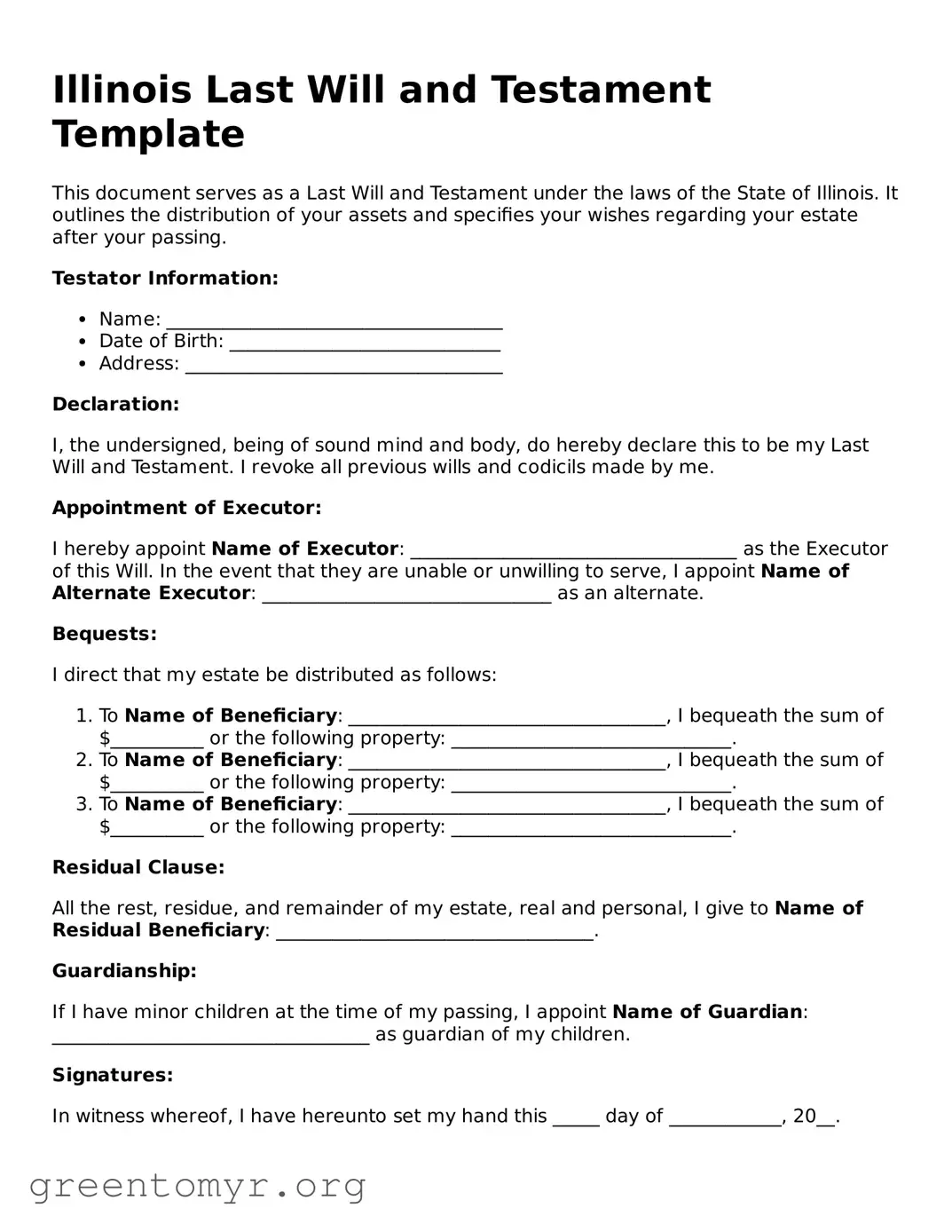
The Illinois Last Will and Testament form serves as a crucial document for individuals wishing to outline their wishes regarding the distribution of their assets after death. This form allows a person, often referred to as the testator, to specify who will inherit their property, name guardians for minor children, and appoint an executor to oversee the administration of their estate. In Illinois, the form must be signed in the presence of at least two witnesses, ensuring that the testator's intentions are clearly documented and legally recognized. Additionally, it is important for the will to be written in clear and precise language to avoid ambiguity that could lead to disputes among heirs. The form can be customized to reflect personal preferences, including charitable donations or specific bequests. By understanding the key elements of the Illinois Last Will and Testament, individuals can take important steps toward securing their legacy and providing peace of mind for their loved ones.
Illinois Last Will and Testament Template
This document serves as a Last Will and Testament under the laws of the State of Illinois. It outlines the distribution of your assets and specifies your wishes regarding your estate after your passing.
Testator Information:
Declaration:
I, the undersigned, being of sound mind and body, do hereby declare this to be my Last Will and Testament. I revoke all previous wills and codicils made by me.
Appointment of Executor:
I hereby appoint Name of Executor: ___________________________________ as the Executor of this Will. In the event that they are unable or unwilling to serve, I appoint Name of Alternate Executor: _______________________________ as an alternate.
Bequests:
I direct that my estate be distributed as follows:
Residual Clause:
All the rest, residue, and remainder of my estate, real and personal, I give to Name of Residual Beneficiary: __________________________________.
Guardianship:
If I have minor children at the time of my passing, I appoint Name of Guardian: __________________________________ as guardian of my children.
Signatures:
In witness whereof, I have hereunto set my hand this _____ day of ____________, 20__.
______________________________
Signature of Testator
Witnesses:
We, the undersigned witnesses, do hereby certify that the above-named Testator signed this Last Will and Testament in our presence, and we affirm that they appeared to be of sound mind and under no duress.
This document is made in accordance with the laws of the State of Illinois.
| Fact Name | Description |
|---|---|
| Definition | The Illinois Last Will and Testament is a legal document that outlines how a person's assets will be distributed after their death. |
| Governing Law | The form is governed by the Illinois Probate Act of 1975. |
| Age Requirement | To create a valid will in Illinois, the individual must be at least 18 years old. |
| Signature Requirement | The will must be signed by the person creating it (the testator) in the presence of at least two witnesses. |
| Witnesses | Witnesses must be at least 18 years old and cannot be beneficiaries of the will to avoid conflicts of interest. |
| Revocation | A will can be revoked at any time by creating a new will or by destroying the original document. |
| Holographic Wills | Illinois recognizes holographic wills, which are handwritten and signed by the testator, but they must meet certain criteria. |
| Executor Appointment | The will allows the testator to appoint an executor, who will be responsible for managing the estate and ensuring the wishes are carried out. |
| Probate Process | Once the testator passes away, the will typically goes through probate, a legal process that validates the will and oversees asset distribution. |
| Changes and Amendments | Changes to the will can be made through a codicil, which must also be signed and witnessed to be valid. |
After obtaining the Illinois Last Will and Testament form, you will need to fill it out carefully to ensure your wishes are clearly stated. This process involves providing personal information and designating how you want your assets distributed. Following these steps will help you complete the form accurately.
A Last Will and Testament is a legal document that outlines how an individual's assets and affairs should be handled after their death. This document specifies who will inherit property, who will serve as the executor, and can even designate guardians for minor children.
In Illinois, any person who is at least 18 years old and of sound mind can create a Last Will and Testament. It is essential that the individual understands the implications of their decisions regarding the distribution of their assets.
To be valid in Illinois, a Last Will and Testament must meet the following requirements:
Yes, you can change your Last Will and Testament at any time while you are alive and of sound mind. Changes can be made by creating a new will or by adding a codicil, which is an amendment to the existing will. It is advisable to follow the same formalities as the original will to ensure validity.
If an individual dies without a Last Will and Testament, they are said to have died "intestate." In such cases, Illinois law dictates how the deceased's assets will be distributed. Generally, assets will go to the closest relatives, which may not align with the deceased's wishes.
Yes, you can disinherit someone in your Last Will and Testament. However, it is crucial to clearly state your intentions within the document to avoid any potential disputes. It is advisable to consult with a legal professional to ensure that your wishes are properly documented.
The executor is the person responsible for carrying out the instructions in the Last Will and Testament. This includes managing the deceased's estate, paying debts and taxes, and distributing assets to beneficiaries. Choosing a trustworthy and organized individual for this role is essential.
To ensure that your Last Will and Testament is legally binding, follow these steps:
Additionally, consider having the will notarized, although this is not a requirement in Illinois.
While it is not legally required to hire an attorney to create a Last Will and Testament, consulting with one can provide valuable guidance. An attorney can help ensure that the will complies with state laws and accurately reflects your wishes, minimizing the risk of future disputes.
Filling out the Illinois Last Will and Testament form can be a straightforward process, but many people make common mistakes that can lead to complications down the line. One of the most frequent errors is not properly identifying the testator. It is crucial to ensure that your full legal name is included, along with any aliases you may use. This helps avoid confusion and ensures that your wishes are clearly understood.
Another mistake involves failing to date the document. Without a date, it can be difficult to determine when the will was created. This could lead to disputes among heirs, especially if multiple versions of the will exist. Always remember to include the date when you finalize your will.
People often overlook the importance of appointing an executor. This individual will be responsible for carrying out the terms of your will. If you do not name someone, the court will appoint an executor, which may not align with your wishes. Choose a trustworthy person who can handle the responsibilities involved.
Additionally, many individuals forget to include specific bequests. If you want to leave particular items or amounts of money to certain people, be sure to list these clearly. Vague language can lead to misunderstandings and disputes among your beneficiaries.
Another common error is not signing the will in the presence of witnesses. In Illinois, you need at least two witnesses to sign the document. If this step is skipped, your will may not be considered valid. Make sure your witnesses are present and understand their role in the process.
Failing to update your will after major life changes is also a significant mistake. Events such as marriage, divorce, or the birth of a child can affect your wishes. Regularly review and update your will to reflect your current situation and intentions.
Some people make the mistake of using outdated forms. Laws can change, and using an old version of the will form may not comply with current legal requirements. Always use the most recent version available to ensure your will is valid.
Additionally, it is important to avoid being overly vague in your instructions. Clear and specific language helps ensure that your wishes are honored. Ambiguity can lead to confusion and potential legal battles among your heirs.
Many individuals also neglect to consider the tax implications of their estate. Understanding how taxes may affect your beneficiaries can help you make informed decisions about your assets. Consulting with a professional can provide valuable insights.
Lastly, some people mistakenly believe that once they complete their will, they no longer need to think about it. A will is not a one-time task. Regularly revisiting your will can help ensure that it continues to reflect your wishes and circumstances.
When preparing a Last Will and Testament in Illinois, several other documents may be beneficial to ensure that your wishes are fully expressed and legally recognized. Each of these documents serves a specific purpose and can help streamline the estate planning process.
Incorporating these documents into your estate planning can provide clarity and ensure your wishes are honored. It is advisable to consult with a legal professional to ensure that all documents comply with Illinois law and accurately reflect your intentions.
When filling out the Illinois Last Will and Testament form, it's important to follow certain guidelines to ensure your wishes are clearly stated and legally valid. Here’s a list of things you should and shouldn't do:
Following these guidelines will help ensure that your Last Will and Testament is effective and reflects your true wishes.
Understanding the Illinois Last Will and Testament form is crucial for effective estate planning. However, several misconceptions can lead to confusion. Below are four common misconceptions:
Clarifying these misconceptions can help individuals navigate the estate planning process more effectively. Understanding the requirements and options available in Illinois can empower individuals to create a will that meets their needs.
When filling out and using the Illinois Last Will and Testament form, keep these key takeaways in mind:
Following these steps will help ensure that your Last Will and Testament accurately reflects your intentions and is legally valid in Illinois.