The Illinois Living Will form serves as a crucial document for individuals who wish to express their healthcare preferences in the event they become unable to communicate their wishes. This legal instrument allows you to outline your desires regarding medical treatment, particularly in situations involving terminal illness or irreversible conditions. By completing this form, you can specify the types of life-sustaining measures you want or do not want, such as resuscitation efforts or artificial nutrition and hydration. Importantly, the Illinois Living Will is designed to ensure that your choices are respected by healthcare providers and loved ones, providing peace of mind during difficult times. Additionally, it is important to understand that this document can be updated or revoked at any time, reflecting changes in your preferences as circumstances evolve. Understanding the components and implications of the Illinois Living Will form is essential for anyone looking to take control of their medical decisions and ensure their wishes are honored.
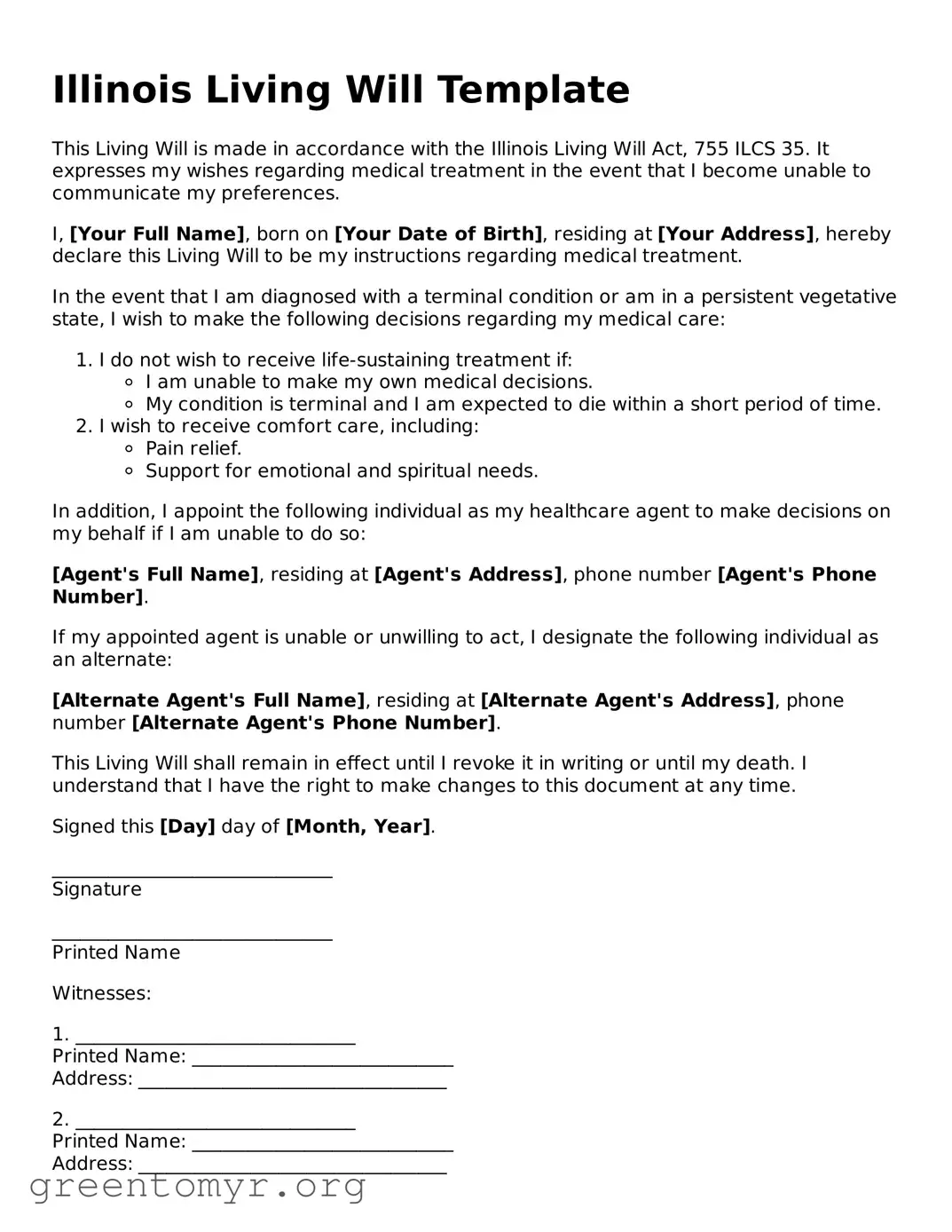
Illinois Living Will Template
This Living Will is made in accordance with the Illinois Living Will Act, 755 ILCS 35. It expresses my wishes regarding medical treatment in the event that I become unable to communicate my preferences.
I, [Your Full Name], born on [Your Date of Birth], residing at [Your Address], hereby declare this Living Will to be my instructions regarding medical treatment.
In the event that I am diagnosed with a terminal condition or am in a persistent vegetative state, I wish to make the following decisions regarding my medical care:
In addition, I appoint the following individual as my healthcare agent to make decisions on my behalf if I am unable to do so:
[Agent's Full Name], residing at [Agent's Address], phone number [Agent's Phone Number].
If my appointed agent is unable or unwilling to act, I designate the following individual as an alternate:
[Alternate Agent's Full Name], residing at [Alternate Agent's Address], phone number [Alternate Agent's Phone Number].
This Living Will shall remain in effect until I revoke it in writing or until my death. I understand that I have the right to make changes to this document at any time.
Signed this [Day] day of [Month, Year].
______________________________
Signature
______________________________
Printed Name
Witnesses:
1. ______________________________
Printed Name: ____________________________
Address: _________________________________
2. ______________________________
Printed Name: ____________________________
Address: _________________________________
| Fact Name | Description |
|---|---|
| Definition | The Illinois Living Will form allows individuals to express their wishes regarding medical treatment in the event they become unable to communicate those wishes. |
| Governing Law | This form is governed by the Illinois Probate Act, specifically 755 ILCS 35/1 et seq. |
| Eligibility | Any adult who is at least 18 years old can create a Living Will in Illinois. |
| Witness Requirement | The form must be signed in the presence of at least two witnesses who are not related to the individual or beneficiaries. |
| Revocation | Individuals can revoke their Living Will at any time, provided they do so in writing or by destroying the document. |
| Healthcare Proxy | The Living Will can be used in conjunction with a healthcare power of attorney, but it serves a different purpose. |
| Scope of Decisions | The form typically addresses end-of-life decisions, such as the refusal of life-sustaining treatment. |
| Legal Standing | Once properly executed, the Living Will is legally binding and must be honored by healthcare providers in Illinois. |
Filling out the Illinois Living Will form is an important step in expressing your healthcare preferences. Once completed, you will have a document that outlines your wishes regarding medical treatment in situations where you may be unable to communicate them yourself. Here are the steps to fill out the form.
An Illinois Living Will is a legal document that allows individuals to express their wishes regarding medical treatment in the event they become unable to communicate their preferences. This document specifically addresses situations where a person is terminally ill or in a state of permanent unconsciousness. By completing a Living Will, individuals can ensure that their healthcare decisions align with their values and beliefs.
Creating a Living Will in Illinois involves several straightforward steps:
Yes, you can change or revoke your Living Will at any time as long as you are competent to make decisions. To revoke the document, you can simply destroy it or create a new Living Will that states your updated wishes. It is important to inform your healthcare providers and family members about any changes you make to ensure your current wishes are respected.
If you do not have a Living Will, your healthcare decisions may be made by family members or medical professionals based on their interpretation of what you would want. This could lead to uncertainty and potential disagreements among loved ones during difficult times. Having a Living Will helps clarify your wishes and can alleviate stress for your family, ensuring that your healthcare preferences are honored.
Completing the Illinois Living Will form is a significant step in ensuring that your healthcare preferences are honored. However, many individuals make common mistakes that can lead to confusion or disputes later on. Understanding these pitfalls can help ensure that your intentions are clearly communicated.
One frequent mistake is failing to provide clear and specific instructions regarding medical treatments. Vague language can lead to misinterpretation by healthcare providers. It is crucial to outline your wishes explicitly, detailing which treatments you do or do not want in specific situations.
Another error is neglecting to sign the document properly. The Illinois Living Will requires your signature to be valid. If the form is not signed, it holds no legal weight. Additionally, witnesses must also sign, confirming that they observed you signing the document.
Some individuals overlook the importance of updating their Living Will. Life circumstances change, and your healthcare preferences may evolve over time. Regularly reviewing and revising the document ensures that it accurately reflects your current wishes.
Additionally, failing to discuss your Living Will with family members can lead to misunderstandings. Open communication about your preferences can help alleviate confusion and ensure that your loved ones understand your decisions. This discussion can also help them feel more comfortable advocating for your wishes when necessary.
People often forget to designate a healthcare proxy or agent. While the Living Will outlines your preferences, having someone appointed to make decisions on your behalf can be crucial if you are unable to communicate. This person should be someone you trust and who understands your values and wishes.
Finally, many individuals do not provide copies of their Living Will to the necessary parties. It is essential to share the document with your healthcare providers, family members, and anyone else involved in your care. This ensures that your wishes are known and can be acted upon when needed.
A Living Will is an essential document for expressing your healthcare preferences in Illinois. However, it often works best in conjunction with other important forms and documents that help ensure your wishes are honored. Below is a list of related documents that you may consider alongside your Living Will.
Having these documents in place alongside your Living Will can provide clarity and guidance for your loved ones and healthcare providers. By preparing these forms, you can help ensure that your medical preferences are understood and respected, ultimately providing peace of mind for you and your family.
A Living Will is a crucial document that outlines an individual's preferences for medical treatment in situations where they are unable to communicate their wishes. Several other documents serve similar purposes in ensuring that personal health care preferences are respected. Here are four documents that share similarities with a Living Will:
When filling out the Illinois Living Will form, it’s important to approach the process with care. Here’s a list of things you should and shouldn’t do.
By following these guidelines, you can ensure that your Living Will accurately reflects your wishes and provides clear guidance for your loved ones and healthcare providers.
Misconceptions about the Illinois Living Will form can lead to confusion and misunderstandings. Here are seven common misconceptions, along with explanations to clarify them.
A Living Will specifically addresses medical decisions and end-of-life care, while a Last Will and Testament deals with the distribution of assets after death.
While legal assistance can be beneficial, Illinois law allows individuals to complete a Living Will without an attorney, as long as they follow the required guidelines.
People of all ages can benefit from a Living Will. Unexpected medical emergencies can occur at any time, making it important for everyone to have a plan in place.
In Illinois, a properly executed Living Will is legally binding and must be honored by healthcare providers, as long as it meets state requirements.
Individuals have the right to modify or revoke their Living Will at any time, as long as they follow the appropriate procedures for doing so.
While it primarily addresses end-of-life care, a Living Will can also specify preferences for other medical treatments in situations where a person is unable to communicate.
A Living Will does not prevent individuals from receiving medical care. It simply outlines the types of treatment a person wishes to receive or decline under specific circumstances.
Filling out and using the Illinois Living Will form is an important step in making your healthcare wishes known. Here are key takeaways to consider:
By following these guidelines, you can ensure that your Living Will accurately represents your healthcare preferences.