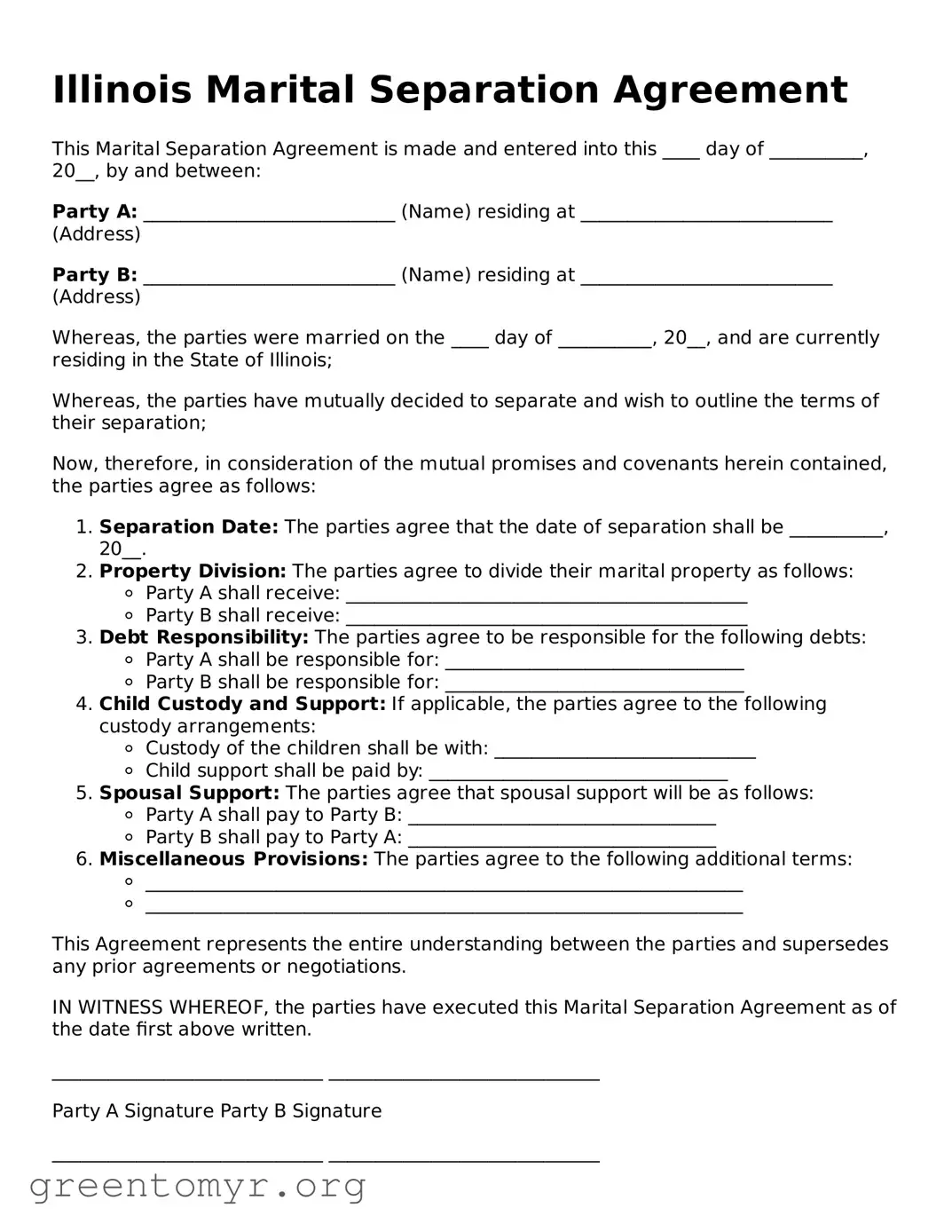
In the realm of family law, navigating the complexities of marital separation can be daunting. The Illinois Marital Separation Agreement form serves as a crucial tool for couples seeking to outline their rights and responsibilities while living apart. This document typically addresses key aspects such as the division of assets and debts, child custody arrangements, and spousal support. By clearly defining these elements, the agreement aims to minimize conflict and provide a structured approach to separation. Couples can use the form to establish guidelines that reflect their unique circumstances, ensuring that both parties are aware of their obligations and entitlements. Moreover, it is essential to recognize that while this agreement can facilitate a smoother transition, it should be crafted with care to avoid potential disputes in the future. Understanding the intricacies of the Illinois Marital Separation Agreement form is vital for anyone considering or undergoing a separation, as it lays the groundwork for a more amicable resolution.
Illinois Marital Separation Agreement
This Marital Separation Agreement is made and entered into this ____ day of __________, 20__, by and between:
Party A: ___________________________ (Name) residing at ___________________________ (Address)
Party B: ___________________________ (Name) residing at ___________________________ (Address)
Whereas, the parties were married on the ____ day of __________, 20__, and are currently residing in the State of Illinois;
Whereas, the parties have mutually decided to separate and wish to outline the terms of their separation;
Now, therefore, in consideration of the mutual promises and covenants herein contained, the parties agree as follows:
This Agreement represents the entire understanding between the parties and supersedes any prior agreements or negotiations.
IN WITNESS WHEREOF, the parties have executed this Marital Separation Agreement as of the date first above written.
_____________________________ _____________________________
Party A Signature Party B Signature
_____________________________ _____________________________
Date Date
| Fact Name | Details |
|---|---|
| Definition | The Illinois Marital Separation Agreement is a legal document that outlines the terms of separation between spouses. |
| Governing Law | This agreement is governed by the Illinois Marriage and Dissolution of Marriage Act. |
| Purpose | It helps clarify the rights and responsibilities of each spouse during the separation period. |
| Content Requirements | The agreement should include provisions related to property division, child custody, and support obligations. |
| Enforceability | Once signed, the agreement can be enforced in court, provided both parties have agreed to its terms voluntarily. |
After obtaining the Illinois Marital Separation Agreement form, individuals should carefully complete it to ensure that all necessary information is accurately recorded. This form is a crucial step in the process of legally formalizing a separation. Following the completion of the form, parties may need to file it with the appropriate court and follow any additional legal procedures as required by Illinois law.
A Marital Separation Agreement is a legal document that outlines the terms of separation between spouses. It addresses various aspects of the couple's lives, including child custody, support, division of property, and any other relevant matters. This agreement is particularly important for couples who wish to live apart but are not yet ready to divorce. It provides clarity and helps prevent disputes during the separation period.
Creating a Marital Separation Agreement involves several steps:
It is advisable to keep a copy for your records and provide one to your spouse.
Yes, a Marital Separation Agreement can be legally binding if it meets certain criteria. Both parties must enter into the agreement voluntarily, and it should be fair and reasonable. Courts often enforce these agreements, especially if they have been properly executed and filed. However, if either party fails to adhere to the terms, the other may seek legal recourse to enforce the agreement.
Yes, you can modify a Marital Separation Agreement after it has been signed, but both parties must agree to the changes. It's essential to document any modifications in writing and have both parties sign the amended agreement. This ensures that the new terms are clear and legally enforceable. If significant changes occur in your circumstances, such as a change in income or living arrangements, it may be wise to revisit and adjust the agreement accordingly.
Filling out the Illinois Marital Separation Agreement form can be a daunting task. Many individuals make mistakes that can lead to complications later on. One common error is failing to include all necessary personal information. This includes full names, addresses, and dates of birth for both parties. Omitting this information can cause delays in processing the agreement.
Another frequent mistake is not being clear about the terms of the separation. Vague language can lead to misunderstandings. It's essential to define responsibilities regarding finances, property, and child custody explicitly. Leaving room for interpretation can create disputes down the line.
People often overlook the importance of accurate financial disclosures. The form requires a complete account of assets and debts. Failing to disclose all financial information can lead to legal repercussions. Transparency is crucial for ensuring a fair agreement.
Additionally, many individuals neglect to consider future changes in their circumstances. The agreement should include provisions for potential changes, such as job loss or relocation. Not planning for these possibilities can render the agreement ineffective in the future.
Another mistake is not having the agreement reviewed by a legal professional. While it may seem straightforward, legal documents can be complex. A lawyer can provide valuable insights and ensure that the agreement complies with Illinois law. Skipping this step can result in costly errors.
Lastly, individuals often forget to sign and date the agreement correctly. Both parties must sign the document for it to be valid. Failing to do so can invalidate the entire agreement. Ensuring that all signatures are in place is a crucial final step in the process.
When navigating a marital separation in Illinois, several important documents may accompany the Marital Separation Agreement. Each of these forms plays a crucial role in ensuring that both parties understand their rights and obligations during this transitional period.
Understanding these documents can help facilitate a smoother separation process. Each form serves a distinct purpose, contributing to a clearer and more organized approach to marital separation.
When filling out the Illinois Marital Separation Agreement form, it is crucial to approach the process with care. Below is a list of things you should and shouldn't do to ensure accuracy and clarity.
Things You Should Do:
Things You Shouldn't Do:
When it comes to the Illinois Marital Separation Agreement form, several misconceptions can cloud understanding. Here’s a look at nine common misunderstandings:
It is the same as divorce. Many people think that a marital separation agreement is equivalent to a divorce. In reality, it is a legal document that outlines the terms of a couple's separation but does not legally end the marriage.
It is only for couples with children. Some believe that only couples with children need a separation agreement. However, any couple considering separation can benefit from having a clear agreement, regardless of whether children are involved.
It is not legally binding. A common misconception is that these agreements hold no legal weight. In fact, once properly executed, they can be enforceable in court, making it important to take them seriously.
It can be verbal. Some people think that a verbal agreement is sufficient. However, for clarity and enforceability, it’s essential to have a written document that both parties sign.
It only covers financial matters. While financial issues are a significant part of the agreement, it can also address other areas, such as property division, spousal support, and even personal matters like living arrangements.
It is a permanent solution. Many assume that once the agreement is signed, it cannot be changed. In truth, couples can modify their agreement later if both parties agree to the changes.
Only one party needs to sign. Some believe that only one spouse’s signature is necessary for the agreement to be valid. Both parties must sign the document for it to be legally binding.
It is only necessary if you plan to divorce. Many think a separation agreement is only needed if divorce is imminent. However, it can serve as a useful tool for couples who want to live separately while maintaining their marriage.
Legal help is unnecessary. Some individuals believe they can create a separation agreement without any legal assistance. While it is possible, consulting with a legal professional can help ensure that the agreement is comprehensive and protects both parties' interests.
Understanding these misconceptions can help couples navigate their separation more effectively. A well-crafted marital separation agreement can provide clarity and peace of mind during a challenging time.
When considering a marital separation in Illinois, understanding the Marital Separation Agreement form is crucial. Here are some key takeaways to keep in mind:
By keeping these points in mind, you can navigate the process of separation more effectively and with greater peace of mind.