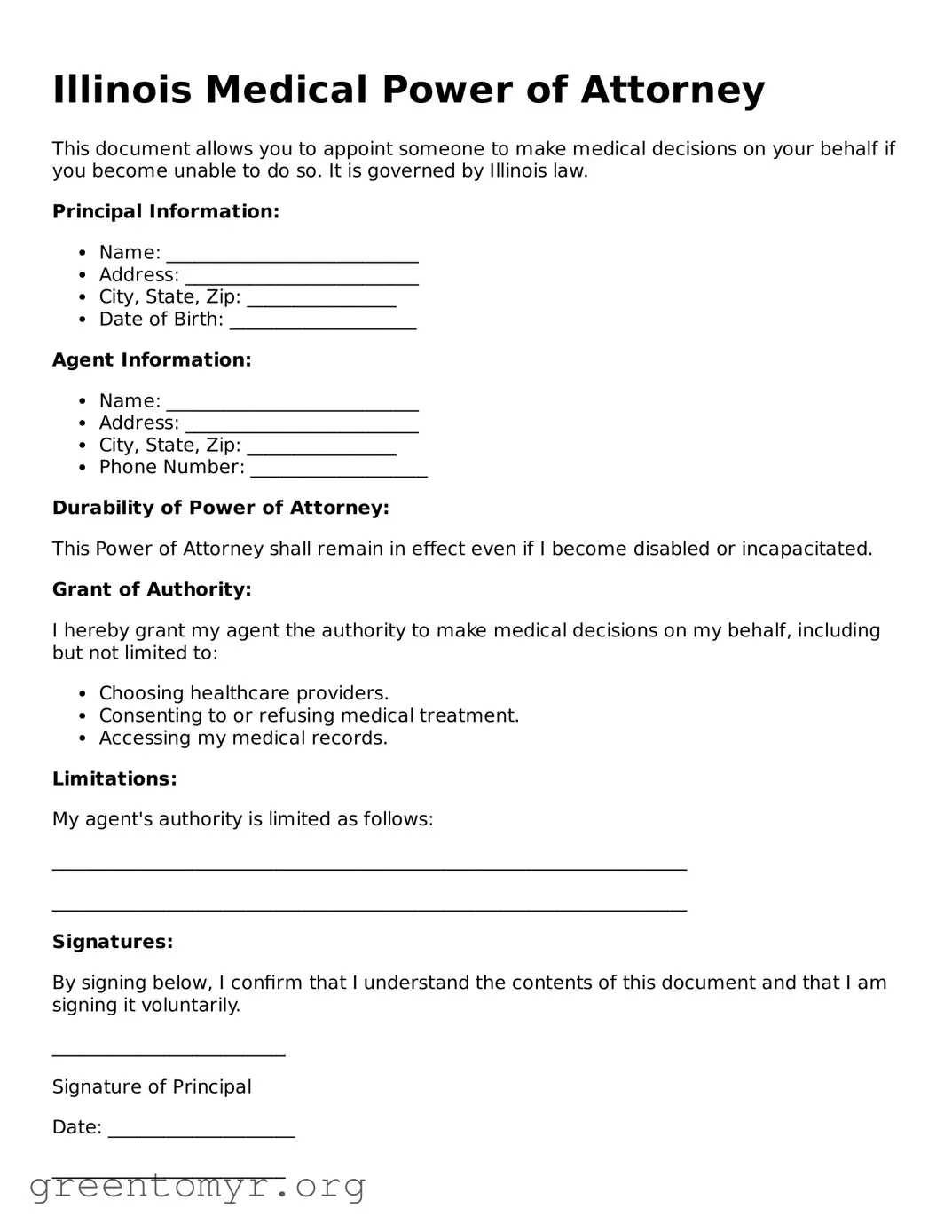
In Illinois, the Medical Power of Attorney form serves as a crucial document that allows individuals to designate someone they trust to make healthcare decisions on their behalf in the event that they become unable to communicate their wishes. This form is particularly important because it ensures that your medical preferences are honored, even when you cannot voice them yourself. The appointed individual, often referred to as an agent or proxy, will have the authority to make choices regarding medical treatments, surgical procedures, and end-of-life care based on your previously expressed wishes. It’s essential to understand that this document not only empowers your chosen representative but also provides peace of mind for you and your loved ones, knowing that decisions will align with your values and desires. Additionally, the Illinois Medical Power of Attorney form must be completed in accordance with specific state guidelines to be valid, including being signed in the presence of a witness or a notary. By taking the time to fill out this form, you are taking an important step in planning for your future healthcare needs.
Illinois Medical Power of Attorney
This document allows you to appoint someone to make medical decisions on your behalf if you become unable to do so. It is governed by Illinois law.
Principal Information:
Agent Information:
Durability of Power of Attorney:
This Power of Attorney shall remain in effect even if I become disabled or incapacitated.
Grant of Authority:
I hereby grant my agent the authority to make medical decisions on my behalf, including but not limited to:
Limitations:
My agent's authority is limited as follows:
____________________________________________________________________
____________________________________________________________________
Signatures:
By signing below, I confirm that I understand the contents of this document and that I am signing it voluntarily.
_________________________
Signature of Principal
Date: ____________________
_________________________
Signature of Agent
Date: ____________________
Witnesses:
Two witnesses must sign this document. Witnesses cannot be the agent or related to the principal.
Date: ____________________
| Fact Name | Details |
|---|---|
| Governing Law | The Illinois Medical Power of Attorney is governed by the Illinois Power of Attorney Act, specifically 755 ILCS 45/1-1 et seq. |
| Purpose | This form allows an individual to designate an agent to make medical decisions on their behalf in the event they become unable to do so. |
| Requirements | The form must be signed by the principal and witnessed by two adults or notarized to be valid. |
| Durability | The authority granted by this form remains in effect until revoked or the principal passes away. |
Filling out the Illinois Medical Power of Attorney form is an important step in ensuring your healthcare wishes are respected. After completing the form, you will need to sign it in front of a witness or a notary public. This step is crucial for the document to be legally valid.
A Medical Power of Attorney (MPOA) is a legal document that allows you to appoint someone to make healthcare decisions on your behalf if you become unable to do so. This person is often referred to as your "agent" or "attorney-in-fact." They will have the authority to make medical decisions based on your wishes and best interests.
Your agent can be anyone you trust to make healthcare decisions for you. This could be a family member, friend, or a trusted advisor. However, your agent cannot be your healthcare provider or an employee of your healthcare provider, unless they are also a family member.
To create an MPOA, you need to fill out the Illinois Medical Power of Attorney form. This form must be signed by you and witnessed by two people or notarized. Make sure the witnesses are not your agent or related to you. Once completed, keep the original document in a safe place and provide copies to your agent and healthcare providers.
Yes, you can change or revoke your MPOA at any time as long as you are still competent. To revoke it, you can simply create a new MPOA or write a statement indicating that you are revoking the previous one. Inform your agent and healthcare providers of any changes you make.
Your agent can make a variety of medical decisions, including:
It's important to discuss your wishes with your agent so they can make decisions that align with your values.
The MPOA goes into effect when your doctor determines that you are unable to make your own healthcare decisions. This is often referred to as being "incapacitated." Until that determination is made, you will continue to make your own decisions.
No, you do not need a lawyer to create a Medical Power of Attorney in Illinois. However, consulting with one can help ensure that your document meets all legal requirements and accurately reflects your wishes.
If you do not have an MPOA and become unable to make your own healthcare decisions, your family may need to go through a court process to appoint a guardian. This can be time-consuming and may not reflect your personal wishes.
Yes, you can have both documents. A Living Will outlines your preferences for medical treatment in specific situations, while a Medical Power of Attorney designates someone to make decisions for you. Having both can provide comprehensive guidance for your healthcare.
Filling out the Illinois Medical Power of Attorney form is a crucial step in ensuring that your healthcare wishes are respected when you are unable to communicate them yourself. However, many individuals make common mistakes that can lead to complications or even invalidate the document. Understanding these pitfalls can help you create a more effective and legally sound directive.
One frequent mistake is failing to choose the right agent. Your agent should be someone you trust implicitly to make healthcare decisions on your behalf. It’s essential to discuss your wishes with this person before naming them as your agent. If you select someone who does not understand your values or preferences, they may struggle to make decisions that align with your wishes.
Another common error is not being specific enough about your wishes. The form allows you to express your preferences regarding medical treatments and interventions. If you leave these sections vague, your agent may have to make difficult decisions without clear guidance. Take the time to articulate your desires clearly, whether you want to receive life-sustaining treatment or prefer a more comfort-focused approach.
Many people overlook the importance of witnessing and notarizing the document. In Illinois, the Medical Power of Attorney must be signed in front of a witness or a notary public. Failing to meet these requirements can render the document invalid. Ensure that your witnesses are eligible, which typically means they should not be your agent or related to you by blood or marriage.
Additionally, individuals often forget to review and update their documents regularly. Life circumstances change—relationships evolve, and health conditions can shift. It’s advisable to revisit your Medical Power of Attorney every few years or after significant life events, such as marriage, divorce, or the birth of a child. This ensures that your agent and your wishes remain aligned.
Some people neglect to consider alternative agents. While it’s essential to designate a primary agent, it’s equally important to name a backup. If your primary agent is unavailable or unable to act, having an alternative ensures that someone can step in and make decisions on your behalf without delay.
Another mistake is not discussing the form with family members. While it may feel uncomfortable, having open conversations about your healthcare preferences can alleviate confusion and potential conflict down the line. Family members may have differing opinions about your care, and discussing your choices can help them understand and support your decisions.
Finally, individuals sometimes forget to keep copies of the completed form. After filling out the Illinois Medical Power of Attorney, it’s crucial to provide copies to your agent, healthcare providers, and family members. This ensures that everyone involved in your care is aware of your wishes and can act accordingly when the time comes.
By avoiding these common mistakes, you can create a Medical Power of Attorney that truly reflects your healthcare preferences and provides peace of mind for both you and your loved ones.
When preparing a Medical Power of Attorney in Illinois, several other forms and documents may be beneficial to ensure comprehensive healthcare planning. Below is a list of commonly used documents that complement the Medical Power of Attorney.
Considering these documents alongside your Medical Power of Attorney can help create a clear and comprehensive plan for your healthcare needs. It ensures that your wishes are respected and that your loved ones have the guidance they need during difficult times.
When filling out the Illinois Medical Power of Attorney form, it is essential to approach the task with care and attention to detail. Below are four important do's and don'ts to keep in mind.
By following these guidelines, you can help ensure that your Medical Power of Attorney accurately reflects your wishes and is legally valid when needed.
When it comes to the Illinois Medical Power of Attorney form, many people hold onto misconceptions that can lead to confusion or even missteps in important healthcare decisions. Here’s a look at some of the most common misunderstandings:
Many believe that the Medical Power of Attorney is only relevant when a person is completely unable to make decisions. However, it can also be used when someone is temporarily incapacitated or unable to communicate their wishes.
While family members often want to help, they do not have the legal authority to make healthcare decisions on your behalf unless you have designated them in a Medical Power of Attorney.
This is a common myth. You can update or revoke your Medical Power of Attorney at any time, as long as you are mentally competent to do so.
Each state has its own specific requirements and forms. The Illinois Medical Power of Attorney form is tailored to meet the laws and regulations of Illinois.
Health emergencies can happen to anyone, regardless of age. Having a Medical Power of Attorney is a wise decision for adults of all ages.
Doctors will follow your wishes as expressed in a Medical Power of Attorney. Without one, they may not have a clear directive, and decisions could fall to family members or the court.
You have the right to choose and change your agent at any time, as long as you are able to make that decision.
While it’s best to have a form that complies with the laws of the state where you reside, many states will recognize a Medical Power of Attorney from another state, provided it meets their legal standards.
Understanding these misconceptions can help you make informed decisions about your healthcare and ensure that your wishes are respected when it matters most.
Filling out and using the Illinois Medical Power of Attorney form is an important step in ensuring that your healthcare wishes are honored. Here are some key takeaways to consider: