Content Navigation

When buying or selling a vehicle in Illinois, having the right documentation is essential for a smooth transaction. The Illinois Motor Vehicle Bill of Sale form serves as a crucial record that outlines the details of the sale, including the buyer's and seller's information, vehicle description, and sale price. This form not only protects both parties by providing proof of ownership transfer but also aids in the registration process with the Illinois Secretary of State. In addition to basic information like the Vehicle Identification Number (VIN) and odometer reading, the form may include a statement regarding any liens on the vehicle, ensuring transparency throughout the process. Completing this form accurately is vital to avoid future disputes and ensure compliance with state regulations. Understanding its components can help you navigate the sale or purchase of a vehicle with confidence.

Illinois Motor Vehicle Bill of Sale Example

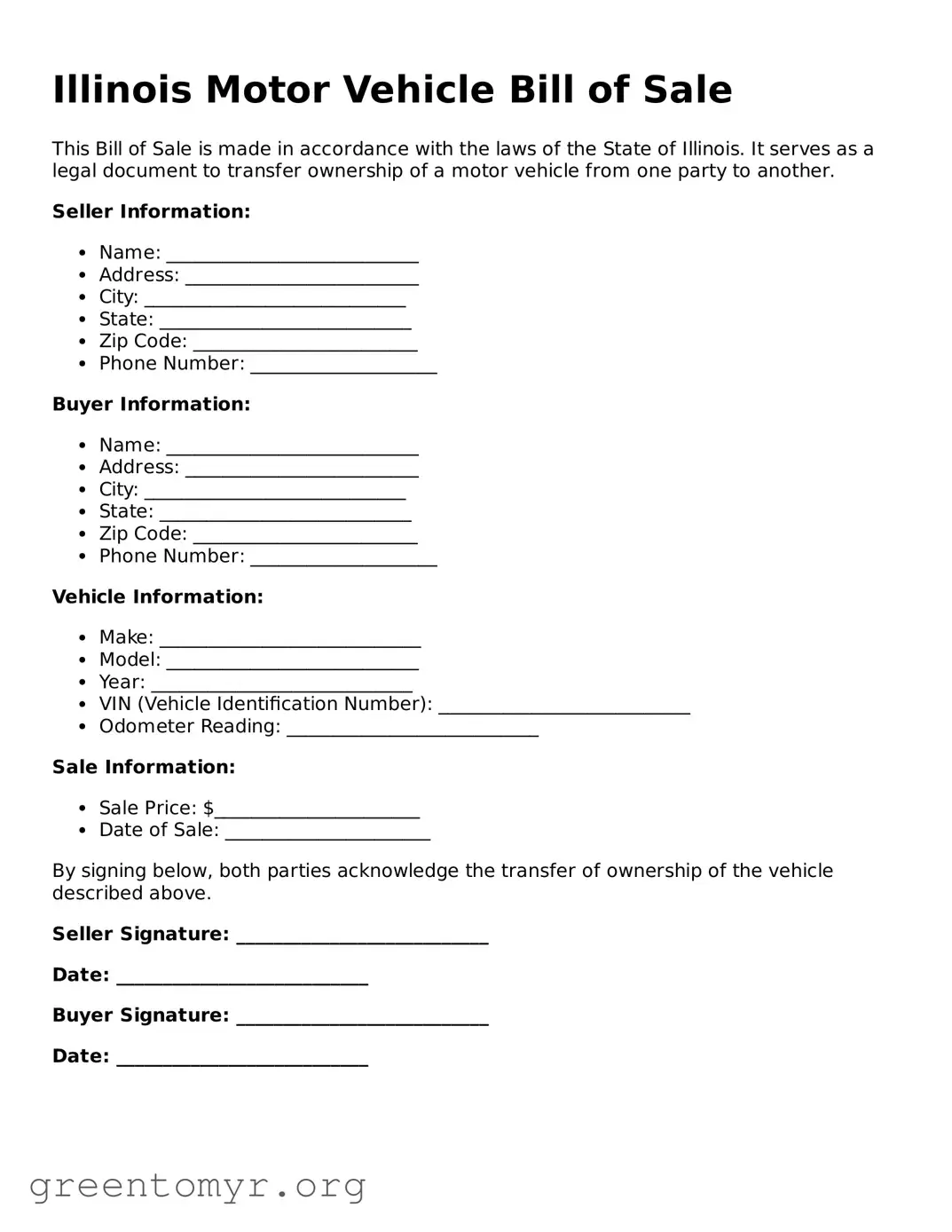
Illinois Motor Vehicle Bill of Sale

This Bill of Sale is made in accordance with the laws of the State of Illinois. It serves as a legal document to transfer ownership of a motor vehicle from one party to another.

Seller Information:

  • Name: ___________________________
  • Address: _________________________
  • City: ____________________________
  • State: ___________________________
  • Zip Code: ________________________
  • Phone Number: ____________________

Buyer Information:

  • Name: ___________________________
  • Address: _________________________
  • City: ____________________________
  • State: ___________________________
  • Zip Code: ________________________
  • Phone Number: ____________________

Vehicle Information:

  • Make: ____________________________
  • Model: ___________________________
  • Year: ____________________________
  • VIN (Vehicle Identification Number): ___________________________
  • Odometer Reading: ___________________________

Sale Information:

  • Sale Price: $______________________
  • Date of Sale: ______________________

By signing below, both parties acknowledge the transfer of ownership of the vehicle described above.

Seller Signature: ___________________________

Date: ___________________________

Buyer Signature: ___________________________

Date: ___________________________

PDF Form Features

Fact Name Description
Purpose The Illinois Motor Vehicle Bill of Sale form is used to document the sale of a vehicle between a buyer and a seller.
Governing Law This form is governed by the Illinois Vehicle Code, specifically 625 ILCS 5/3-1001.
Required Information Essential details include the vehicle's make, model, year, VIN, and the purchase price.
Signatures Both the buyer and seller must sign the form to validate the transaction.
Notarization While notarization is not mandatory, it is recommended to prevent disputes.
Record Keeping Both parties should retain a copy of the completed Bill of Sale for their records.

Guide to Using Illinois Motor Vehicle Bill of Sale

After obtaining the Illinois Motor Vehicle Bill of Sale form, you will need to complete it accurately to ensure a smooth transfer of ownership. Follow these steps carefully to fill out the form correctly.

  1. Begin by entering the date of the sale at the top of the form.
  2. Provide the seller's full name and address in the designated fields.
  3. Enter the buyer's full name and address next.
  4. Fill in the vehicle details, including the make, model, year, and Vehicle Identification Number (VIN).
  5. Specify the purchase price of the vehicle in the appropriate section.
  6. If applicable, indicate any trade-in vehicle details, including its make, model, and VIN.
  7. Both the seller and buyer should sign and date the form at the bottom.

Once the form is completed, ensure that both parties retain a copy for their records. This document will serve as proof of the transaction and is essential for the buyer when registering the vehicle.

Get Answers on Illinois Motor Vehicle Bill of Sale

What is a Motor Vehicle Bill of Sale in Illinois?

A Motor Vehicle Bill of Sale is a legal document that records the transfer of ownership of a vehicle from one party to another in Illinois. This form serves as proof of the transaction and includes important details such as the vehicle's make, model, year, and Vehicle Identification Number (VIN). It also captures the buyer's and seller's information, making it essential for both parties during the sale.

Why do I need a Bill of Sale for my vehicle transaction?

A Bill of Sale is crucial for several reasons:

  • It provides legal evidence of the sale, protecting both the buyer and seller.
  • The document helps in establishing a clear record of ownership, which is important for registration and title transfer.
  • If any disputes arise regarding the sale, having a Bill of Sale can simplify resolution efforts.

What information is required on the Illinois Motor Vehicle Bill of Sale?

To create a valid Bill of Sale in Illinois, the following information should be included:

  1. The full names and addresses of both the buyer and seller.
  2. The vehicle's details, including make, model, year, and VIN.
  3. The sale price of the vehicle.
  4. The date of the sale.
  5. Any additional terms or conditions agreed upon by both parties.

Do I need to have the Bill of Sale notarized?

In Illinois, notarization is not a strict requirement for a Bill of Sale. However, having the document notarized can add an extra layer of authenticity and may be beneficial if there are any disputes in the future. It is often recommended to have both parties sign the document in the presence of a notary public to ensure its validity.

How do I use the Bill of Sale after the sale is completed?

After completing the sale, both the buyer and seller should retain a copy of the Bill of Sale for their records. The buyer will need to present this document when registering the vehicle with the Illinois Secretary of State. It is also advisable for the seller to keep a copy as proof of the transaction in case any issues arise later.

Common mistakes

Filling out the Illinois Motor Vehicle Bill of Sale form can seem straightforward, but many people make common mistakes that can lead to complications later. One frequent error is failing to include all necessary information. Buyers and sellers often forget to provide details like the vehicle identification number (VIN), the sale price, or the date of the transaction. Omitting these key elements can create confusion and potentially invalidate the document.

Another mistake involves incorrect signatures. Both the seller and the buyer must sign the form. Sometimes, one party neglects to sign, thinking it’s unnecessary. This oversight can lead to disputes about the sale. It’s crucial that both parties review the document carefully and ensure all required signatures are present before finalizing the sale.

People also often misinterpret the purpose of the Bill of Sale. Some believe it’s merely a receipt, while it serves as a legal document that can protect both the buyer and the seller. Without a properly filled-out Bill of Sale, the buyer may face challenges when registering the vehicle, and the seller could be held liable for issues that arise after the sale. Understanding the significance of this document is essential.

Finally, many individuals fail to keep a copy of the completed Bill of Sale for their records. After the transaction, it’s vital to retain a copy in case any disputes arise later. This document serves as proof of the sale and can be crucial for both parties. Always make sure to keep a copy in a safe place.

Documents used along the form

The Illinois Motor Vehicle Bill of Sale form is an important document for transferring ownership of a vehicle. When completing this process, several other forms and documents may be necessary to ensure a smooth transaction. Below is a list of commonly used documents that accompany the Bill of Sale.

  • Title Transfer Document: This document is essential for officially transferring ownership of the vehicle from the seller to the buyer. It includes details such as the vehicle identification number (VIN), the names of both parties, and the sale price.
  • Application for Vehicle Transaction(s) (Form VSD 190): This form is used to apply for a new title or registration after the sale. It provides the necessary information to the Illinois Secretary of State’s office to update their records.
  • Odometer Disclosure Statement: Required for vehicles under 10 years old, this statement verifies the mileage on the vehicle at the time of sale. Both the seller and buyer must sign this document to confirm the accuracy of the odometer reading.
  • Affidavit of Seller: This document may be used to affirm the seller's ownership and the absence of any liens on the vehicle. It provides additional protection for the buyer by confirming that the seller has the right to sell the vehicle.
  • Proof of Insurance: Before completing the sale, the buyer must provide proof of insurance for the vehicle. This document ensures that the buyer has coverage in place as required by Illinois law.

Having these documents ready can facilitate a smooth transfer of ownership and help both parties avoid potential issues in the future. Always ensure that all necessary paperwork is completed accurately and retained for your records.

Similar forms

The Motor Vehicle Bill of Sale form is an important document for transferring ownership of a vehicle. It shares similarities with several other documents used in various transactions. Here are five documents that are similar to the Motor Vehicle Bill of Sale:

  • Real Estate Purchase Agreement: Like a bill of sale, this document outlines the terms of a property transfer. It includes details about the buyer, seller, and property, ensuring both parties understand their responsibilities.
  • Boat Bill of Sale: This document serves a similar purpose for boats. It records the sale, including the buyer and seller's information, and details about the boat, ensuring a smooth transfer of ownership.
  • Equipment Bill of Sale: When selling machinery or equipment, this document is used. It specifies the terms of the sale and protects both the buyer and seller by providing a record of the transaction.
  • Mobile Home Bill of Sale: Similar to the Motor Vehicle Bill of Sale, this document is used for the sale of mobile homes. It includes essential details about the buyer, seller, and the mobile home itself.
  • Personal Property Bill of Sale: This document covers the sale of various personal items. It provides a clear record of the transaction and includes details about the items being sold, ensuring both parties are on the same page.

Dos and Don'ts

When filling out the Illinois Motor Vehicle Bill of Sale form, it is essential to follow specific guidelines to ensure accuracy and compliance. Here are nine important dos and don'ts:

  • Do provide complete and accurate information about the vehicle, including the make, model, year, and VIN.
  • Do include the names and addresses of both the buyer and the seller.
  • Do specify the sale price clearly to avoid any disputes later.
  • Do date the form at the time of the sale to establish a clear timeline.
  • Do keep a copy of the completed bill of sale for your records.
  • Don't leave any fields blank; incomplete forms can lead to issues with registration.
  • Don't use whiteout or any other correction fluid on the form; it can invalidate the document.
  • Don't sign the form until all parties are present; signatures should be obtained simultaneously.
  • Don't forget to check for any additional requirements specific to your county or municipality.

Misconceptions

The Illinois Motor Vehicle Bill of Sale form is an important document for anyone buying or selling a vehicle in the state. However, several misconceptions surround this form. Here are ten common misunderstandings:

  1. The Bill of Sale is not necessary for vehicle transfers. Many believe that a Bill of Sale is optional, but it serves as a legal record of the transaction, protecting both the buyer and seller.
  2. Only the seller needs to sign the Bill of Sale. In reality, both the buyer and seller should sign the document to ensure its validity and to confirm the agreement.
  3. The Bill of Sale can be handwritten. While a handwritten Bill of Sale is acceptable, using a standardized form is recommended for clarity and completeness.
  4. The Bill of Sale does not need to be notarized. Notarization is not a requirement in Illinois, but having the document notarized can add an extra layer of protection.
  5. The Bill of Sale is the same as the title transfer. These are distinct documents. The Bill of Sale records the sale, while the title transfer officially changes ownership with the state.
  6. All vehicle sales require a Bill of Sale. While it is highly recommended, certain informal transactions, such as gifts, may not require one.
  7. The Bill of Sale must include a vehicle inspection. A vehicle inspection is not a requirement for the Bill of Sale, though it can be beneficial for buyers.
  8. The form must be filed with the state. The Bill of Sale does not need to be submitted to the state; it is primarily for the records of the buyer and seller.
  9. There is a specific format for the Bill of Sale. While there are recommended elements to include, there is no strict format as long as it contains necessary information.
  10. Using a Bill of Sale protects the seller from all liabilities. A Bill of Sale does not absolve the seller of all responsibilities, especially if there are undisclosed issues with the vehicle.

Understanding these misconceptions can help ensure a smoother transaction when buying or selling a vehicle in Illinois.

Key takeaways

When dealing with the Illinois Motor Vehicle Bill of Sale form, understanding the key elements is crucial for a smooth transaction. Here are some essential takeaways to keep in mind:

  1. Purpose of the Form: The Bill of Sale serves as a legal document that confirms the transfer of ownership from the seller to the buyer.
  2. Required Information: Ensure you include all necessary details, such as the vehicle's make, model, year, VIN (Vehicle Identification Number), and odometer reading.
  3. Seller and Buyer Information: Both parties must provide their names, addresses, and signatures. This information is vital for verifying the identities involved in the transaction.
  4. Consideration Amount: Clearly state the sale price of the vehicle. This amount is essential for tax purposes and future reference.
  5. Notarization: Although not required, having the Bill of Sale notarized can add an extra layer of security and legitimacy to the transaction.
  6. Keep Copies: Both the buyer and seller should retain a copy of the completed Bill of Sale for their records. This document may be needed for future reference or in case of disputes.
  7. Registration and Title Transfer: After completing the Bill of Sale, the buyer must take it to the local Department of Motor Vehicles (DMV) to register the vehicle and transfer the title.

Being diligent in filling out and using the Illinois Motor Vehicle Bill of Sale form can prevent future complications. Always double-check the information for accuracy before finalizing the sale.