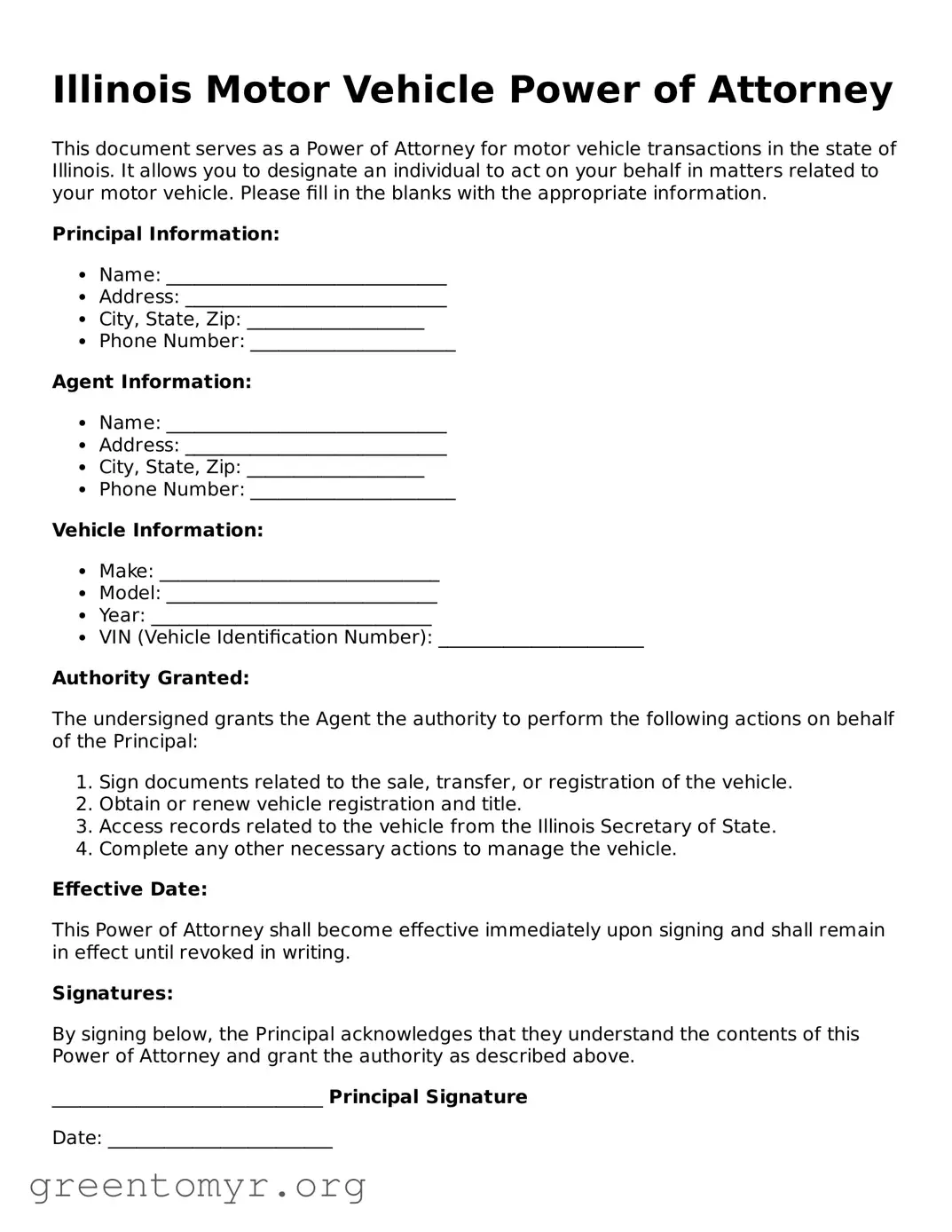
The Illinois Motor Vehicle Power of Attorney form serves as a crucial legal document that empowers individuals to designate another person to handle specific tasks related to their motor vehicle. This form is particularly useful when the vehicle owner cannot be present to manage transactions such as title transfers, registration renewals, or other administrative duties. By completing this form, the vehicle owner grants authority to an agent, who can then act on their behalf, ensuring that necessary actions are taken efficiently and without delay. The document includes essential details such as the names of both the principal and the agent, a description of the vehicle, and the specific powers granted. Additionally, it may require notarization to validate the authority bestowed upon the agent. Understanding the nuances of this form is vital for anyone looking to streamline their vehicle management processes, especially in situations where time and accessibility are of the essence.
Illinois Motor Vehicle Power of Attorney
This document serves as a Power of Attorney for motor vehicle transactions in the state of Illinois. It allows you to designate an individual to act on your behalf in matters related to your motor vehicle. Please fill in the blanks with the appropriate information.
Principal Information:
Agent Information:
Vehicle Information:
Authority Granted:
The undersigned grants the Agent the authority to perform the following actions on behalf of the Principal:
Effective Date:
This Power of Attorney shall become effective immediately upon signing and shall remain in effect until revoked in writing.
Signatures:
By signing below, the Principal acknowledges that they understand the contents of this Power of Attorney and grant the authority as described above.
_____________________________ Principal Signature
Date: ________________________
_____________________________ Agent Signature
Date: ________________________
Witness:
_____________________________ Witness Signature
Date: ________________________
This Power of Attorney is governed by the laws of the state of Illinois.
| Fact Name | Description |
|---|---|
| Purpose | The Illinois Motor Vehicle Power of Attorney form allows an individual to designate another person to act on their behalf regarding vehicle-related matters. |
| Governing Law | This form is governed by the Illinois Vehicle Code, specifically 625 ILCS 5/1-101 et seq. |
| Authorized Actions | The designated agent can perform tasks such as signing title transfers, registering vehicles, and obtaining license plates. |
| Notarization Requirement | To be valid, the form must be signed in the presence of a notary public. |
| Revocation | The principal can revoke the power of attorney at any time, provided that proper notice is given to the agent. |
| Durability | This power of attorney is durable, meaning it remains effective even if the principal becomes incapacitated. |
| Agent's Responsibilities | The agent must act in the best interest of the principal and follow their instructions when handling vehicle matters. |
| Limitations | The form does not grant the agent the authority to sell the vehicle unless explicitly stated. |
| Filing | While the form does not need to be filed with the state, it should be kept in a safe place and presented when required. |
Completing the Illinois Motor Vehicle Power of Attorney form requires attention to detail. After filling out the form, it will authorize another individual to act on your behalf in matters related to your motor vehicle. Follow these steps to ensure accurate completion.
The Illinois Motor Vehicle Power of Attorney form is a legal document that allows an individual, known as the principal, to designate another person, called the agent, to act on their behalf regarding specific motor vehicle transactions. This can include tasks such as signing titles, transferring ownership, or handling registration matters.
Any competent adult can be designated as an agent in the Illinois Motor Vehicle Power of Attorney form. This means that the person you choose should be trustworthy and capable of handling the responsibilities you assign to them. Common choices include family members, friends, or trusted advisors.
Your agent can perform a variety of transactions related to your motor vehicle. These may include:
Yes, the Illinois Motor Vehicle Power of Attorney form must be notarized to be considered valid. This step ensures that the signatures on the document are authentic and that the principal is signing voluntarily. Notarization provides an added layer of protection against fraud.
The effectiveness of the Power of Attorney can vary based on your preferences. It can be set to remain in effect until a specific date, until a particular task is completed, or until you revoke it. If you wish to revoke the Power of Attorney, you must do so in writing and notify your agent accordingly.
Yes, you can revoke the Power of Attorney at any time as long as you are mentally competent. To do this, you should provide a written notice of revocation to your agent and any relevant parties, such as the Illinois Secretary of State, if applicable. It is advisable to keep a copy of the revocation for your records.
If your designated agent is unable to perform their duties, the Power of Attorney may become ineffective. It is wise to appoint an alternate agent in your document to ensure that someone can step in if needed. This can help avoid complications in managing your motor vehicle affairs.
While there is no fee for simply completing the Illinois Motor Vehicle Power of Attorney form, there may be fees associated with any transactions your agent undertakes on your behalf, such as title transfers or registration fees. Always check with the Illinois Secretary of State’s office for the most current fee schedule.
The Illinois Motor Vehicle Power of Attorney form can be obtained from the Illinois Secretary of State’s website or at any local Secretary of State facility. It is essential to ensure that you are using the most current version of the form to avoid any issues.
Filling out the Illinois Motor Vehicle Power of Attorney form can be straightforward, but mistakes often occur that can lead to complications. One common error is not providing complete information. Each section of the form is important. Omitting details, such as the vehicle identification number (VIN) or the correct name of the person being granted authority, can render the document invalid. Ensure every field is filled out accurately to avoid any delays in processing.
Another frequent mistake is failing to sign the form properly. The Power of Attorney must be signed by the principal—the person granting authority. If the signature is missing or does not match the name on the form, the document may be rejected. It’s crucial to double-check that the signature is clear and consistent with the identity of the person completing the form.
Many individuals overlook the need for witnesses or notarization. In Illinois, certain Power of Attorney documents may require a witness signature or notarization to be legally binding. Neglecting this step can lead to issues when trying to use the Power of Attorney. Always verify the specific requirements for the document to ensure it meets legal standards.
Additionally, people often misunderstand the scope of authority granted. The form allows you to specify what powers are being delegated. Failing to clearly define these powers can lead to confusion later on. For instance, if the agent is meant to handle only the sale of a vehicle, but the form is too broad, it could lead to unauthorized actions. Clarity is key in this section.
Lastly, not keeping a copy of the completed form is a common oversight. Once the Power of Attorney is filled out and signed, it’s essential to retain a copy for personal records. This can serve as a reference in case any disputes arise or if the agent needs to prove their authority. Keeping a record ensures that all parties are aware of the terms outlined in the document.
When dealing with motor vehicle transactions in Illinois, several forms and documents may accompany the Motor Vehicle Power of Attorney. Each of these documents serves a specific purpose and can streamline the process of transferring vehicle ownership or handling related matters.
Having these documents prepared can facilitate a smoother transaction process and help ensure compliance with Illinois law. Always consider seeking assistance if you have questions about any of these forms.
The Motor Vehicle Power of Attorney form allows you to designate someone to handle specific vehicle-related tasks on your behalf. This document shares similarities with several other legal documents that also empower individuals to act on behalf of others. Here are four such documents:
When filling out the Illinois Motor Vehicle Power of Attorney form, there are important steps to follow. Here are some things you should and shouldn't do:
Following these guidelines can help ensure that the form is completed correctly and is valid for your needs.
Understanding the Illinois Motor Vehicle Power of Attorney form is essential for vehicle owners and those who may need to manage vehicle transactions on behalf of another person. However, several misconceptions can lead to confusion. Here are six common misconceptions:
This is not true. The Illinois Motor Vehicle Power of Attorney can be granted to anyone, not just family members. This flexibility allows individuals to appoint trusted friends or professionals to handle their vehicle-related matters.
While many people associate this form with the sale of a vehicle, it can also be used for various other transactions. This includes registering a vehicle, transferring ownership, or handling title issues.
This misconception is misleading. The Illinois Motor Vehicle Power of Attorney can be revoked at any time by the principal, as long as they are competent to do so. It is important to provide written notice of the revocation to the agent.
Although notarization can provide additional security, it is not a requirement for the Illinois Motor Vehicle Power of Attorney to be valid. The form must be signed by the principal and the agent, but notarization is optional.
This is incorrect. The Illinois Motor Vehicle Power of Attorney remains in effect until the principal revokes it or passes away. It does not have a built-in expiration date unless specified by the principal.
In fact, a principal can appoint multiple agents if they wish. This allows for flexibility in handling vehicle matters, as different agents may be designated for specific tasks or responsibilities.
Clarifying these misconceptions can help individuals feel more confident in using the Illinois Motor Vehicle Power of Attorney form effectively. Understanding the true nature of this document can facilitate smoother transactions and ensure that vehicle ownership is managed appropriately.
Filling out and utilizing the Illinois Motor Vehicle Power of Attorney form is a straightforward process, but it's essential to understand its implications. Here are some key takeaways to consider:
Understanding these points can help ensure that the process goes smoothly and that your intentions are clearly communicated. Always consider consulting with a legal professional if you have any questions or concerns.