In the realm of employment law, non-compete agreements play a significant role in shaping the relationship between employers and employees in Illinois. These agreements, designed to protect a company's proprietary information and competitive edge, can restrict an employee's ability to work for competitors or start a similar business after leaving a job. The Illinois Non-compete Agreement form outlines the specific terms and conditions under which these restrictions apply, including the duration of the non-compete period, the geographic scope, and the types of activities that are prohibited. Understanding the nuances of this form is crucial for both employers seeking to safeguard their interests and employees who must navigate their career options post-employment. It’s important to note that Illinois law has recently evolved, introducing stricter guidelines regarding enforceability, particularly concerning the necessity of consideration and the reasonableness of the restrictions imposed. By examining the key components of the Illinois Non-compete Agreement form, individuals can better comprehend their rights and obligations, ensuring a fair balance between protecting business interests and allowing for personal career growth.
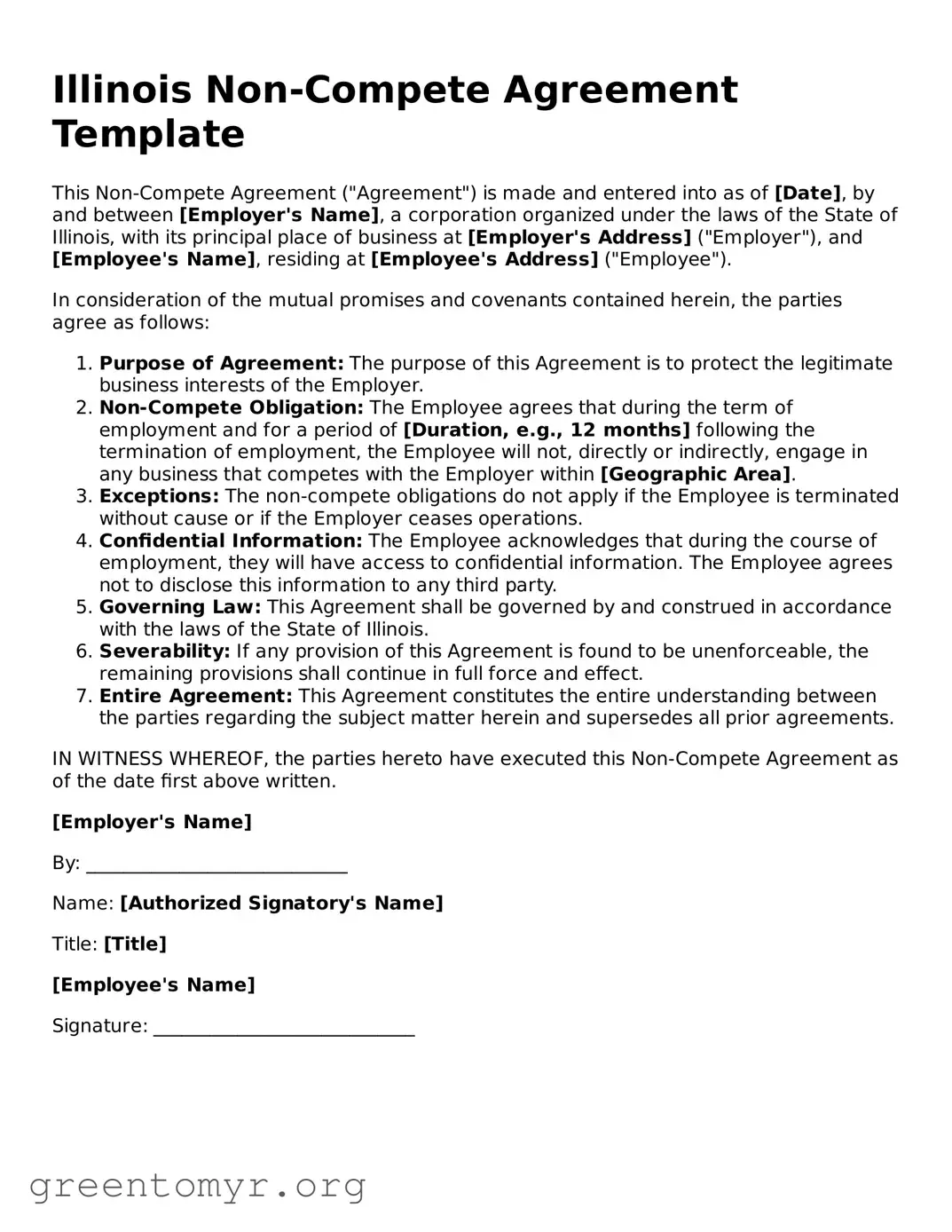
Illinois Non-Compete Agreement Template
This Non-Compete Agreement ("Agreement") is made and entered into as of [Date], by and between [Employer's Name], a corporation organized under the laws of the State of Illinois, with its principal place of business at [Employer's Address] ("Employer"), and [Employee's Name], residing at [Employee's Address] ("Employee").
In consideration of the mutual promises and covenants contained herein, the parties agree as follows:
IN WITNESS WHEREOF, the parties hereto have executed this Non-Compete Agreement as of the date first above written.
[Employer's Name]
By: ____________________________
Name: [Authorized Signatory's Name]
Title: [Title]
[Employee's Name]
Signature: ____________________________
| Fact Name | Description |
|---|---|
| Definition | An Illinois Non-compete Agreement is a contract that restricts an employee from working for competitors after leaving a job. |
| Governing Law | This agreement is governed by Illinois state law, specifically under the Illinois Freedom to Work Act. |
| Enforceability | Non-compete agreements are enforceable in Illinois if they are reasonable in scope, duration, and geographic area. |
| Consideration | For a non-compete agreement to be valid, there must be consideration, such as a job offer or a promotion. |
| Duration | Typically, the duration of the restriction should not exceed two years, although this can vary based on circumstances. |
| Exceptions | Certain professions, like physicians, have specific exceptions under Illinois law regarding non-compete agreements. |
Once you have the Illinois Non-compete Agreement form in front of you, it’s important to fill it out carefully to ensure all necessary information is provided. Follow these steps to complete the form accurately.
After completing the form, make sure to review it for any errors or omissions. Once verified, submit it as instructed, and keep a copy for your records.
A Non-compete Agreement is a contract between an employer and an employee that restricts the employee from working for competitors or starting a competing business for a specified period after leaving the company. In Illinois, these agreements must be reasonable in scope and duration to be enforceable.
Typically, a Non-compete Agreement should include the following components:
Yes, Non-compete Agreements can be enforceable in Illinois, but they must meet certain criteria. The agreement must protect legitimate business interests, be reasonable in duration and geographic scope, and not impose undue hardship on the employee.
In Illinois, the duration of a Non-compete Agreement should be reasonable. Generally, agreements lasting between six months to two years are considered acceptable, depending on the nature of the business and the employee's role.
If you violate a Non-compete Agreement, the employer may take legal action against you. This could include seeking an injunction to prevent you from working for a competitor or pursuing damages for any losses incurred due to the violation.
Yes, you can negotiate the terms of a Non-compete Agreement before signing it. It’s important to discuss any concerns you have with your employer and seek modifications that make the agreement more reasonable and fair for both parties.
If you’re asked to sign a Non-compete Agreement, take the time to read it carefully. Consider consulting with a legal professional who can help you understand the implications and whether the terms are reasonable.
Yes, a Non-compete Agreement can be enforced after you leave your job, provided it meets the enforceability criteria. If the agreement is deemed reasonable and protects legitimate business interests, your former employer may seek to enforce it.
Filling out the Illinois Non-compete Agreement form can be a complex task, and many individuals make mistakes that could have serious implications for their employment and future opportunities. One common error is failing to clearly define the scope of the non-compete. It is essential to specify the geographic area and the types of activities that are restricted. Without this clarity, the agreement may be deemed unenforceable.
Another mistake is overlooking the duration of the non-compete clause. Many people either make the time frame too long or too short. An excessively lengthy duration could lead to challenges in court, while a very short period may not provide adequate protection for the employer. Striking the right balance is crucial.
Some individuals neglect to consider the consideration element of the agreement. For a non-compete to be valid, there must be something of value exchanged. This could be a job offer, a promotion, or other benefits. If this aspect is not addressed, the agreement may not hold up in legal proceedings.
Additionally, people often fail to read the entire agreement thoroughly before signing. Skimming through the document can lead to misunderstandings about the terms and conditions. It is vital to understand what rights are being waived and the potential impact on future employment.
Another common error is not consulting with a legal professional before signing the agreement. Legal advice can provide insights into the enforceability of the terms and help individuals negotiate better conditions. Ignoring this step can result in signing an agreement that may not be in one's best interest.
Some individuals also make the mistake of not keeping a copy of the signed agreement. Without a copy, it can be challenging to recall the specific terms later on. This oversight can lead to disputes or confusion in the future.
Another issue arises when people assume that all non-compete agreements are the same. Each agreement is unique and must be tailored to the specific situation. Failing to recognize this can lead to unintended consequences.
People sometimes forget to consider the impact of the non-compete on their career trajectory. It is essential to evaluate how the restrictions may limit future job opportunities. Taking the time to reflect on these implications can save a lot of trouble later.
Lastly, individuals may underestimate the importance of negotiation. Many believe they must accept the terms as they are presented. However, negotiating for more favorable terms can lead to a more balanced agreement that protects both parties.
When preparing a Non-compete Agreement in Illinois, several additional forms and documents may be required to ensure clarity and legal compliance. These documents help define the terms of employment, protect intellectual property, and outline the responsibilities of both parties involved. Below is a list of commonly used forms that often accompany a Non-compete Agreement.
These documents play a crucial role in establishing a clear understanding between employers and employees regarding their rights and responsibilities. Ensuring that all necessary forms are in place can help prevent disputes and protect the interests of both parties.
A Non-compete Agreement is a crucial document in the business world, particularly for employers and employees. It serves to protect a company's interests by restricting an employee's ability to work with competitors after leaving. Here are six documents that share similarities with a Non-compete Agreement:
Each of these documents plays a vital role in establishing boundaries and protecting business interests, similar to the Non-compete Agreement.
When filling out the Illinois Non-compete Agreement form, it is essential to approach the task with care. Here are some key things to do and avoid:
By following these guidelines, you can navigate the process with confidence and clarity.
Non-compete agreements can often be misunderstood. Here are ten common misconceptions about the Illinois Non-compete Agreement form, along with explanations to clarify these misunderstandings.
Not all non-compete agreements hold up in court. In Illinois, these agreements must be reasonable in scope and duration to be enforceable.
Illinois courts generally favor agreements that are limited in time. A duration of two years or less is often considered reasonable.
Independent contractors and business partners may also be required to sign non-compete agreements to protect business interests.
These agreements cannot completely bar an individual from working in their field. They must allow for reasonable opportunities to work.
While a non-compete agreement may limit where you can work afterward, it does not prevent you from leaving your current job.
These agreements serve different purposes. A non-disclosure agreement protects confidential information, while a non-compete restricts employment opportunities.
Illinois law requires that non-compete agreements be reasonable in terms of geographic scope and the type of work restricted.
Parties can negotiate terms before signing. In some cases, agreements can be modified later if both parties agree.
Even entry-level employees may be asked to sign non-compete agreements, depending on the nature of their work and access to sensitive information.
While they can limit job opportunities, they can also protect legitimate business interests, such as trade secrets and client relationships.
Understanding these misconceptions can help individuals navigate their rights and obligations under Illinois non-compete agreements more effectively.
When filling out and using the Illinois Non-compete Agreement form, it is essential to understand its purpose and implications. Here are some key takeaways to consider:
By considering these takeaways, both employers and employees can better navigate the complexities of non-compete agreements in Illinois.