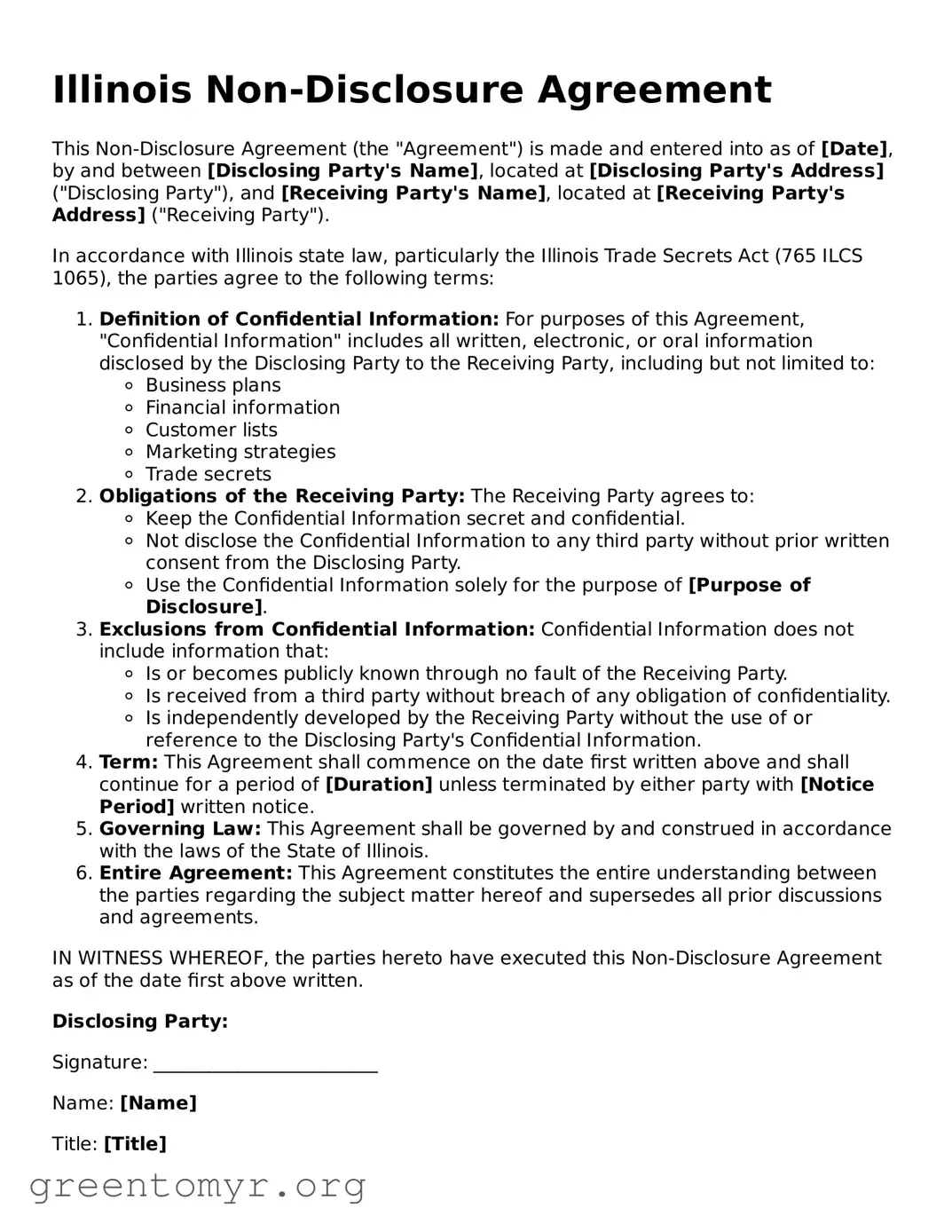
In the fast-paced world of business, protecting sensitive information is paramount, and the Illinois Non-disclosure Agreement (NDA) form serves as a vital tool in this endeavor. This legal document establishes a confidential relationship between parties, ensuring that proprietary information, trade secrets, and other sensitive data remain protected from unauthorized disclosure. When entering into an NDA, both parties outline what constitutes confidential information, the duration of the confidentiality obligation, and the permissible uses of the disclosed information. Additionally, the form addresses potential consequences for breaches, which can include legal action and financial penalties. By clearly defining these elements, the Illinois NDA not only safeguards business interests but also fosters trust and collaboration between parties, making it an essential component of many professional relationships.
Illinois Non-Disclosure Agreement
This Non-Disclosure Agreement (the "Agreement") is made and entered into as of [Date], by and between [Disclosing Party's Name], located at [Disclosing Party's Address] ("Disclosing Party"), and [Receiving Party's Name], located at [Receiving Party's Address] ("Receiving Party").
In accordance with Illinois state law, particularly the Illinois Trade Secrets Act (765 ILCS 1065), the parties agree to the following terms:
IN WITNESS WHEREOF, the parties hereto have executed this Non-Disclosure Agreement as of the date first above written.
Disclosing Party:
Signature: ________________________
Name: [Name]
Title: [Title]
Receiving Party:
Signature: ________________________
Name: [Name]
Title: [Title]
| Fact Name | Description |
|---|---|
| Definition | An Illinois Non-disclosure Agreement (NDA) is a legal contract that establishes a confidential relationship between parties to protect sensitive information. |
| Purpose | The primary purpose of an NDA is to prevent the unauthorized sharing of proprietary information, trade secrets, or any other confidential material. |
| Governing Law | The NDA is governed by Illinois state law, ensuring that any disputes arising from the agreement will be resolved according to Illinois legal standards. |
| Duration | Typically, the confidentiality obligations in an NDA can last for a specified period, often ranging from one to five years, depending on the agreement. |
| Enforceability | For an NDA to be enforceable in Illinois, it must be reasonable in scope and duration, and it should not impose undue hardship on the parties involved. |
After you have obtained the Illinois Non-disclosure Agreement form, you will need to complete it accurately to ensure its validity. Follow these steps carefully to fill out the form correctly.
A Non-disclosure Agreement, commonly referred to as an NDA, is a legal contract designed to protect sensitive information. When two parties enter into this agreement, they commit to keeping certain information confidential. This can include trade secrets, proprietary data, or any other private information that one party wishes to share with the other while ensuring that it remains undisclosed to third parties.
In Illinois, individuals and businesses often use NDAs to safeguard their intellectual property and sensitive business information. For instance, if a company is sharing its innovative ideas with a potential partner or investor, an NDA ensures that these ideas are not disclosed to competitors. This legal protection fosters trust and encourages collaboration.
NDAs can protect a wide range of information, including but not limited to:
Essentially, any information that is not public and provides a competitive advantage can be protected under an NDA.
The duration of confidentiality obligations in an NDA can vary. Typically, NDAs specify a timeframe during which the information must remain confidential. This period can range from a few years to indefinitely, depending on the nature of the information and the agreement between the parties. It is crucial to clearly outline this duration in the NDA to avoid misunderstandings.
Yes, NDAs can be enforced in Illinois, provided they are properly drafted and do not violate public policy. Courts in Illinois generally uphold NDAs as long as they are reasonable in scope and duration. If a party breaches the agreement, the other party may seek legal remedies, which could include monetary damages or injunctive relief.
A well-drafted NDA should include several key elements:
Including these components ensures clarity and helps protect the interests of both parties involved.
While it is not strictly necessary to have a lawyer draft an NDA, it is highly advisable. Legal professionals can ensure that the agreement complies with Illinois laws and adequately protects your interests. They can also help tailor the NDA to your specific situation, which can prevent potential disputes in the future.
Yes, an NDA can be mutual, meaning that both parties agree to protect each other's confidential information. This type of agreement is common in situations where both parties will be sharing sensitive information. A mutual NDA ensures that both sides are equally committed to maintaining confidentiality.
If a party breaches an NDA, the non-breaching party has several options. They may seek damages for any losses incurred due to the breach. Additionally, they can request that a court issue an injunction to prevent further disclosure of the confidential information. The specific remedies available will depend on the terms of the NDA and the nature of the breach.
Creating an NDA for your business in Illinois can be accomplished through several steps:
Following these steps will help you create a robust NDA that serves your business needs.
When filling out the Illinois Non-disclosure Agreement (NDA) form, individuals often make common mistakes that can lead to misunderstandings or legal issues. One frequent error is failing to clearly define the confidential information. Without a precise description, it can be challenging to enforce the agreement later. Parties may have different interpretations of what constitutes confidential information, leading to disputes.
Another mistake is neglecting to specify the duration of the confidentiality obligations. An NDA should indicate how long the information must remain confidential. If this detail is omitted, the agreement may lack clarity, leaving parties unsure about their responsibilities over time.
Many individuals also overlook the importance of including all relevant parties in the agreement. It is crucial to ensure that anyone who will have access to the confidential information is named in the NDA. Failing to do so can result in unauthorized disclosures, which could undermine the purpose of the agreement.
Inaccurate or incomplete signatures can invalidate an NDA. Some people may forget to sign the document or fail to provide the necessary dates. It is essential to ensure that all signatures are present and properly dated to avoid challenges to the agreement's validity.
Another common mistake is using vague language. An NDA should be clear and specific to avoid ambiguity. Phrases that can be interpreted in multiple ways should be avoided. Clear language helps all parties understand their obligations and reduces the risk of future disputes.
Individuals often fail to consider the governing law clause. This clause specifies which state’s laws will govern the agreement. Not including this information can lead to confusion about legal rights and obligations, especially if parties are located in different states.
Additionally, some people forget to include remedies for breach of contract. An NDA should outline the consequences of violating the agreement. Without these provisions, parties may not know their options if a breach occurs, which can complicate enforcement.
Finally, individuals may neglect to review the NDA with legal counsel. While it is possible to fill out the form independently, consulting a legal expert can help identify potential issues and ensure that the agreement meets all necessary legal requirements. Skipping this step can lead to significant pitfalls down the line.
In the context of business transactions and partnerships, the Illinois Non-disclosure Agreement (NDA) serves as a critical document for protecting sensitive information. However, several other forms and documents are often utilized in conjunction with an NDA to ensure comprehensive legal protection and clarity in business dealings. Below is a list of these documents, each playing a unique role in safeguarding interests.
Each of these documents complements the Illinois Non-disclosure Agreement by addressing specific aspects of business relationships and protecting sensitive information. Utilizing them effectively can help parties navigate complex interactions while safeguarding their interests.
When filling out the Illinois Non-disclosure Agreement (NDA) form, it is essential to approach the task with care. Adhering to best practices can help ensure that the agreement is valid and enforceable. Below are some key dos and don'ts to consider.
Following these guidelines can help protect sensitive information and foster trust between parties involved in the agreement.
Non-disclosure agreements (NDAs) are crucial for protecting sensitive information in various business dealings. However, several misconceptions can lead to misunderstandings about their purpose and function in Illinois. Here are six common misconceptions:
Understanding these misconceptions can help individuals and businesses navigate the complexities of non-disclosure agreements effectively.
When filling out and using the Illinois Non-disclosure Agreement (NDA) form, keep these key takeaways in mind:
Following these guidelines will help ensure that the Illinois Non-disclosure Agreement is effective and legally binding.