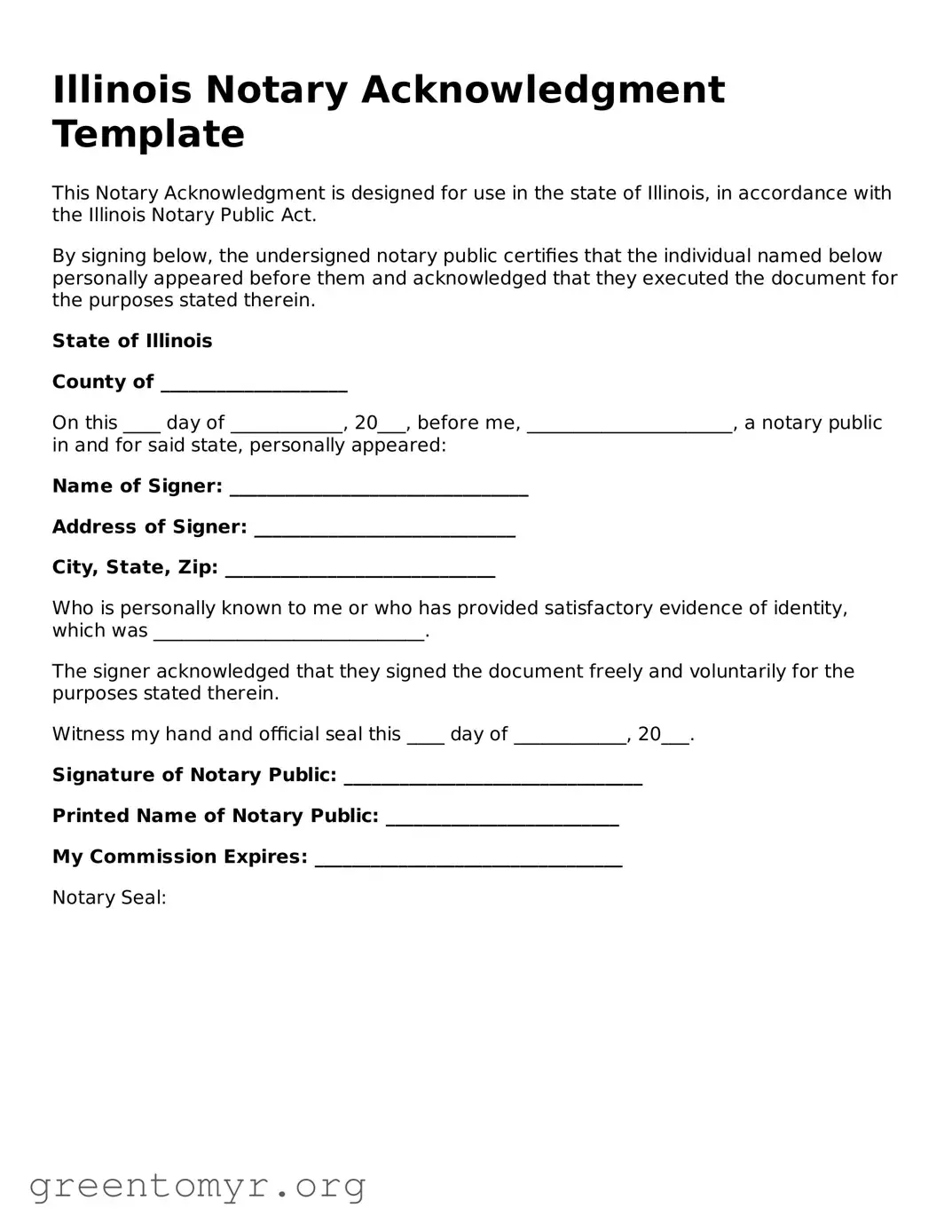
The Illinois Notary Acknowledgement form plays a crucial role in various legal and financial transactions across the state. This document serves as a formal declaration by a notary public that a signer has willingly appeared before them and acknowledged their signature on a specific document. Essential details include the name of the individual signing, the date of the acknowledgment, and the notary's signature and seal. This form is often required for documents such as contracts, deeds, and affidavits, ensuring that the signer's identity is verified and that they understand the implications of their signature. Proper completion of the form not only enhances the integrity of the document but also provides legal protection for all parties involved. Understanding the requirements and implications of the Illinois Notary Acknowledgement form is vital for anyone engaged in legal transactions, as failure to adhere to the correct procedures can lead to complications and disputes down the line.
Illinois Notary Acknowledgment Template
This Notary Acknowledgment is designed for use in the state of Illinois, in accordance with the Illinois Notary Public Act.
By signing below, the undersigned notary public certifies that the individual named below personally appeared before them and acknowledged that they executed the document for the purposes stated therein.
State of Illinois
County of ____________________
On this ____ day of ____________, 20___, before me, ______________________, a notary public in and for said state, personally appeared:
Name of Signer: ________________________________
Address of Signer: ____________________________
City, State, Zip: _____________________________
Who is personally known to me or who has provided satisfactory evidence of identity, which was _____________________________.
The signer acknowledged that they signed the document freely and voluntarily for the purposes stated therein.
Witness my hand and official seal this ____ day of ____________, 20___.
Signature of Notary Public: ________________________________
Printed Name of Notary Public: _________________________
My Commission Expires: _________________________________
Notary Seal:
| Fact Name | Details |
|---|---|
| Purpose | The Illinois Notary Acknowledgment form is used to verify the identity of the signer and confirm that they signed the document willingly. |
| Governing Law | This form is governed by the Illinois Notary Public Act, specifically 5 ILCS 312. |
| Required Information | The form must include the name of the signer, the date of the acknowledgment, and the notary's signature and seal. |
| Usage | It is commonly used for real estate transactions, legal documents, and other official paperwork requiring notarization. |
After obtaining the Illinois Notary Acknowledgment form, you will need to complete it accurately to ensure it is valid. Follow the steps below to fill out the form correctly.
The Illinois Notary Acknowledgment form is a legal document used to verify that a person has signed a document in the presence of a notary public. This form ensures that the signature is authentic and that the signer is aware of the contents of the document they are signing.
In Illinois, a notary public must be at least 18 years old, a resident of Illinois or a legal resident of the United States, and able to read and write English. They must also complete the application process and receive their notary commission from the state.
You typically need a Notary Acknowledgment form when signing important documents such as contracts, deeds, or affidavits. It is especially crucial for documents that require verification of the signer's identity and consent.
To complete the form, follow these steps:
When visiting a notary, bring the following:
Yes, notaries in Illinois may charge a fee for their services. The maximum fee is set by the state, but many notaries charge less. It's a good idea to ask about fees before your appointment.
Yes, a notary public can refuse to notarize a document if they suspect fraud, if the signer is not present, or if the document is incomplete. Notaries have a responsibility to ensure the integrity of the notarization process.
The Notary Acknowledgment itself does not expire, but the document it accompanies may have its own validity period. Always check the specific requirements for the document you are using.
You can find a notary public in Illinois through various sources, including:
Filling out the Illinois Notary Acknowledgement form can seem straightforward, but many people make common mistakes that can lead to delays or rejections. One frequent error is failing to include the correct name of the person whose signature is being acknowledged. It is crucial that the name matches the identification presented to the notary. Any discrepancies can raise questions about the validity of the acknowledgment.
Another mistake involves the omission of the date. The date of the acknowledgment is essential because it indicates when the notary performed the service. Leaving this blank or writing an incorrect date can render the document ineffective.
People often neglect to check the notary's signature. A notary must sign the acknowledgment form in the designated area. If the signature is missing or illegible, the acknowledgment may not be valid. Additionally, the notary's seal must be affixed correctly; a missing or unclear seal can lead to complications.
Providing the wrong type of identification is another common error. Notaries typically require specific forms of ID, such as a driver's license or passport. Using an invalid form of identification can result in the notary refusing to acknowledge the signature.
Another mistake is failing to ensure that the signer is present during the acknowledgment. The notary must witness the signing of the document. If the signer is not physically present, the acknowledgment cannot be completed correctly.
Some individuals forget to include the venue on the form. The venue specifies where the acknowledgment took place, which is an important detail for legal purposes. Omitting this information can lead to confusion about the jurisdiction.
Using incorrect language in the acknowledgment statement can also pose a problem. The wording must conform to the requirements set forth by Illinois law. Any deviation from the standard language can result in a form that is not legally binding.
People sometimes overlook the requirement for the notary to be impartial. A notary should not have a personal interest in the transaction. If there is a conflict of interest, the acknowledgment may be challenged later.
Another common oversight is not keeping a record of the notarization. Notaries are required to maintain a journal of their activities. Failing to document the acknowledgment can create issues if the notarization is called into question.
Lastly, individuals may rush through the process, leading to careless mistakes. Taking the time to review each section of the form thoroughly can help prevent errors and ensure that the acknowledgment is completed correctly. Attention to detail is key in this process.
When engaging in legal transactions in Illinois, various forms and documents often accompany the Illinois Notary Acknowledgment form. Each of these documents serves a specific purpose and plays a crucial role in ensuring that agreements are valid and enforceable. Below is a list of commonly used forms that may be required alongside the Notary Acknowledgment.
Understanding these documents and their purposes can help individuals navigate legal processes more effectively. Each form plays a vital role in ensuring clarity and protection in various transactions, ultimately contributing to a smoother legal experience.
The Notary Acknowledgment form serves a specific purpose, but several other documents share similarities in function and intent. Here’s a look at four of them:
When filling out the Illinois Notary Acknowledgment form, it’s important to follow certain guidelines to ensure the document is valid and effective. Here’s a helpful list of dos and don’ts to keep in mind.
Understanding the Illinois Notary Acknowledgment form is essential for anyone involved in legal documents. Unfortunately, several misconceptions can lead to confusion. Here is a list of nine common misconceptions about this form, along with clarifications to help demystify the process.
By addressing these misconceptions, individuals can better navigate the requirements and processes associated with the Illinois Notary Acknowledgment form. Understanding the role of a notary and the purpose of an acknowledgment can lead to smoother transactions and greater legal clarity.
When filling out and using the Illinois Notary Acknowledgment form, keep these key points in mind: