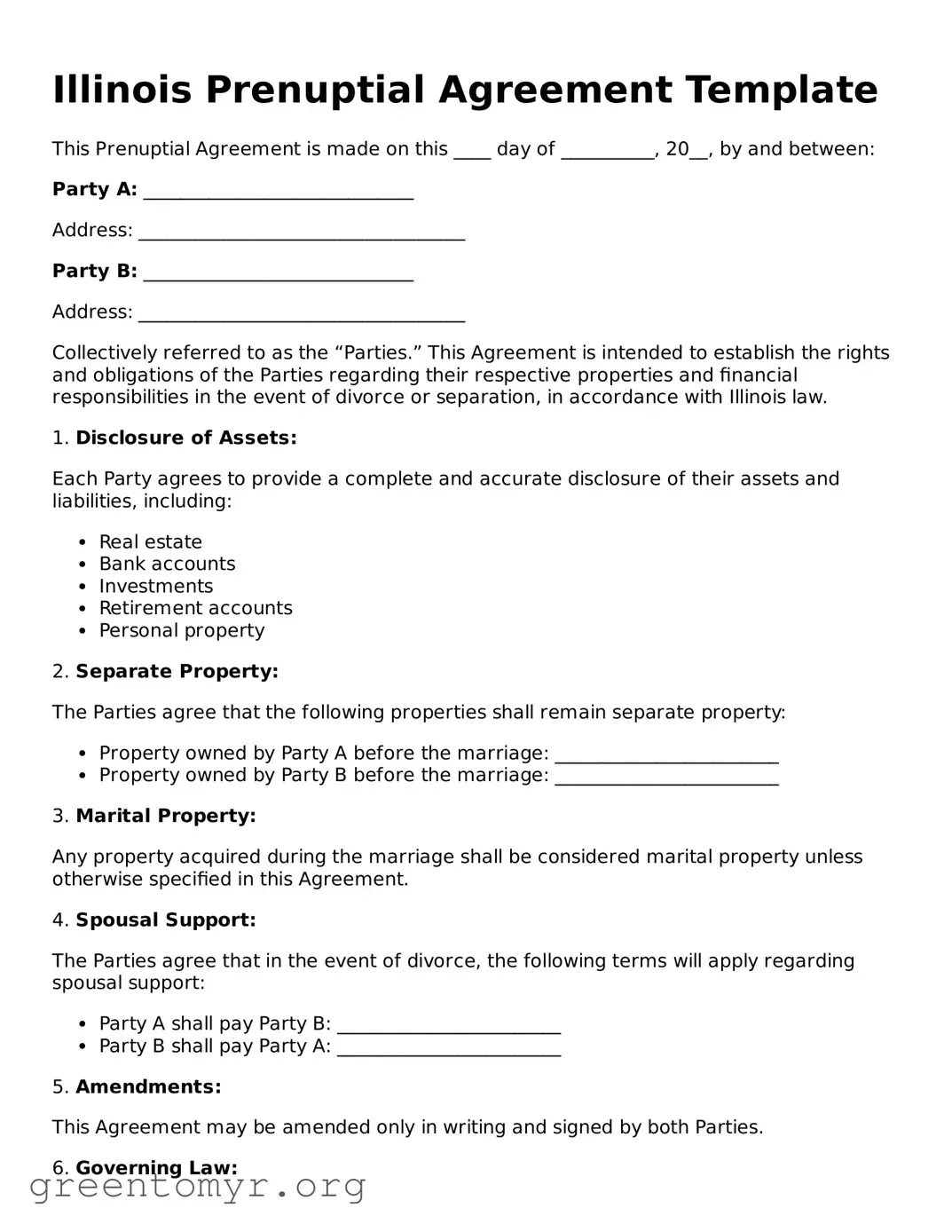
In Illinois, a prenuptial agreement serves as a vital tool for couples preparing for marriage, allowing them to outline the division of assets and responsibilities should the marriage end. This agreement can address various aspects, including the management of property acquired before and during the marriage, the treatment of debts, and the potential spousal support obligations. By clearly defining each party's rights and obligations, the form aims to minimize conflict and uncertainty in the event of a divorce. Importantly, both parties must voluntarily sign the agreement, ensuring that it reflects their mutual understanding and consent. Furthermore, it is advisable for each party to seek independent legal counsel to ensure that their interests are adequately represented and protected. The Illinois Prenuptial Agreement form must meet specific legal requirements to be enforceable, including full disclosure of assets and a fair and reasonable approach to the terms agreed upon. Overall, this document plays a crucial role in fostering transparency and security in a relationship, allowing couples to enter marriage with a clear understanding of their financial landscape.
Illinois Prenuptial Agreement Template
This Prenuptial Agreement is made on this ____ day of __________, 20__, by and between:
Party A: _____________________________
Address: ___________________________________
Party B: _____________________________
Address: ___________________________________
Collectively referred to as the “Parties.” This Agreement is intended to establish the rights and obligations of the Parties regarding their respective properties and financial responsibilities in the event of divorce or separation, in accordance with Illinois law.
1. Disclosure of Assets:
Each Party agrees to provide a complete and accurate disclosure of their assets and liabilities, including:
2. Separate Property:
The Parties agree that the following properties shall remain separate property:
3. Marital Property:
Any property acquired during the marriage shall be considered marital property unless otherwise specified in this Agreement.
4. Spousal Support:
The Parties agree that in the event of divorce, the following terms will apply regarding spousal support:
5. Amendments:
This Agreement may be amended only in writing and signed by both Parties.
6. Governing Law:
This Agreement shall be governed by the laws of the State of Illinois.
7. Execution:
Each Party acknowledges that they have read this Agreement, understand its contents, and voluntarily enter into it.
IN WITNESS WHEREOF, the Parties have executed this Prenuptial Agreement as of the date first above written.
______________________________
Party A Signature
______________________________
Party B Signature
______________________________
Date
| Fact Name | Description |
|---|---|
| Definition | An Illinois prenuptial agreement is a contract between two individuals before marriage that outlines the distribution of assets and responsibilities in the event of divorce or separation. |
| Governing Law | The Illinois Uniform Premarital Agreement Act governs prenuptial agreements in the state, ensuring they meet specific legal standards. |
| Requirements | For a prenuptial agreement to be enforceable in Illinois, it must be in writing and signed by both parties. |
| Disclosure | Full financial disclosure is required. Each party must provide a complete list of assets and liabilities to ensure fairness. |
| Enforceability | Agreements may be challenged in court if they are found to be unconscionable or if one party did not enter into the agreement voluntarily. |
Filling out the Illinois Prenuptial Agreement form requires careful attention to detail. This form is essential for couples considering marriage who wish to outline their financial rights and responsibilities. By completing it, both parties can ensure clarity and mutual understanding regarding their assets and obligations. Below are the steps to guide you through the process of filling out this important document.
A prenuptial agreement, often called a prenup, is a legal document that couples create before getting married. This agreement outlines how assets and debts will be divided in the event of a divorce or separation. In Illinois, prenuptial agreements are recognized and enforceable as long as they meet certain legal requirements.
Many couples choose to create a prenuptial agreement for various reasons, including:
A comprehensive prenuptial agreement typically includes:
Yes, certain topics cannot be included in a prenuptial agreement. For instance, agreements related to child custody or child support are generally not enforceable, as these matters are determined based on the best interests of the child at the time of divorce. Additionally, any terms that are illegal or against public policy cannot be included.
Creating a prenuptial agreement involves several steps:
Yes, a prenuptial agreement can be modified or revoked at any time, but this must be done in writing and signed by both parties. It's important to follow the same legal formalities as the original agreement to ensure that any changes are enforceable.
In Illinois, prenuptial agreements are generally enforceable if they meet specific criteria, such as being entered into voluntarily by both parties, being fair and reasonable, and being in writing. However, if one party can prove that they were coerced or did not fully understand the agreement, it may be challenged in court.
It's advisable to begin discussing a prenuptial agreement well before the wedding date. Open communication about financial matters can help prevent misunderstandings and ensure that both parties feel comfortable with the terms. Starting early allows ample time for negotiation and consultation with legal professionals.
While it is not legally required to have a lawyer, it is highly recommended. An attorney can help ensure that the agreement is fair, legally sound, and compliant with Illinois law. Having separate legal representation for both parties can also help prevent any potential claims of coercion or unfairness.
Completing the Illinois Prenuptial Agreement form requires careful attention to detail. One common mistake individuals make is failing to provide complete information about their assets and liabilities. Omitting important financial details can lead to misunderstandings and complications in the future. It is essential to list all properties, bank accounts, investments, and debts to ensure clarity and transparency.
Another frequent error involves not having the agreement reviewed by a legal professional. While it may seem unnecessary, consulting with an attorney can help identify potential issues and ensure that the agreement complies with state laws. Relying solely on templates or online resources without expert guidance can result in enforceability problems later on.
People often neglect to discuss the terms of the prenuptial agreement with their partner. Open communication is vital. Failing to engage in a constructive dialogue can lead to resentment or misunderstandings. Both parties should be on the same page regarding the agreement's terms to foster trust and cooperation.
Additionally, some individuals make the mistake of signing the agreement under pressure. It is crucial that both parties have adequate time to review and consider the terms. Signing under duress can render the agreement invalid. Each person should feel comfortable and willing to enter into the agreement voluntarily.
Another mistake is not updating the prenuptial agreement after significant life changes. Events such as the birth of a child, a change in financial status, or a shift in career can affect the terms of the agreement. Regularly reviewing and amending the document ensures that it remains relevant and reflective of both parties' current situations.
Many people also overlook the importance of including provisions for dispute resolution. Without clear guidelines for resolving disagreements, couples may face challenges if conflicts arise. Including mediation or arbitration clauses can provide a structured approach to handling disputes, thereby reducing potential stress and conflict.
Some individuals fail to understand the implications of their prenuptial agreement on estate planning. It is essential to consider how the agreement interacts with wills and trusts. Neglecting to coordinate these documents can lead to unintended consequences regarding asset distribution.
Finally, individuals sometimes forget to consider the potential impact of their prenuptial agreement on their financial future. Understanding how the agreement affects future earnings, property acquisitions, and debts is crucial. Couples should evaluate their long-term financial goals and ensure that the agreement aligns with their aspirations.
When preparing for marriage, many couples consider creating a prenuptial agreement to outline their financial rights and responsibilities. However, this document is often accompanied by several other important forms and documents that can help clarify various aspects of the relationship and future planning. Below is a list of common documents that may be used alongside the Illinois Prenuptial Agreement.
Each of these documents serves a specific purpose and can contribute to a clearer understanding of the couple's financial and personal arrangements. By addressing these various aspects, couples can foster a stronger foundation for their marriage, ensuring that both partners feel secure and informed as they embark on this new chapter together.
A Prenuptial Agreement is an important document that outlines the financial and personal arrangements between two individuals before they marry. Several other documents share similar characteristics, serving to protect interests and clarify expectations in various situations. Below are six documents that resemble a Prenuptial Agreement in purpose or function:
Understanding these documents can help individuals navigate their financial and personal relationships more effectively. Each serves a unique purpose but shares the common goal of protecting interests and clarifying expectations.
When filling out the Illinois Prenuptial Agreement form, it’s essential to approach the process with care. Here are some important dos and don’ts to keep in mind:
Understanding prenuptial agreements is essential for couples considering marriage. However, several misconceptions can lead to confusion. Below are five common misconceptions about the Illinois Prenuptial Agreement form.
By addressing these misconceptions, couples can make informed decisions about their financial futures together.
When considering a prenuptial agreement in Illinois, it is essential to understand the key elements involved in filling out and utilizing the form effectively. Here are ten important takeaways:
By keeping these key points in mind, individuals can navigate the process of creating a prenuptial agreement in Illinois with greater confidence and clarity.