In the realm of financial transactions, the Illinois Promissory Note serves as a crucial instrument that outlines the terms of a loan agreement between a lender and a borrower. This document clearly specifies the amount borrowed, the interest rate applicable, and the repayment schedule, providing both parties with a clear understanding of their obligations. It also includes essential details such as the maturity date, which indicates when the loan must be fully repaid. By outlining the consequences of default, the Promissory Note helps protect the lender's interests while also informing the borrower of the potential repercussions of failing to meet their obligations. Additionally, the form may incorporate provisions for prepayment, allowing borrowers the flexibility to pay off the loan early without incurring penalties. Understanding these key elements is vital for anyone considering entering into a loan agreement in Illinois, as it establishes a foundation of trust and clarity in the lending process.
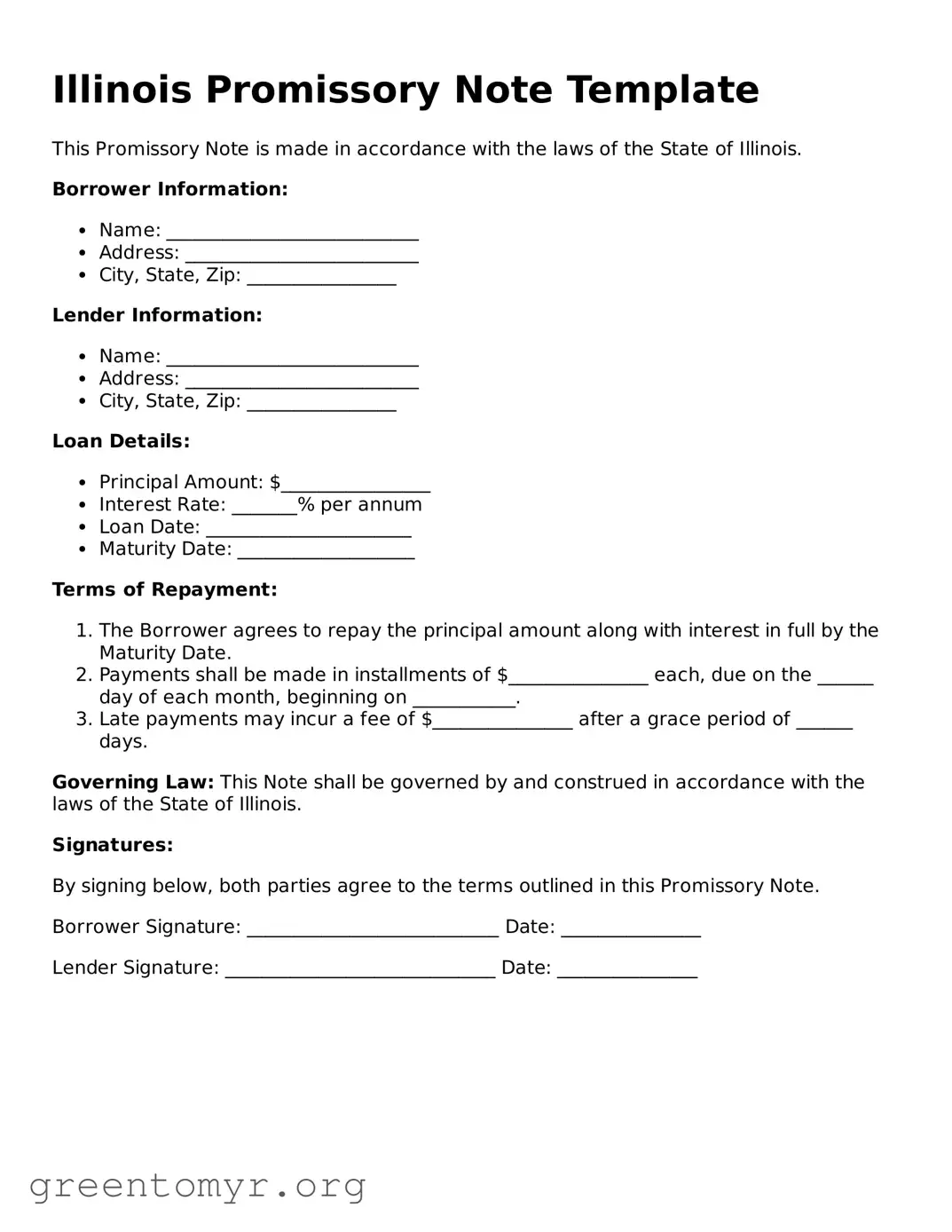
Illinois Promissory Note Template
This Promissory Note is made in accordance with the laws of the State of Illinois.
Borrower Information:
Lender Information:
Loan Details:
Terms of Repayment:
Governing Law: This Note shall be governed by and construed in accordance with the laws of the State of Illinois.
Signatures:
By signing below, both parties agree to the terms outlined in this Promissory Note.
Borrower Signature: ___________________________ Date: _______________
Lender Signature: _____________________________ Date: _______________
| Fact Name | Description |
|---|---|
| Definition | An Illinois promissory note is a written promise to pay a specific amount of money to a designated person or entity. |
| Governing Law | The Illinois Uniform Commercial Code (UCC) governs promissory notes in Illinois. |
| Essential Elements | A valid promissory note must include the amount owed, the interest rate (if any), the due date, and the signatures of the parties involved. |
| Interest Rates | Illinois law allows parties to agree on an interest rate, but it cannot exceed the legal maximum rate. |
| Transferability | Promissory notes in Illinois can be transferred to another party, making them negotiable instruments. |
| Default Consequences | If the borrower defaults, the lender can take legal action to recover the owed amount. |
| Statute of Limitations | The statute of limitations for enforcing a promissory note in Illinois is generally 10 years. |
| Witness Requirements | While not required, having a witness sign the promissory note can strengthen its validity. |
| Notarization | Notarization is not mandatory, but it can provide additional proof of authenticity. |
| Use Cases | Promissory notes are commonly used for personal loans, business transactions, and real estate financing. |
After you have gathered all necessary information, you are ready to fill out the Illinois Promissory Note form. This document will require specific details to ensure clarity and legality. Follow these steps to complete the form accurately.
Once the form is completed, keep a copy for your records. The signed document can then be shared with the involved parties to finalize the agreement.
A promissory note is a written promise to pay a specific amount of money to a designated person or entity at a specified time or on demand. This financial instrument outlines the terms of the loan, including the interest rate, repayment schedule, and any consequences for defaulting on the loan. In Illinois, using a promissory note can help formalize a loan agreement between parties, providing legal protection for both the lender and the borrower.
Any individual or business can use a promissory note in Illinois. This includes personal loans between friends or family members, as well as business loans between companies. The important thing is that both parties agree to the terms outlined in the note. Having a written document helps to clarify expectations and responsibilities, reducing the potential for misunderstandings.
When creating a promissory note, it is essential to include several key elements to ensure clarity and enforceability:
Yes, a promissory note is legally binding in Illinois as long as it meets certain requirements. The note must be clear, concise, and include all necessary details about the loan agreement. If the borrower fails to repay the loan as agreed, the lender can take legal action to recover the owed amount. However, it is advisable to consult with a legal professional to ensure that the note complies with state laws and regulations.
Yes, a promissory note can be modified after it is signed, but both parties must agree to the changes. It is crucial to document any modifications in writing and have both parties sign the updated note. This helps to maintain clarity and avoid potential disputes in the future. Verbal agreements are not typically enforceable, so written documentation is essential.
If the borrower defaults, meaning they fail to make payments as agreed, the lender has several options. They may contact the borrower to discuss the situation and attempt to work out a solution. If that does not resolve the issue, the lender can take legal action to recover the owed amount. This may involve filing a lawsuit, which could lead to wage garnishment or other collection methods. It's important for both parties to understand their rights and responsibilities to avoid such situations.
When completing the Illinois Promissory Note form, individuals often encounter several common mistakes that can lead to confusion or legal issues. One frequent error is the omission of essential details. For example, failing to include the full names and addresses of both the borrower and the lender can create ambiguity about who is involved in the agreement. Clear identification is crucial to ensure that all parties understand their rights and obligations.
Another mistake involves incorrect or inconsistent amounts. Borrowers may write the loan amount in words but fail to match it with the numerical figure. This inconsistency can lead to disputes about the actual amount owed. It is vital to double-check that both representations of the amount align to avoid misunderstandings in the future.
People also sometimes neglect to include the repayment terms. A well-drafted promissory note should specify when payments are due and the interest rate, if applicable. Omitting this information can create uncertainty regarding the payment schedule and lead to potential conflicts between the borrower and lender.
Lastly, many individuals forget to sign and date the document. A promissory note is not legally binding without the signatures of both parties. Even if all other information is correct, without signatures, the note may be considered invalid. Therefore, it is important to ensure that both parties sign and date the form before it is finalized.
The Illinois Promissory Note is a crucial document for outlining the terms of a loan agreement between a borrower and a lender. However, several other forms and documents often accompany it to ensure clarity and protection for both parties involved in the transaction.
Using these documents alongside the Illinois Promissory Note can enhance the understanding and security of the lending process. Each form plays a significant role in protecting the interests of both the lender and the borrower, ensuring a smoother transaction.
When filling out the Illinois Promissory Note form, attention to detail is crucial. Here are some guidelines to help ensure the process goes smoothly.
By following these dos and don'ts, individuals can navigate the process of completing the Illinois Promissory Note form with greater ease and confidence.
Understanding the Illinois Promissory Note form is essential for anyone involved in lending or borrowing money. However, several misconceptions can lead to confusion. Here are eight common misunderstandings:
By debunking these misconceptions, individuals can better navigate the complexities of promissory notes in Illinois, ensuring that they are informed and prepared for their financial dealings.
When filling out and using the Illinois Promissory Note form, it is essential to understand the following key points:
Following these guidelines will help create a clear and enforceable agreement between the parties involved.