The Illinois Quitclaim Deed form serves as a crucial legal instrument for individuals looking to transfer property ownership with minimal complications. This form allows the current owner, known as the grantor, to convey their interest in a property to another party, referred to as the grantee, without making any warranties about the title's quality. It is particularly useful in situations where the transfer occurs between family members or in cases of informal agreements, as it simplifies the process by eliminating the need for a title search. While the Quitclaim Deed does not guarantee that the grantor holds clear title to the property, it provides a straightforward means of transferring whatever interest the grantor may have. Essential elements of the form include the names and addresses of both parties, a legal description of the property, and the signature of the grantor, often requiring notarization to ensure validity. Understanding the implications of using a Quitclaim Deed is vital, as it can have significant consequences for both parties involved, particularly regarding future claims and liabilities associated with the property. As such, careful consideration and, when necessary, legal guidance are advised before proceeding with this type of deed in Illinois.
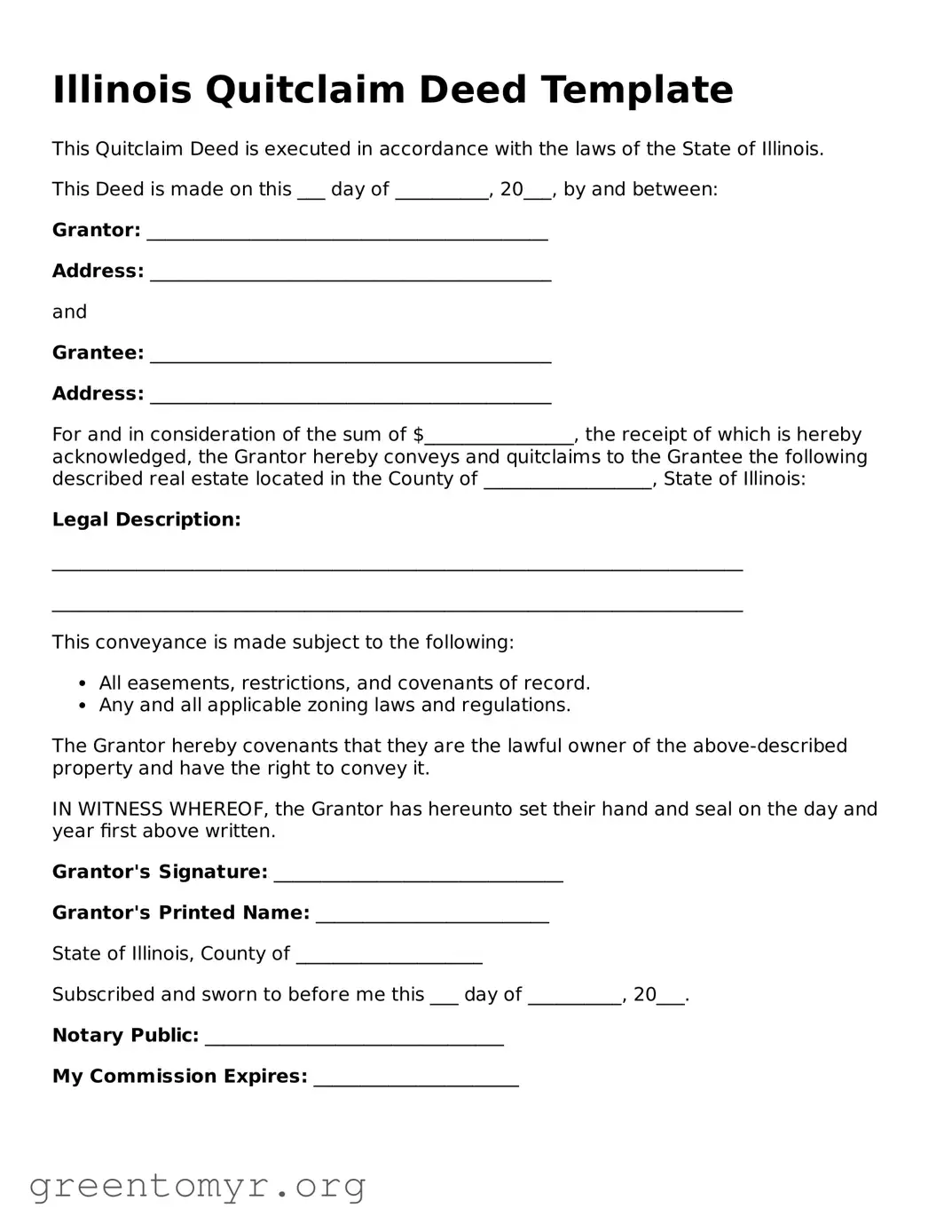
Illinois Quitclaim Deed Template
This Quitclaim Deed is executed in accordance with the laws of the State of Illinois.
This Deed is made on this ___ day of __________, 20___, by and between:
Grantor: ___________________________________________
Address: ___________________________________________
and
Grantee: ___________________________________________
Address: ___________________________________________
For and in consideration of the sum of $________________, the receipt of which is hereby acknowledged, the Grantor hereby conveys and quitclaims to the Grantee the following described real estate located in the County of __________________, State of Illinois:
Legal Description:
__________________________________________________________________________
__________________________________________________________________________
This conveyance is made subject to the following:
The Grantor hereby covenants that they are the lawful owner of the above-described property and have the right to convey it.
IN WITNESS WHEREOF, the Grantor has hereunto set their hand and seal on the day and year first above written.
Grantor's Signature: _______________________________
Grantor's Printed Name: _________________________
State of Illinois, County of ____________________
Subscribed and sworn to before me this ___ day of __________, 20___.
Notary Public: ________________________________
My Commission Expires: ______________________
| Fact Name | Description |
|---|---|
| Definition | An Illinois Quitclaim Deed is a legal document used to transfer ownership of real estate without guaranteeing clear title. |
| Governing Law | The Illinois Quitclaim Deed is governed by the Illinois Compiled Statutes, specifically 765 ILCS 1005. |
| Parties Involved | The form involves at least two parties: the grantor (seller) and the grantee (buyer). |
| Consideration | While not required, it is customary to include a consideration amount, which represents the value exchanged for the property. |
| Recording Requirements | To be effective against third parties, the deed must be recorded with the local county recorder's office. |
| Limitations | This type of deed does not provide warranties or guarantees about the property’s title, which means the grantee assumes all risks. |
| Use Cases | Commonly used in situations like transfers between family members or clearing up title issues. |
Once you have the Illinois Quitclaim Deed form in hand, you are ready to begin the process of transferring property ownership. This form is essential for documenting the change in ownership and ensuring that all parties are clear on the transaction. Follow these steps carefully to complete the form accurately.
After submitting the Quitclaim Deed, it is advisable to keep a copy for your records. This document will serve as proof of the property transfer and can be important for future legal matters or transactions involving the property.
A Quitclaim Deed is a legal document used to transfer ownership of real estate from one party to another. In Illinois, this deed allows the grantor (the person transferring the property) to relinquish any claim they may have on the property. However, it does not guarantee that the grantor has clear title or ownership rights. This type of deed is often used among family members or in situations where the parties know each other well.
To complete a Quitclaim Deed in Illinois, follow these steps:
While it is not legally required to have a lawyer prepare a Quitclaim Deed, it is often advisable. A lawyer can ensure that the deed is completed correctly and that all necessary information is included. This can help avoid potential disputes or issues in the future. If you are unsure about the process or the implications of transferring property, consulting with a legal professional can be beneficial.
Yes, there are typically fees associated with recording a Quitclaim Deed in Illinois. These fees vary by county, so it is important to check with your local recorder's office for the exact amount. Additionally, there may be costs for obtaining a notary public and any necessary copies of the deed.
Once you file a Quitclaim Deed with the county recorder's office, the transfer of ownership is officially recorded. The grantee (the person receiving the property) will have their name added to the public records. This provides legal proof of ownership. However, it is important for the grantee to conduct a title search to ensure there are no liens or claims against the property.
A Quitclaim Deed cannot be revoked once it has been executed and recorded. However, if there are valid reasons, such as fraud or mistake, a court may allow for the deed to be challenged. It is crucial to understand that this type of deed transfers any interest the grantor has, but it does not guarantee the validity of that interest.
No, a Quitclaim Deed is not the same as a Warranty Deed. A Warranty Deed provides guarantees that the grantor holds clear title to the property and has the right to transfer it. In contrast, a Quitclaim Deed offers no such guarantees. It simply transfers whatever interest the grantor may have, if any, without any warranties.
When completing the Illinois Quitclaim Deed form, individuals often make several common mistakes that can lead to delays or complications in the transfer of property. One frequent error is failing to include the correct legal description of the property. This description should be precise and match the information on the property’s title. Omitting details or using vague language can create confusion and may invalidate the deed.
Another common mistake is neglecting to properly identify the grantor and grantee. The names must be spelled correctly and should match the names on the property title. If there are any discrepancies, it could result in legal challenges or difficulties in the future. Always double-check the spelling and ensure that the names are consistent throughout the document.
People also often forget to sign the Quitclaim Deed in the appropriate places. Both the grantor and any witnesses, if required, must provide their signatures. A missing signature can render the deed ineffective. It is crucial to ensure that all necessary parties sign the document before submission.
In addition, individuals may overlook the requirement for notarization. In Illinois, a Quitclaim Deed must be notarized to be valid. Failing to have the deed notarized can prevent it from being accepted by the county recorder's office. Always confirm that a notary has witnessed the signing of the document.
Another mistake involves not filing the Quitclaim Deed with the appropriate county office. After completing the form, it is essential to submit it to the local recorder of deeds. Not filing the deed can lead to issues with property ownership and may affect the rights of the parties involved.
Lastly, many people underestimate the importance of checking for any outstanding liens or encumbrances on the property before completing the Quitclaim Deed. Transferring property with unresolved issues can lead to complications down the road. Conducting a thorough title search ensures that all potential problems are addressed prior to the transfer.
When transferring property ownership in Illinois, the Quitclaim Deed is a commonly used document. However, it is often accompanied by several other forms and documents that facilitate a smooth transaction. Understanding these related documents can help ensure that all legal requirements are met and that the transfer of property is clear and effective.
In summary, the Illinois Quitclaim Deed is just one piece of the puzzle in property transactions. Each of the documents listed plays a crucial role in ensuring a clear, legally sound transfer of ownership. Familiarity with these forms can help buyers and sellers navigate the complexities of real estate transactions with greater confidence.
A Quitclaim Deed is a legal document used to transfer ownership of property without making any guarantees about the title. Several other documents serve similar purposes in real estate transactions. Below are six documents that share similarities with a Quitclaim Deed:
When filling out the Illinois Quitclaim Deed form, it's important to be careful and thorough. Here are some things you should and shouldn't do:
When it comes to real estate transactions, the Illinois Quitclaim Deed form often gets misunderstood. Here are eight common misconceptions that can lead to confusion:
Many believe that a quitclaim deed transfers full ownership of a property. While it does transfer the interest that the grantor has, it does not guarantee that the grantor actually owns the property or has the right to transfer it.
While these deeds are often used among family members, they can be used in various situations, such as settling disputes or transferring property between business partners.
Some people think that by using a quitclaim deed, any existing liens on the property are wiped out. This is not true; liens remain attached to the property regardless of how ownership is transferred.
A common myth is that quitclaim deeds offer protection to the buyer. In reality, they provide no warranties or guarantees about the property’s title, leaving buyers vulnerable to issues.
Quitclaim deeds are used in many states across the U.S., not just Illinois. Each state may have its own rules and regulations regarding their use.
In fact, quitclaim deeds are relatively straightforward. They typically require basic information about the parties involved and the property, making them accessible for most people.
Some individuals believe that once a quitclaim deed is executed, it cannot be undone. However, if both parties agree, they can execute a new deed to reverse the transfer.
Not all quitclaim deeds are created equal. Variations exist based on state laws and specific circumstances, which can affect how they should be filled out and executed.
Understanding these misconceptions can help you navigate property transfers more effectively. Knowledge is key when dealing with real estate transactions.
When dealing with the Illinois Quitclaim Deed form, it’s important to understand its purpose and how to fill it out correctly. Here are some key takeaways to keep in mind: