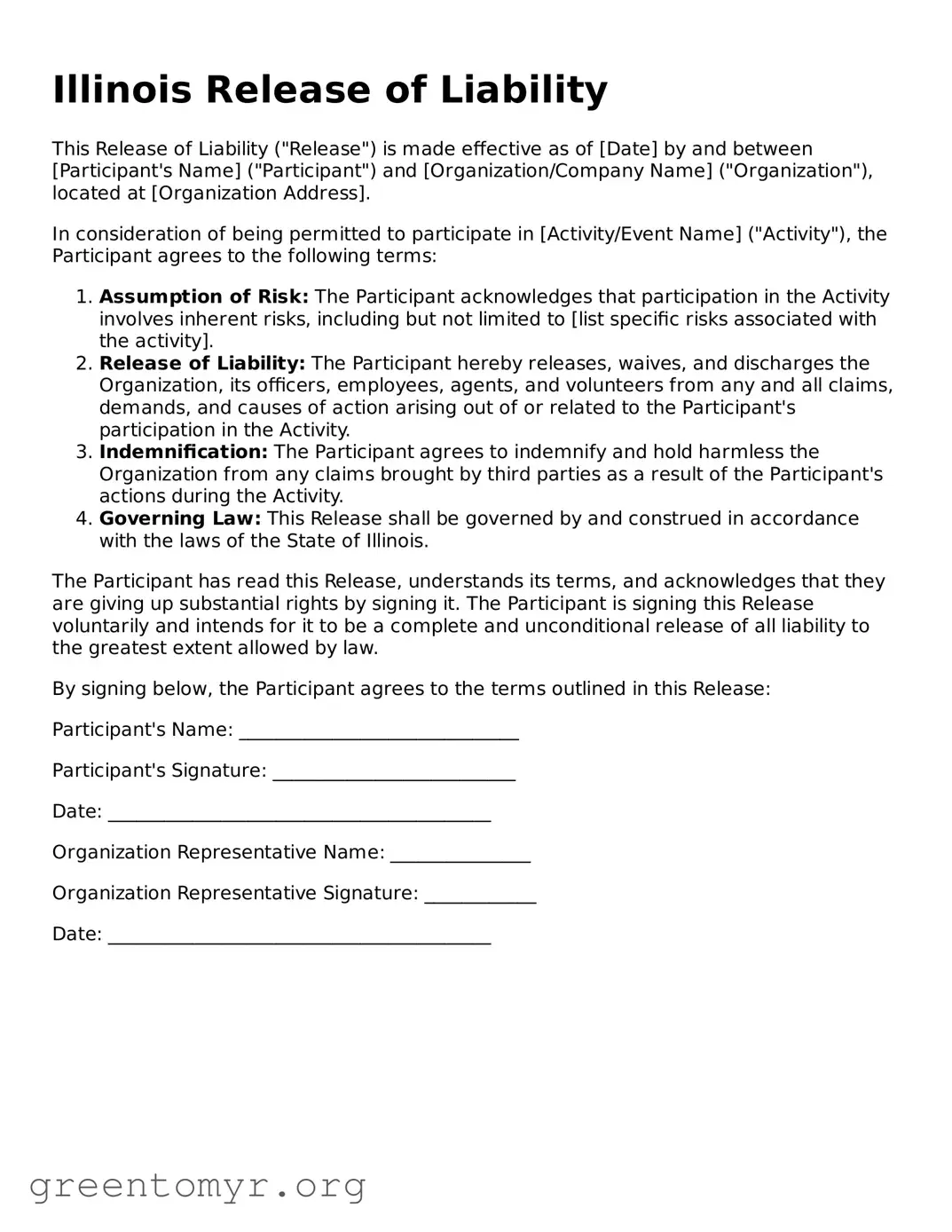
The Illinois Release of Liability form is an important document designed to protect individuals and organizations from legal claims arising from injuries or damages that may occur during activities or events. This form serves as a written acknowledgment by participants that they understand the risks involved and agree to waive their right to hold the organizer responsible for any potential harm. It typically includes sections for the participant's name, the nature of the activity, and a clear statement of the risks involved. By signing this form, participants confirm their voluntary participation and acceptance of those risks. Additionally, the form may outline any specific conditions or limitations related to the waiver, ensuring that all parties are aware of their rights and responsibilities. Understanding the nuances of this form can help both organizers and participants navigate potential legal issues effectively.
Illinois Release of Liability
This Release of Liability ("Release") is made effective as of [Date] by and between [Participant's Name] ("Participant") and [Organization/Company Name] ("Organization"), located at [Organization Address].
In consideration of being permitted to participate in [Activity/Event Name] ("Activity"), the Participant agrees to the following terms:
The Participant has read this Release, understands its terms, and acknowledges that they are giving up substantial rights by signing it. The Participant is signing this Release voluntarily and intends for it to be a complete and unconditional release of all liability to the greatest extent allowed by law.
By signing below, the Participant agrees to the terms outlined in this Release:
Participant's Name: ______________________________
Participant's Signature: __________________________
Date: _________________________________________
Organization Representative Name: _______________
Organization Representative Signature: ____________
Date: _________________________________________
| Fact Name | Description |
|---|---|
| Purpose | The Illinois Release of Liability form is designed to protect businesses and individuals from legal claims by participants in various activities. |
| Governing Law | This form is governed by Illinois state law, specifically under the principles of contract law and liability waivers. |
| Voluntary Agreement | Participants must voluntarily sign the form, acknowledging the risks associated with the activity and waiving their right to sue. |
| Clarity of Terms | The form should clearly outline the risks involved and the scope of the release to ensure enforceability in court. |
| Age Requirement | Minors typically require a parent or guardian to sign the form on their behalf to ensure legal validity. |
| Limitations | Some limitations exist regarding the types of activities that can be covered; gross negligence or willful misconduct cannot be waived. |
After obtaining the Illinois Release of Liability form, you will need to provide specific information to complete it. This form typically requires details about the parties involved and the nature of the activity. Carefully following the steps below will ensure the form is filled out correctly.
Once the form is completed, review it for accuracy. Ensure that all necessary fields are filled out and that your signature is clear. After that, you can submit the form as required by the organization or individual involved.
The Illinois Release of Liability form is a legal document that allows individuals to waive their right to hold another party responsible for any injuries or damages that may occur during a specific activity or event. This form is commonly used in various settings, such as recreational activities, sports events, or other situations where risks are present.
Organizations, businesses, or individuals that host activities involving potential risks often use this form. Examples include sports clubs, fitness centers, event organizers, and outdoor adventure companies. Participants in these activities are usually asked to sign the form to acknowledge their understanding of the risks involved.
Yes, when properly executed, the Release of Liability form is generally considered legally binding in Illinois. However, its enforceability can depend on several factors, including the clarity of the language used, the circumstances under which it was signed, and whether it meets specific legal requirements. Courts may scrutinize these documents, particularly in cases involving negligence.
A comprehensive Release of Liability form should include the following elements:
Minors cannot legally sign contracts, including a Release of Liability form. Instead, a parent or legal guardian must sign on behalf of the minor. This signature indicates that the parent or guardian understands the risks and agrees to waive liability for their child.
If an individual is injured during an activity after signing the Release of Liability form, the enforceability of the waiver will depend on various factors. Courts may consider whether the risks were adequately disclosed and whether the injury resulted from negligence. In some cases, the waiver may not protect the organization or individual from liability.
Once signed, a Release of Liability form generally cannot be revoked unilaterally. However, if a participant feels that they were coerced into signing or did not fully understand the terms, they may have grounds to contest the validity of the waiver. It is advisable to consult legal counsel in such situations.
While there are no specific statutory requirements for a Release of Liability form in Illinois, it must be clear and unambiguous. The language should be straightforward, and it should explicitly state the risks involved. Additionally, it is recommended to have the document reviewed by legal counsel to ensure compliance with applicable laws.
To enhance the effectiveness of a Release of Liability form, consider the following tips:
Release of Liability forms can often be found online through legal document websites or templates. However, it is crucial to ensure that any form used is tailored to meet Illinois laws and the specific needs of the activity or event. Consulting with a legal professional is advisable to create a custom form that adequately addresses potential risks.
Filling out the Illinois Release of Liability form requires careful attention to detail. One common mistake is failing to provide accurate personal information. Individuals often overlook the importance of including their full name, address, and contact details. Incomplete or incorrect information can lead to complications later, especially if a claim needs to be processed.
Another frequent error involves misunderstanding the scope of the release. Many people do not fully grasp what activities or risks they are waiving their rights to pursue. It is essential to read the form thoroughly to understand what is covered and what is not. Misinterpretation can result in unintended consequences, such as losing the right to seek compensation for injuries.
Some individuals neglect to sign and date the form. A signature is a critical component of any legal document. Without it, the release may be deemed invalid. Additionally, failing to date the document can create confusion regarding when the release was executed, which may affect its enforceability.
Another mistake is not having a witness or notary present when signing the form. While not always required, having a witness can add an extra layer of credibility. In some cases, notarization may be necessary to ensure the document holds up in court. Individuals should check the specific requirements for their situation.
People often rush through the process, leading to incomplete sections. Leaving any part of the form blank can result in delays or disputes later on. Each section should be filled out completely, as omissions can create ambiguity and potential legal challenges.
Additionally, some individuals fail to ask questions if they do not understand certain terms or clauses. Ignorance of the content can lead to uninformed consent. It is advisable to seek clarification from a knowledgeable source before proceeding.
Another common oversight is not keeping a copy of the completed form. Individuals should always retain a signed copy for their records. This can be crucial if any disputes arise in the future, as it serves as proof of the agreement and the terms accepted.
Finally, some people do not consider the implications of the release on their insurance coverage. They may assume that signing a release absolves them of all responsibility. However, it is vital to understand how this may interact with existing insurance policies. Consulting with an insurance professional can provide clarity on how to navigate these complexities.
When engaging in activities that may involve risk, it is important to have the appropriate documentation in place to protect all parties involved. The Illinois Release of Liability form is commonly used, but several other forms and documents can complement it. Here is a list of other important documents often utilized alongside the Release of Liability form.
Having these documents in place can provide clarity and protection for all parties involved in an activity. It is advisable to review each form carefully and ensure that all necessary signatures are obtained prior to participation. This proactive approach can help mitigate risks and enhance the overall experience.
The Release of Liability form shares similarities with several other legal documents. Each of these documents serves to limit or clarify the responsibilities of parties involved in various activities. Below are four documents that are comparable to the Release of Liability form:
When filling out the Illinois Release of Liability form, it’s important to approach the process carefully. Here are some key dos and don’ts to keep in mind:
Many people have misunderstandings about the Illinois Release of Liability form. This document is often used to protect businesses and individuals from legal claims. Here are seven common misconceptions about it:
While the form can limit liability, it does not provide blanket immunity. If gross negligence or intentional harm occurs, the release may not hold up in court.
This form can be used for a variety of activities, not just those deemed high-risk. Any situation where there is potential for injury may benefit from a release of liability.
While the form does restrict certain claims, it does not prevent lawsuits for issues like fraud, misrepresentation, or violations of public policy.
In Illinois, notarization is not a requirement for a Release of Liability form to be enforceable. However, having it notarized can add an extra layer of credibility.
Minors cannot legally sign contracts, including a Release of Liability. A parent or guardian must sign on their behalf to make it valid.
The form should be tailored to fit the specific circumstances of the activity and the parties involved. Generic forms may not provide adequate protection.
In some cases, individuals can revoke consent before the activity occurs. However, once the activity has started, it may be difficult to withdraw from the agreement.
Understanding these misconceptions can help individuals and businesses use the Illinois Release of Liability form more effectively and ensure they are adequately protected.
When filling out and using the Illinois Release of Liability form, consider the following key takeaways: