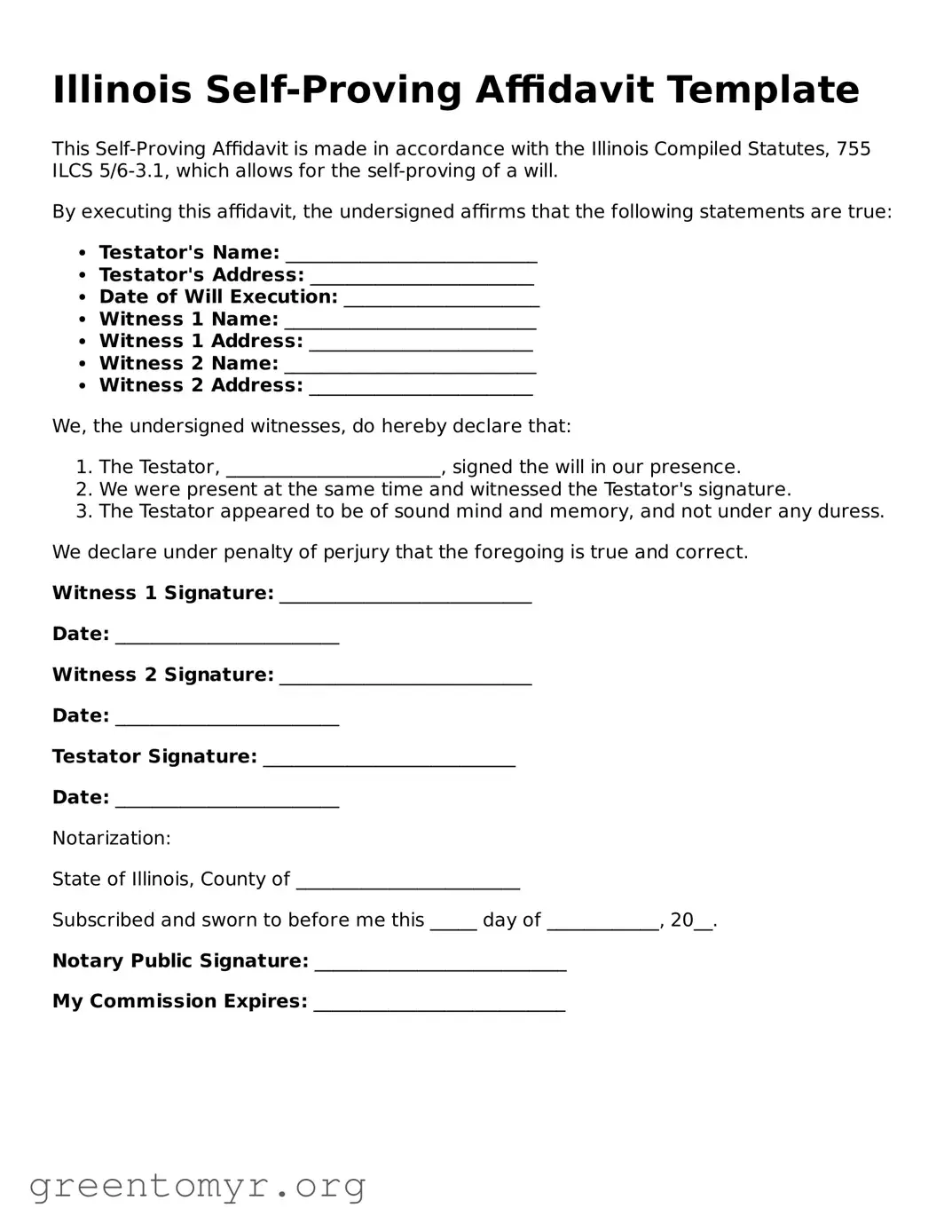
The Illinois Self-Proving Affidavit form is an important legal document designed to simplify the probate process for individuals who have created a will. This form allows a testator, or the person who made the will, to affirm the validity of their will at the time of signing, thus reducing the need for witnesses to testify about its authenticity after the testator's passing. By including a Self-Proving Affidavit, the will can be accepted by the court without further proof, streamlining the process for the loved ones left behind. The form requires the signatures of the testator and witnesses, along with a notary public's acknowledgment, ensuring that all parties involved have confirmed their identities and understanding of the document. This added layer of verification not only provides peace of mind but also helps prevent potential disputes regarding the will’s validity. Understanding how to properly complete and file this affidavit is crucial for anyone looking to ensure their final wishes are honored without unnecessary complications.
Illinois Self-Proving Affidavit Template
This Self-Proving Affidavit is made in accordance with the Illinois Compiled Statutes, 755 ILCS 5/6-3.1, which allows for the self-proving of a will.
By executing this affidavit, the undersigned affirms that the following statements are true:
We, the undersigned witnesses, do hereby declare that:
We declare under penalty of perjury that the foregoing is true and correct.
Witness 1 Signature: ___________________________
Date: ________________________
Witness 2 Signature: ___________________________
Date: ________________________
Testator Signature: ___________________________
Date: ________________________
Notarization:
State of Illinois, County of ________________________
Subscribed and sworn to before me this _____ day of ____________, 20__.
Notary Public Signature: ___________________________
My Commission Expires: ___________________________
| Fact Name | Description |
|---|---|
| Purpose | The Illinois Self-Proving Affidavit allows a testator's will to be validated without the need for witnesses during probate proceedings. |
| Governing Law | This form is governed by 755 ILCS 5/6-3.1 of the Illinois Compiled Statutes. |
| Requirements | The affidavit must be signed by the testator and two witnesses in the presence of each other. |
| Notarization | A notary public must also sign the affidavit to confirm the identities of the signers. |
| Effectiveness | Using this affidavit can expedite the probate process, as it eliminates the need for witness testimony. |
| Availability | The form can be obtained from various legal resources or state websites for use in Illinois. |
After completing the Illinois Self-Proving Affidavit form, the next step is to ensure it is signed and witnessed appropriately. This process involves gathering necessary signatures and possibly notarization to validate the document.
An Illinois Self-Proving Affidavit is a legal document that allows a testator's will to be accepted in court without requiring witnesses to testify about the will's authenticity. This affidavit is typically signed by the testator and witnesses in the presence of a notary public, simplifying the probate process.
Using a Self-Proving Affidavit can expedite the probate process. It eliminates the need for witnesses to appear in court, which can save time and reduce complications. This is particularly beneficial if witnesses are unavailable or if their testimony could be challenged.
The Self-Proving Affidavit must be signed by:
To complete the Self-Proving Affidavit, follow these steps:
No, a Self-Proving Affidavit is not mandatory in Illinois. However, it is highly recommended as it simplifies the probate process. Without it, witnesses may need to testify in court, which can lead to delays and complications.
Yes, you can revoke a Self-Proving Affidavit. If you create a new will or make significant changes to your existing will, the previous affidavit becomes void. It’s important to ensure that any revocation is clearly documented to avoid confusion during the probate process.
The Self-Proving Affidavit significantly streamlines the probate process. When presented to the court, it allows the will to be admitted without requiring witness testimony. This can lead to a quicker resolution of the estate and less potential for disputes among heirs.
You can obtain a Self-Proving Affidavit form from various sources, including:
Ensure that the form you use complies with Illinois law to avoid any issues during the probate process.
Filling out the Illinois Self-Proving Affidavit form is an important step in ensuring that a will is recognized as valid without the need for witnesses to testify in court. However, many individuals make mistakes during this process that can lead to complications down the line. Understanding these common pitfalls can help you navigate the form more effectively.
One frequent error is failing to include all necessary signatures. The Self-Proving Affidavit must be signed by both the testator and the witnesses. If even one signature is missing, the affidavit may not hold up in court. It’s crucial to double-check that everyone involved has signed the document in the appropriate places.
Another mistake often made is not providing accurate information about the witnesses. The affidavit requires that witnesses be competent adults who are not beneficiaries of the will. If a witness is named who stands to gain from the estate, this could invalidate the affidavit. Always ensure that the individuals signing as witnesses meet the legal criteria.
People sometimes overlook the importance of the notary public’s role. The Self-Proving Affidavit must be notarized to be considered valid. Failing to have a notary present during the signing process can render the document ineffective. It is advisable to arrange for a notary at the time of signing to avoid this issue.
Inaccuracies in the date can also cause problems. The affidavit should clearly indicate when it was signed. If the date is left blank or incorrectly filled out, it may lead to confusion or disputes about the timing of the will’s execution. Always ensure that the date is filled in correctly and legibly.
Moreover, individuals sometimes neglect to read the instructions thoroughly. The form may have specific requirements that need to be followed closely. Skipping over these details can result in an improperly filled out affidavit. Taking the time to read the instructions carefully can save a lot of trouble later on.
Lastly, many people fail to keep copies of the completed affidavit. After filling out the form, it is essential to retain a copy for personal records and to provide one to the executor of the estate. Not having a copy can lead to difficulties in proving the will’s validity when the time comes.
By being aware of these common mistakes, you can approach the Illinois Self-Proving Affidavit form with confidence. Careful attention to detail will help ensure that your wishes are honored and that your estate is handled according to your intentions.
When preparing a will in Illinois, several documents often accompany the Self-Proving Affidavit. These forms help ensure that the will is valid and can be executed smoothly. Below are some key documents that are typically used alongside the Self-Proving Affidavit.
Each of these documents plays a crucial role in estate planning. They help ensure that your wishes are honored and can provide clarity for your loved ones during difficult times. It's essential to consider each one carefully and seek guidance if needed.
The Self-Proving Affidavit form shares similarities with several other legal documents. Each of these documents serves a specific purpose in the realm of estate planning and probate. Below is a list of documents that are comparable to the Self-Proving Affidavit, highlighting their similarities.
When filling out the Illinois Self-Proving Affidavit form, it's important to approach the task with care. Here are some key do's and don'ts to keep in mind:
The Illinois Self-Proving Affidavit is an important legal document that can streamline the probate process for a will. However, several misconceptions surround this form. Here are ten common misunderstandings:
Understanding these misconceptions can help individuals make informed decisions about their estate planning and the use of the Illinois Self-Proving Affidavit.
When filling out and using the Illinois Self-Proving Affidavit form, it is essential to keep several key points in mind. These points will help ensure that the process is smooth and legally sound.
These takeaways are designed to provide clarity and support in the process of using the Illinois Self-Proving Affidavit form. Following these guidelines can help ensure that your intentions are honored and that your wishes are carried out as you desire.