In Illinois, the Small Estate Affidavit serves as a crucial tool for individuals seeking to simplify the process of settling a deceased person's estate when the total value of the estate is below a certain threshold. This form allows heirs or beneficiaries to claim property without the need for formal probate proceedings, which can often be time-consuming and costly. By utilizing the Small Estate Affidavit, individuals can assert their rights to the deceased's assets, such as bank accounts, personal belongings, and real estate, provided the estate meets the criteria established by Illinois law. The form requires specific information, including the names of the heirs, the estimated value of the estate, and a declaration that the estate qualifies as a small estate. Moreover, the affidavit must be notarized and submitted to the appropriate financial institutions or entities to facilitate the transfer of assets. Understanding the nuances of this form is essential for ensuring a smooth transition of property and minimizing complications during a difficult time.
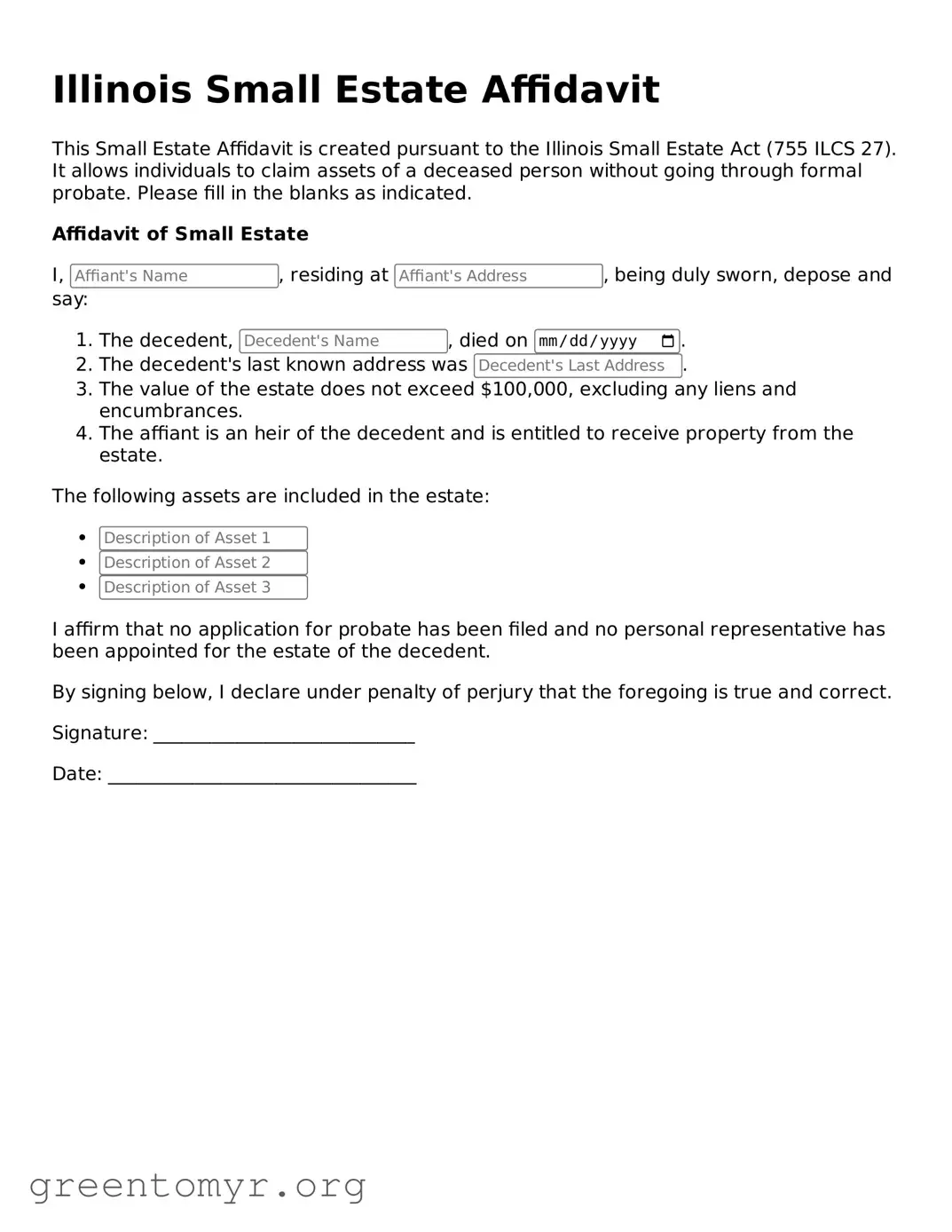
Illinois Small Estate Affidavit
This Small Estate Affidavit is created pursuant to the Illinois Small Estate Act (755 ILCS 27). It allows individuals to claim assets of a deceased person without going through formal probate. Please fill in the blanks as indicated.
Affidavit of Small Estate
I, , residing at , being duly sworn, depose and say:
The following assets are included in the estate:
I affirm that no application for probate has been filed and no personal representative has been appointed for the estate of the decedent.
By signing below, I declare under penalty of perjury that the foregoing is true and correct.
Signature: ____________________________
Date: _________________________________
| Fact Name | Details |
|---|---|
| Purpose | The Illinois Small Estate Affidavit is used to simplify the transfer of assets from a deceased person's estate when the total value is below a certain threshold. |
| Governing Law | The use of the Small Estate Affidavit is governed by the Illinois Probate Act, specifically 755 ILCS 27-1. |
| Value Limit | As of 2023, the total value of the estate must not exceed $100,000 to qualify for the Small Estate Affidavit. |
| Eligible Assets | Real estate, bank accounts, and personal property can be transferred using this affidavit, provided they fall under the value limit. |
| Filing Requirements | The affidavit must be signed by the heirs and notarized before it can be used to claim assets. |
| Timeframe | There is no specific deadline for filing the Small Estate Affidavit, but it should be completed promptly to avoid complications. |
| Heirs' Rights | Only heirs of the deceased, as defined by Illinois law, can utilize the Small Estate Affidavit to claim assets. |
| Limitations | This process does not apply to all types of assets, such as those held in a trust or life insurance proceeds, which may have different requirements. |
Once the Illinois Small Estate Affidavit form is completed, it will be submitted to the appropriate court. This step is crucial for ensuring that the estate is handled according to the wishes of the deceased and in compliance with state laws. Following the steps below will help you accurately fill out the form.
The Illinois Small Estate Affidavit is a legal document that allows a person to claim the assets of a deceased individual without going through the formal probate process. This is typically used when the total value of the deceased's assets is below a certain threshold, making the process simpler and faster for heirs.
Generally, any individual who is a legal heir or beneficiary of the deceased can use the Small Estate Affidavit. This includes spouses, children, or other relatives who are entitled to inherit under Illinois law. However, the total value of the estate must be below $100,000, excluding certain assets like real estate.
The Small Estate Affidavit can be used to claim various types of assets, including:
However, it does not apply to real estate or assets that are held in a trust.
To complete the Small Estate Affidavit, follow these steps:
Ensure that all information is accurate to avoid delays in processing.
No, you typically do not need to file the Small Estate Affidavit with the court. Instead, you present it directly to the institutions or entities holding the deceased's assets, such as banks or financial institutions. They will then process your claim based on the affidavit.
If the deceased had outstanding debts, the Small Estate Affidavit does not absolve those debts. Creditors may still pursue payment from the estate. It is advisable to settle any debts before distributing assets to heirs to avoid potential legal issues.
Filling out the Illinois Small Estate Affidavit form can be a straightforward process, but several common mistakes can lead to delays or complications. One frequent error is failing to include all required information. The form requests specific details about the deceased, including their full name, date of death, and the names of the heirs. Omitting any of this information can result in the affidavit being rejected.
Another common mistake is not properly identifying the assets. The affidavit must clearly list all the assets of the deceased that fall under the small estate threshold. This includes bank accounts, real estate, and personal property. Inaccuracies or vague descriptions can create confusion and may lead to disputes among heirs.
Many individuals also overlook the importance of signatures. The form requires the signatures of all heirs, and failing to obtain these can invalidate the affidavit. Additionally, heirs must be of legal age and competent to sign. If a minor or an incapacitated individual is listed as an heir, this can complicate the process further.
Finally, some people neglect to check the eligibility criteria for using the Small Estate Affidavit. The estate must meet specific value limits, and certain types of assets may not qualify. If the estate exceeds these limits or includes disallowed assets, individuals may need to pursue a different legal process. Understanding these requirements is crucial for a smooth filing experience.
The Illinois Small Estate Affidavit is a useful tool for settling the estate of a deceased person when the total value of the estate is below a certain threshold. However, there are other forms and documents that often accompany this affidavit to ensure a smooth process. Here are some of the key documents commonly used alongside the Small Estate Affidavit.
Using these documents in conjunction with the Illinois Small Estate Affidavit can facilitate the process of settling an estate. It is important to ensure that all necessary forms are completed accurately to avoid delays.
The Small Estate Affidavit form serves a specific purpose in the estate settlement process, particularly for estates that fall below a certain value threshold. Several other documents share similarities with this form in terms of their function and use. Below are four such documents, each explained in detail.
When filling out the Illinois Small Estate Affidavit form, it is important to follow specific guidelines to ensure accuracy and compliance. Below is a list of things you should and shouldn't do:
Following these guidelines will help ensure a smoother process when dealing with small estates in Illinois.
Understanding the Illinois Small Estate Affidavit can be challenging, especially with the many misconceptions surrounding it. Here are seven common misunderstandings, clarified for better comprehension.
This is not true. While heirs often use the affidavit, any person who is entitled to the estate can file it. This includes beneficiaries named in a will or those designated by law.
Actually, there are limits. In Illinois, the Small Estate Affidavit is only applicable for estates valued at $100,000 or less, excluding real estate. Anything above this threshold requires a different probate process.
In fact, you do not need to go to court. The affidavit can be submitted directly to the financial institutions or other entities holding the deceased’s assets.
There is no strict deadline for filing the Small Estate Affidavit. However, it is wise to file it in a timely manner to ensure a smooth transfer of assets.
This is misleading. While it is important to address debts, the Small Estate Affidavit can still be filed even if some debts remain. However, the estate may need to be responsible for those debts before distributing assets.
This is incorrect. Multiple affidavits can be filed if there are different assets or beneficiaries involved. Each affidavit can address separate accounts or properties as needed.
While it simplifies the process, it does not exempt the executor or heirs from any legal obligations. They must still comply with state laws regarding estate distribution and debts.
Clearing up these misconceptions can make the process of handling a small estate in Illinois much more manageable. Understanding the facts helps ensure that everything proceeds smoothly and legally.
The Illinois Small Estate Affidavit is a legal document that allows individuals to settle the estate of a deceased person without going through formal probate. Here are key takeaways regarding its use: