The Indiana Affidavit of Residency form serves as a crucial document for individuals needing to verify their residency status within the state. This form is often required for various purposes, such as enrolling children in schools, applying for certain government benefits, or establishing eligibility for specific programs. By completing the affidavit, individuals affirm their current address and demonstrate their commitment to residing in Indiana. The form typically requires personal information, including the name, address, and signature of the individual, as well as details about the residency duration. Additionally, it may need to be notarized to ensure authenticity. Understanding the requirements and implications of this affidavit can help residents navigate their responsibilities and rights effectively.
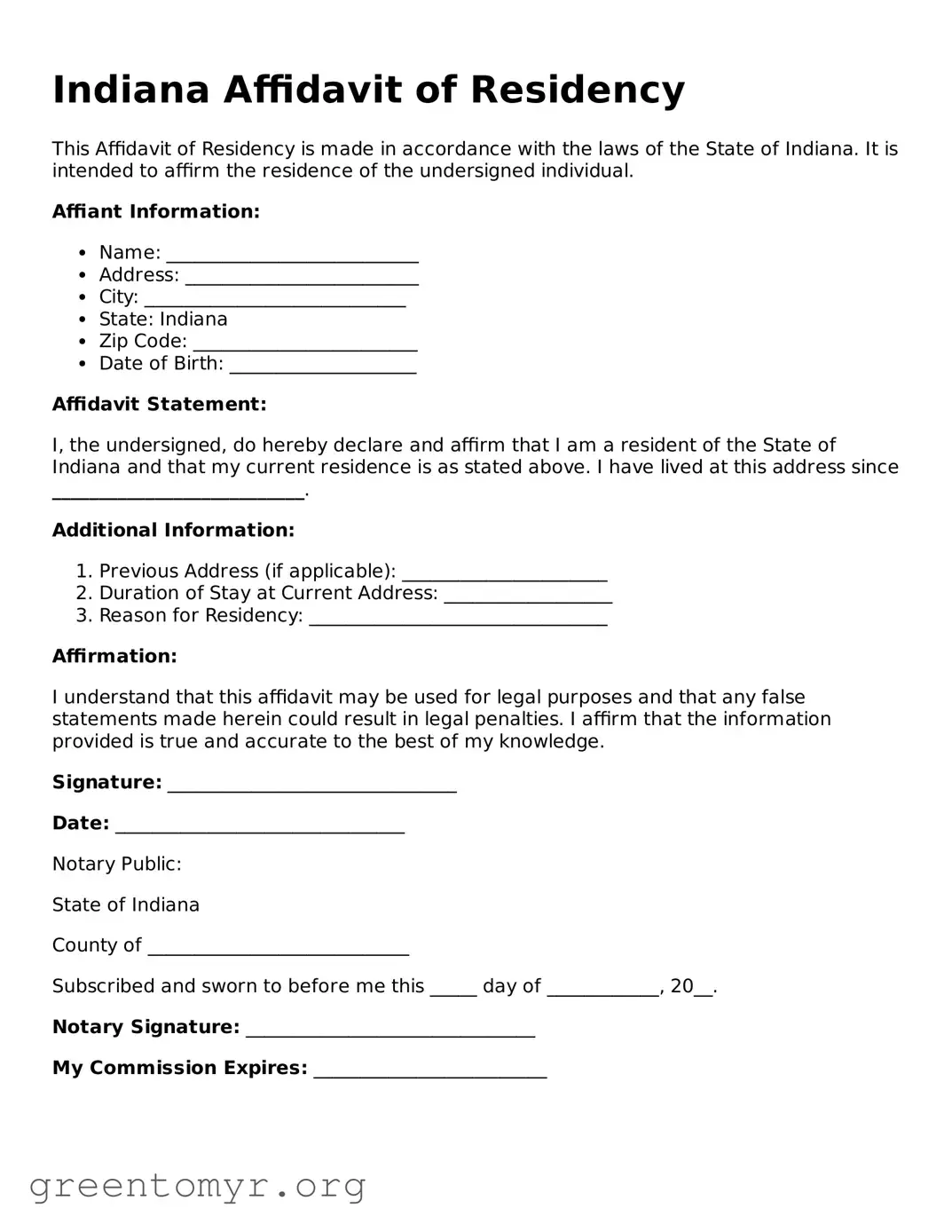
Indiana Affidavit of Residency
This Affidavit of Residency is made in accordance with the laws of the State of Indiana. It is intended to affirm the residence of the undersigned individual.
Affiant Information:
Affidavit Statement:
I, the undersigned, do hereby declare and affirm that I am a resident of the State of Indiana and that my current residence is as stated above. I have lived at this address since ___________________________.
Additional Information:
Affirmation:
I understand that this affidavit may be used for legal purposes and that any false statements made herein could result in legal penalties. I affirm that the information provided is true and accurate to the best of my knowledge.
Signature: _______________________________
Date: _______________________________
Notary Public:
State of Indiana
County of ____________________________
Subscribed and sworn to before me this _____ day of ____________, 20__.
Notary Signature: _______________________________
My Commission Expires: _________________________
| Fact Name | Details |
|---|---|
| Purpose | The Indiana Affidavit of Residency form is used to verify an individual's residence in Indiana. |
| Governing Law | This form is governed by Indiana Code Title 1, Article 1-5-3. |
| Who Can Use It | Any resident of Indiana can complete this form to confirm their residency status. |
| Usage | The affidavit may be required for various legal purposes, including school enrollment and voting registration. |
| Notarization | The form typically requires notarization to verify the identity of the person signing it. |
| Information Required | Applicants must provide their name, address, and other identifying information. |
| Submission | After completion, the form must be submitted to the relevant authority, such as a school district or local government office. |
| Validity | The affidavit is valid as long as the information provided is accurate and up to date. |
| Consequences of False Information | Providing false information on this form can lead to legal penalties, including fines or criminal charges. |
| Accessibility | The form can usually be obtained online or at local government offices, making it accessible to residents. |
Completing the Indiana Affidavit of Residency form is a straightforward process. Once you have filled out the form, you will need to submit it to the appropriate authority, which may include your local school district or other designated agencies. Ensure that all information is accurate and complete to avoid any delays.
The Indiana Affidavit of Residency form is a legal document used to verify a person's residency in the state of Indiana. This form is often required for various purposes, such as enrolling children in school, applying for certain benefits, or establishing residency for voting. It serves as a sworn statement confirming that an individual resides at a specific address within Indiana.
Individuals who need to prove their residency in Indiana may be required to complete this form. Common scenarios include:
The form can typically be obtained from various sources, including:
It’s important to ensure that you are using the most current version of the form.
The Affidavit of Residency form generally requires the following information:
Yes, when you sign the Affidavit of Residency, you are making a sworn statement. This means that the information provided must be true and accurate. Providing false information can lead to legal consequences, including potential charges of perjury.
In most cases, the Indiana Affidavit of Residency does not require a witness or notary. However, it is always wise to check the specific requirements of the organization or agency requesting the form. Some may have additional stipulations regarding signatures.
Once you have completed the Affidavit of Residency, submission methods can vary based on the purpose for which you are using it. Common submission methods include:
If you move after submitting the Affidavit of Residency, it is important to notify the relevant parties. This may include schools, election offices, or any other institutions that require your residency verification. You may need to fill out a new Affidavit to reflect your new address.
For additional details about residency requirements, you can visit the Indiana state government website or contact local government offices. They can provide guidance tailored to your specific situation and answer any further questions you may have.
Filling out the Indiana Affidavit of Residency form can seem straightforward, but many individuals encounter pitfalls that can complicate the process. One common mistake is failing to provide accurate information about residency. It is essential to ensure that the address listed is current and reflects where you actually reside. Inaccuracies can lead to delays or even rejection of the affidavit.
Another frequent error is neglecting to sign the form. A signature is a vital part of this document, as it affirms that the information provided is true to the best of your knowledge. Without a signature, the affidavit may be considered incomplete, causing further complications down the line.
Additionally, individuals often overlook the requirement for a witness or notary. Depending on the specific instructions for the affidavit, having a witness present during the signing or obtaining a notary’s acknowledgment may be necessary. Failing to include this step can invalidate the affidavit.
People sometimes misinterpret the instructions regarding supporting documents. The affidavit may require additional proof of residency, such as utility bills or lease agreements. Not providing these documents, or submitting incorrect ones, can lead to unnecessary delays in processing.
Finally, some individuals rush through the form without reviewing it thoroughly. This can lead to typographical errors or omissions that might seem minor but can have significant consequences. Taking the time to double-check all entries ensures that the affidavit is complete and accurate, reducing the risk of complications.
When dealing with residency issues in Indiana, the Affidavit of Residency form is often accompanied by several other important documents. Each of these forms serves a specific purpose and helps to clarify residency status or provide additional proof of residence. Below is a list of commonly used documents that may be required alongside the Affidavit of Residency.
Gathering these documents can streamline the process of proving residency in Indiana. Each piece of evidence contributes to a clearer understanding of an individual’s living situation, ensuring that all necessary information is available for review. Being well-prepared can make a significant difference when submitting residency-related forms.
When filling out the Indiana Affidavit of Residency form, it is essential to follow specific guidelines to ensure accuracy and compliance. Below is a list of things you should and shouldn't do.
The Indiana Affidavit of Residency form is often misunderstood. Here are ten common misconceptions about this form:
Many people think the affidavit is only necessary for students attending school. In reality, it can be used by anyone needing to prove their residency in Indiana.
While notarization can add credibility, it is not a strict requirement for the affidavit to be valid.
Some believe they can submit the affidavit whenever they want. However, it must be submitted within specific timeframes related to the purpose for which it is needed.
This form is not limited to homeowners. Renters and others can also use it to establish residency.
While the affidavit is a formal statement, it does not carry the same weight as a legal document. It serves mainly as a declaration of residency.
Many think they need several witnesses to sign the affidavit. In most cases, only one witness is sufficient.
People often assume it is only for those who have lived in Indiana for a long time. New residents can also use the affidavit to establish their residency.
Some believe the affidavit must be completed online. However, it can also be filled out on paper and submitted in person or by mail.
Many think the affidavit is difficult to understand. In fact, it is designed to be straightforward and user-friendly.
Some people worry that they cannot make changes after submission. However, it is possible to amend the affidavit if necessary.
When filling out and using the Indiana Affidavit of Residency form, consider the following key takeaways: