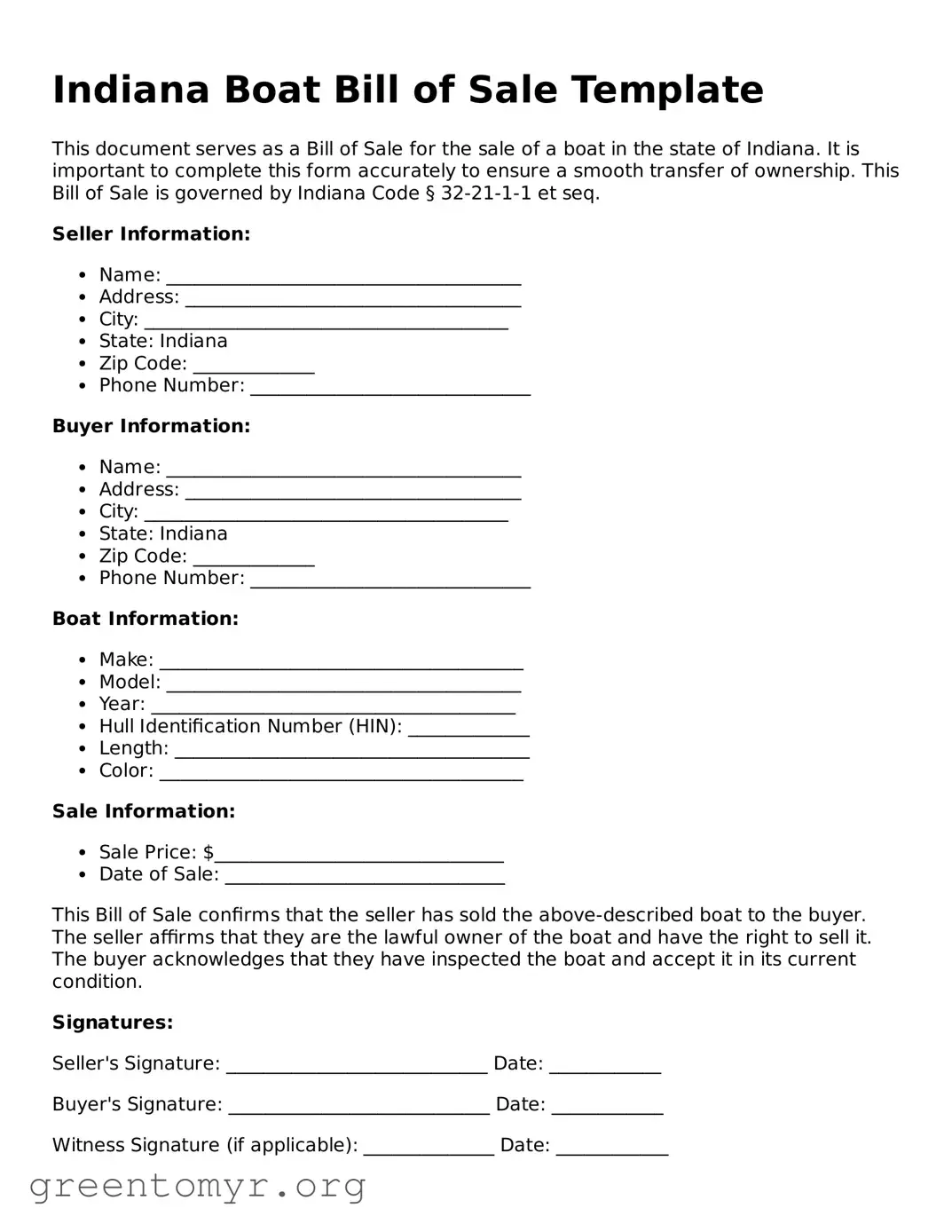
When buying or selling a boat in Indiana, having the right documentation is essential to ensure a smooth transaction. The Indiana Boat Bill of Sale form serves as a crucial legal document that records the details of the sale, including information about the buyer, the seller, and the boat itself. This form typically captures important details such as the boat's make, model, year, and identification number, along with the sale price and date of the transaction. Both parties must sign the document to validate the agreement, making it an important step in transferring ownership. Additionally, this bill of sale can serve as proof of ownership for the buyer, which may be necessary for registration purposes with the Indiana Department of Natural Resources. Understanding the key elements of this form can help ensure that both buyers and sellers are protected throughout the process.
Indiana Boat Bill of Sale Template
This document serves as a Bill of Sale for the sale of a boat in the state of Indiana. It is important to complete this form accurately to ensure a smooth transfer of ownership. This Bill of Sale is governed by Indiana Code § 32-21-1-1 et seq.
Seller Information:
Buyer Information:
Boat Information:
Sale Information:
This Bill of Sale confirms that the seller has sold the above-described boat to the buyer. The seller affirms that they are the lawful owner of the boat and have the right to sell it. The buyer acknowledges that they have inspected the boat and accept it in its current condition.
Signatures:
Seller's Signature: ____________________________ Date: ____________
Buyer's Signature: ____________________________ Date: ____________
Witness Signature (if applicable): ______________ Date: ____________
| Fact Name | Details |
|---|---|
| Purpose | The Indiana Boat Bill of Sale form serves as a legal document to transfer ownership of a boat from one party to another. |
| Governing Law | This form is governed by Indiana Code Title 9, Article 31, which outlines regulations for boats and watercraft. |
| Required Information | Essential details include the buyer's and seller's names, addresses, the boat's description, and the sale price. |
| Signatures | Both the buyer and seller must sign the form to validate the transaction and confirm the transfer of ownership. |
| Use for Registration | The completed Bill of Sale can be used to register the boat with the Indiana Department of Natural Resources. |
| Record Keeping | It is advisable for both parties to keep a copy of the Bill of Sale for their records, as it provides proof of ownership transfer. |
After gathering the necessary information, you can proceed to fill out the Indiana Boat Bill of Sale form. This form is essential for documenting the sale of a boat and ensuring both parties have a clear record of the transaction.
The Indiana Boat Bill of Sale form is a legal document used to record the sale of a boat in the state of Indiana. This form serves as proof of ownership transfer between the seller and the buyer. It includes important details about the boat, such as its make, model, year, and hull identification number, as well as the names and addresses of both parties involved in the transaction.
A Boat Bill of Sale is essential for several reasons:
When filling out the Indiana Boat Bill of Sale, be sure to include the following details:
While notarization is not required for the Indiana Boat Bill of Sale, it is highly recommended. Having the document notarized adds an extra layer of security and can help prevent potential disputes in the future. A notary public will verify the identities of both parties and witness the signing of the document, making it more official.
After completing the Indiana Boat Bill of Sale, the buyer should keep the original document for their records. The buyer will also need to submit it to the Indiana Department of Natural Resources (DNR) when registering the boat. It’s important to do this promptly to ensure that the boat is legally registered in the new owner’s name.
When filling out the Indiana Boat Bill of Sale form, many individuals make common mistakes that can lead to complications down the line. One frequent error is not providing complete information about the boat. It’s essential to include details such as the make, model, year, and hull identification number (HIN). Omitting any of these can create confusion regarding ownership.
Another mistake is failing to accurately list the seller’s and buyer’s information. Both parties should ensure their names, addresses, and contact details are correct. Inaccurate information can result in delays or disputes later on, especially if the document needs to be referenced for registration purposes.
Many people also overlook the importance of the date of sale. Without a clear date, it can be challenging to establish when the transaction occurred. This date is crucial for both parties, particularly for tax purposes and for determining the timeline for any potential issues that may arise after the sale.
Additionally, some individuals forget to include the sale price. This is not just a formality; it serves as a record of the transaction. If the sale price is missing, it can lead to misunderstandings and complications, especially if the buyer needs to register the boat or prove ownership.
Another common oversight is not signing the document. Both the seller and buyer must sign the Boat Bill of Sale to make it legally binding. A missing signature can render the document invalid, causing problems if either party needs to prove ownership or if disputes arise.
People often neglect to provide information about any liens on the boat. If there are outstanding loans or claims against the vessel, these should be disclosed. Failing to do so can result in legal issues for the buyer, who may unknowingly purchase a boat with encumbrances.
It’s also important to remember that the form must be filled out in ink, not pencil. Using ink ensures that the information remains permanent and legible. Pencil can smudge or fade over time, which could lead to difficulties in the future.
Lastly, many individuals forget to keep a copy of the completed Boat Bill of Sale for their records. Having a copy is vital for both the buyer and seller. It serves as proof of the transaction and can be useful for future reference, whether for registration, insurance, or potential disputes.
The Indiana Boat Bill of Sale form is an important document for the transfer of ownership of a boat. Along with this form, several other documents may be required or beneficial during the sale or purchase of a boat. Below is a list of forms and documents commonly used in conjunction with the Indiana Boat Bill of Sale.
These documents play a crucial role in ensuring a smooth transaction and protecting the interests of both the buyer and seller. It is advisable to gather all necessary paperwork to facilitate the process of buying or selling a boat in Indiana.
The Boat Bill of Sale form serves an important role in the transfer of ownership for a boat. It shares similarities with several other documents that facilitate the transfer of ownership for various types of property. Here are four such documents:
When filling out the Indiana Boat Bill of Sale form, it is important to follow specific guidelines to ensure that the document is valid and serves its purpose. Here are seven things you should and shouldn't do:
Following these guidelines will help ensure a smooth transaction and proper documentation for the sale of the boat.
When it comes to the Indiana Boat Bill of Sale form, there are several misconceptions that can lead to confusion for boat buyers and sellers. Understanding these misconceptions can help ensure a smooth transaction and compliance with state laws. Here are five common misunderstandings:
Many people believe that a Bill of Sale is optional when buying or selling a boat. In reality, having a Bill of Sale is crucial. It serves as proof of ownership and can protect both parties in case of disputes.
Some individuals think that notarization is a requirement for the Indiana Boat Bill of Sale. While notarization can add an extra layer of authenticity, it is not a legal requirement in Indiana.
It is a common belief that the Bill of Sale must be submitted to a state agency. However, in Indiana, the Bill of Sale is primarily for the buyer and seller’s records. The state does not require the document to be filed.
People often assume that one standard form works for all types of boats. However, different types of vessels may require specific information, so it’s important to ensure that the form you use fits the boat you are buying or selling.
Some think that the Bill of Sale is only necessary for private transactions. In fact, whether you’re buying from a dealer or an individual, a Bill of Sale is beneficial for documenting the sale and protecting your interests.
When filling out and using the Indiana Boat Bill of Sale form, there are several important aspects to keep in mind. Understanding these key takeaways can help ensure a smooth transaction.
By following these guidelines, both buyers and sellers can navigate the process of completing the Indiana Boat Bill of Sale form effectively.