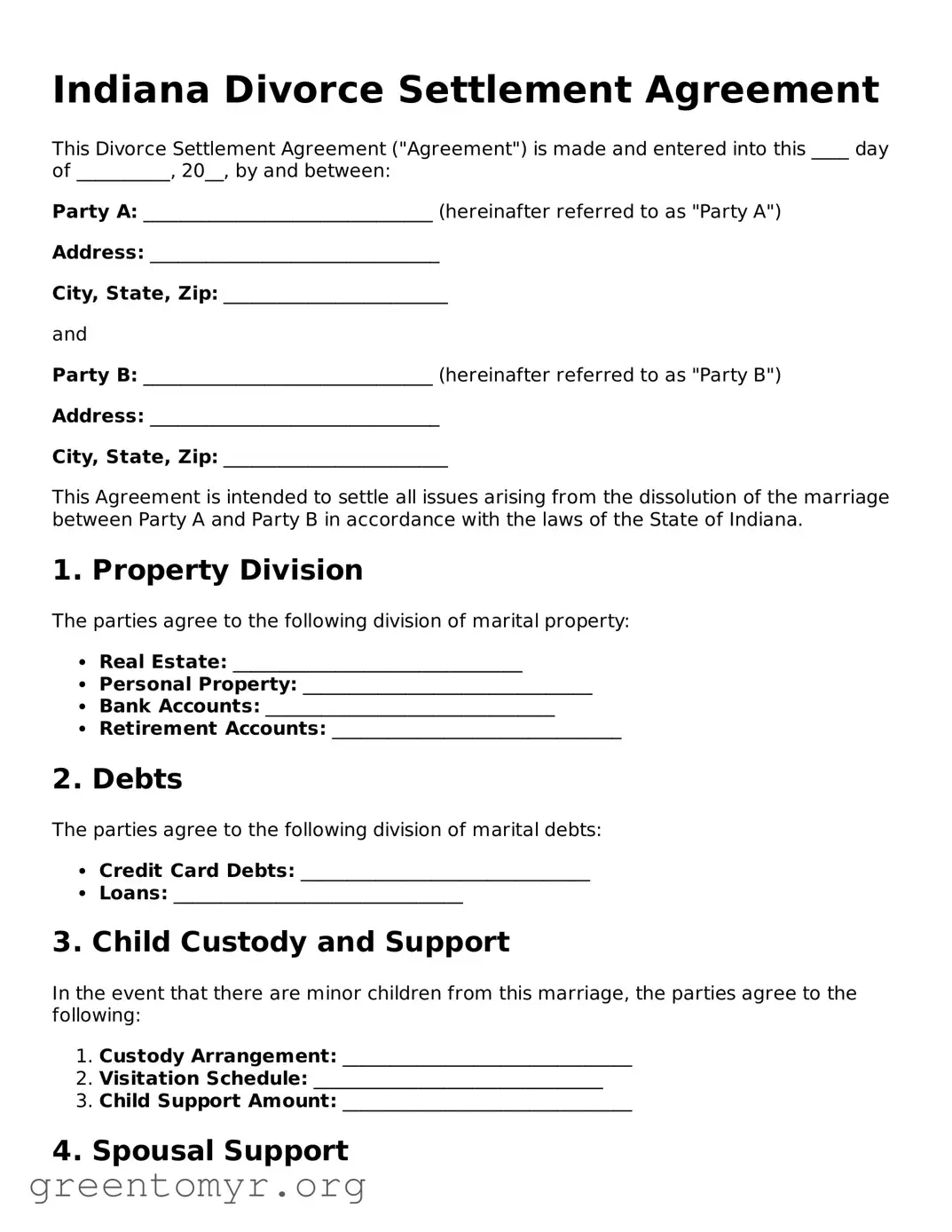
The Indiana Divorce Settlement Agreement form plays a crucial role in the dissolution of marriage process, serving as a comprehensive document that outlines the terms agreed upon by both spouses. This form addresses key aspects such as the division of marital property, allocation of debts, and arrangements for child custody and support. By clearly delineating responsibilities and rights, the agreement aims to minimize disputes and facilitate a smoother transition for both parties. Additionally, it can cover spousal support, visitation schedules, and any other relevant issues that may arise during the divorce proceedings. Understanding the components of this form is essential for individuals navigating the complexities of divorce in Indiana, as it not only reflects the mutual decisions made but also serves as a legally binding contract once signed and submitted to the court.
Indiana Divorce Settlement Agreement
This Divorce Settlement Agreement ("Agreement") is made and entered into this ____ day of __________, 20__, by and between:
Party A: _______________________________ (hereinafter referred to as "Party A")
Address: _______________________________
City, State, Zip: ________________________
and
Party B: _______________________________ (hereinafter referred to as "Party B")
Address: _______________________________
City, State, Zip: ________________________
This Agreement is intended to settle all issues arising from the dissolution of the marriage between Party A and Party B in accordance with the laws of the State of Indiana.
1. Property Division
The parties agree to the following division of marital property:
2. Debts
The parties agree to the following division of marital debts:
3. Child Custody and Support
In the event that there are minor children from this marriage, the parties agree to the following:
4. Spousal Support
The parties agree to the following regarding spousal support:
Amount: _______________________________
Duration: _______________________________
5. Miscellaneous Provisions
The parties further agree to the following terms:
This Agreement represents the complete understanding between the parties and supersedes any prior agreements or understandings, whether written or oral. By signing below, both parties acknowledge that they have read, understood, and voluntarily agree to the terms of this Agreement.
Party A Signature: _______________________________ Date: _____________
Party B Signature: _______________________________ Date: _____________
| Fact Name | Details |
|---|---|
| Governing Law | The Indiana Divorce Settlement Agreement form is governed by Indiana Code Title 31, Article 15. |
| Purpose | This form is used to outline the terms of a divorce settlement between spouses, addressing issues like property division, child custody, and support. |
| Mandatory Use | While not always mandatory, using a settlement agreement can streamline the divorce process and reduce court involvement. |
| Mutual Agreement | Both parties must agree to the terms laid out in the settlement for it to be valid and enforceable. |
| Filing Requirements | The completed form must be filed with the appropriate Indiana court as part of the divorce proceedings. |
| Child Support Guidelines | If children are involved, the agreement must adhere to Indiana's child support guidelines to ensure fairness. |
| Modification | Once finalized, the agreement can be modified, but both parties must consent to any changes. |
| Legal Advice | It is advisable for both parties to seek legal counsel to ensure their rights are protected before signing the agreement. |
Filling out the Indiana Divorce Settlement Agreement form is an important step in the divorce process. This document outlines the terms agreed upon by both parties regarding property division, child custody, and other essential matters. Once completed, you will be ready to submit it to the court as part of your divorce proceedings.
After completing the form, gather any additional documents needed for your divorce case. You will then be prepared to file your paperwork with the court, setting the stage for the next steps in your divorce journey.
The Indiana Divorce Settlement Agreement form is a legal document that outlines the terms agreed upon by both spouses during a divorce. This document typically covers aspects such as property division, spousal support, child custody, and child support. It serves to ensure that both parties are on the same page and helps facilitate the divorce process.
Both spouses involved in the divorce need to fill out and sign the Indiana Divorce Settlement Agreement form. It is essential that both parties agree to the terms outlined in the document. If there are children involved, the agreement will also need to address custody and support matters.
To fill out the form, follow these steps:
Yes, you can modify the agreement after it is signed, but both parties must agree to the changes. It is advisable to document any modifications in writing and have both parties sign the updated agreement. This helps avoid misunderstandings later on.
If both spouses cannot reach an agreement, they may need to seek mediation or legal assistance. A mediator can help facilitate discussions and find common ground. If mediation fails, the case may go to court, where a judge will make decisions regarding the divorce terms.
Yes, once both parties sign the Indiana Divorce Settlement Agreement form, it becomes legally binding. This means that both spouses are required to adhere to the terms outlined in the document. If one party fails to comply, the other may seek legal recourse.
While it is not mandatory to have a lawyer to complete the form, it is often recommended. A lawyer can provide guidance, ensure that your rights are protected, and help you understand the implications of the agreement. If you have complex issues or significant assets, legal advice can be especially beneficial.
The completed Indiana Divorce Settlement Agreement should be filed with the court where your divorce case is being processed. Typically, this will be the county court where one of the spouses resides. Make sure to keep a copy for your records as well.
The time it takes to finalize the divorce can vary. After submitting the Indiana Divorce Settlement Agreement, the court will review the document. If everything is in order, the divorce can be finalized relatively quickly, often within a few weeks. However, if there are complications or disputes, it may take longer.
If your spouse does not sign the agreement, it may indicate that they do not agree with the terms. In this case, you may need to engage in negotiations or mediation to reach a consensus. If an agreement cannot be reached, you may need to proceed with a court hearing where a judge will decide the terms of the divorce.
Filling out the Indiana Divorce Settlement Agreement form can be a daunting task. Many individuals make common mistakes that can lead to complications later on. Understanding these pitfalls can help ensure a smoother process.
One frequent mistake is failing to provide complete information. Many people overlook sections that require details about assets, debts, or child custody arrangements. Omitting information can lead to misunderstandings and disputes down the line. It’s crucial to be thorough and transparent, as this document serves as the foundation for the divorce settlement.
Another error involves not being specific enough in the terms of the agreement. For instance, vague language regarding property division or spousal support can create confusion. Parties may have different interpretations of what was agreed upon. Clear and precise language helps to avoid future disagreements and ensures that both parties are on the same page.
Additionally, individuals often forget to consider tax implications. For example, the division of assets can have tax consequences that may not be immediately apparent. Failing to account for these implications can lead to unexpected financial burdens after the divorce is finalized. Consulting with a financial advisor or tax professional can be beneficial in this regard.
Lastly, many people neglect to review the agreement thoroughly before signing. Rushing through the process can result in overlooking critical details or errors. It’s advisable to take the time to read through the entire document carefully. Seeking legal advice can provide additional assurance that the agreement is fair and comprehensive.
When navigating the complexities of divorce in Indiana, several important documents often accompany the Divorce Settlement Agreement. Each of these documents serves a distinct purpose and contributes to a smoother legal process. Understanding them can help individuals prepare for what lies ahead.
Each of these documents plays a vital role in the divorce process. Being informed about them can empower individuals as they work through this challenging time. With careful attention to detail, one can navigate the legal landscape with greater confidence and clarity.
Separation Agreement: This document outlines the terms agreed upon by both spouses during a separation period. Like the Divorce Settlement Agreement, it addresses issues such as property division, child custody, and support obligations.
Child Custody Agreement: This agreement specifically focuses on the arrangements for the care and custody of children. It is similar in that it aims to provide clarity and mutual understanding, ensuring the best interests of the children are prioritized.
Property Settlement Agreement: This document deals with the division of marital property. It parallels the Divorce Settlement Agreement by outlining how assets and debts will be divided between the spouses.
Spousal Support Agreement: This agreement specifies the terms of financial support one spouse will provide to the other post-divorce. It is akin to the Divorce Settlement Agreement, as it addresses financial responsibilities following the end of the marriage.
Marital Settlement Agreement: This document is a comprehensive agreement that resolves all issues related to the divorce. It is similar to the Divorce Settlement Agreement in that it covers various aspects such as asset division, child custody, and support.
Final Judgment of Divorce: This court document finalizes the divorce process. While it is a legal order, it often incorporates the terms laid out in the Divorce Settlement Agreement, ensuring that all agreed-upon matters are legally binding.
When filling out the Indiana Divorce Settlement Agreement form, it is important to approach the process carefully. Here are six key things to keep in mind:
By following these guidelines, you can help ensure that your Divorce Settlement Agreement is completed accurately and efficiently.
When it comes to the Indiana Divorce Settlement Agreement form, many misunderstandings can arise. Here are six common misconceptions that people often have:
Many believe that the Divorce Settlement Agreement is only necessary for couples who have children. In reality, this form is essential for all divorcing couples, regardless of whether children are involved. It helps outline the division of assets, debts, and other important matters.
While the Divorce Settlement Agreement is a crucial document, some think it automatically becomes a legally binding contract upon signing. However, it must be approved by the court to have legal effect. Until then, it serves as a proposal for settlement.
Some individuals assume that the agreement will ensure a fair division of property and assets. Fairness is subjective, and the agreement reflects what both parties have negotiated. It’s important to seek legal advice to understand your rights and options.
Many believe that once the Divorce Settlement Agreement is signed, it cannot be altered. In truth, if circumstances change or if both parties agree, modifications can be made. However, these changes must also be approved by the court.
Some think that the Divorce Settlement Agreement addresses all aspects of a divorce, including emotional issues or future disputes. However, it primarily focuses on financial matters and property division. Other issues may need separate agreements or court orders.
Many underestimate the complexity involved in preparing a Divorce Settlement Agreement. While it may seem straightforward, gathering necessary information and negotiating terms can be time-consuming. Patience and attention to detail are essential.
Understanding these misconceptions can help individuals navigate the divorce process more effectively. It's always advisable to consult with a legal professional for personalized guidance.
When navigating the Indiana Divorce Settlement Agreement form, several key takeaways can help ensure a smoother process. Understanding the intricacies of this form is essential for both parties involved in a divorce. Below are some important points to consider:
By keeping these points in mind, individuals can navigate the Indiana Divorce Settlement Agreement form with greater confidence and clarity.