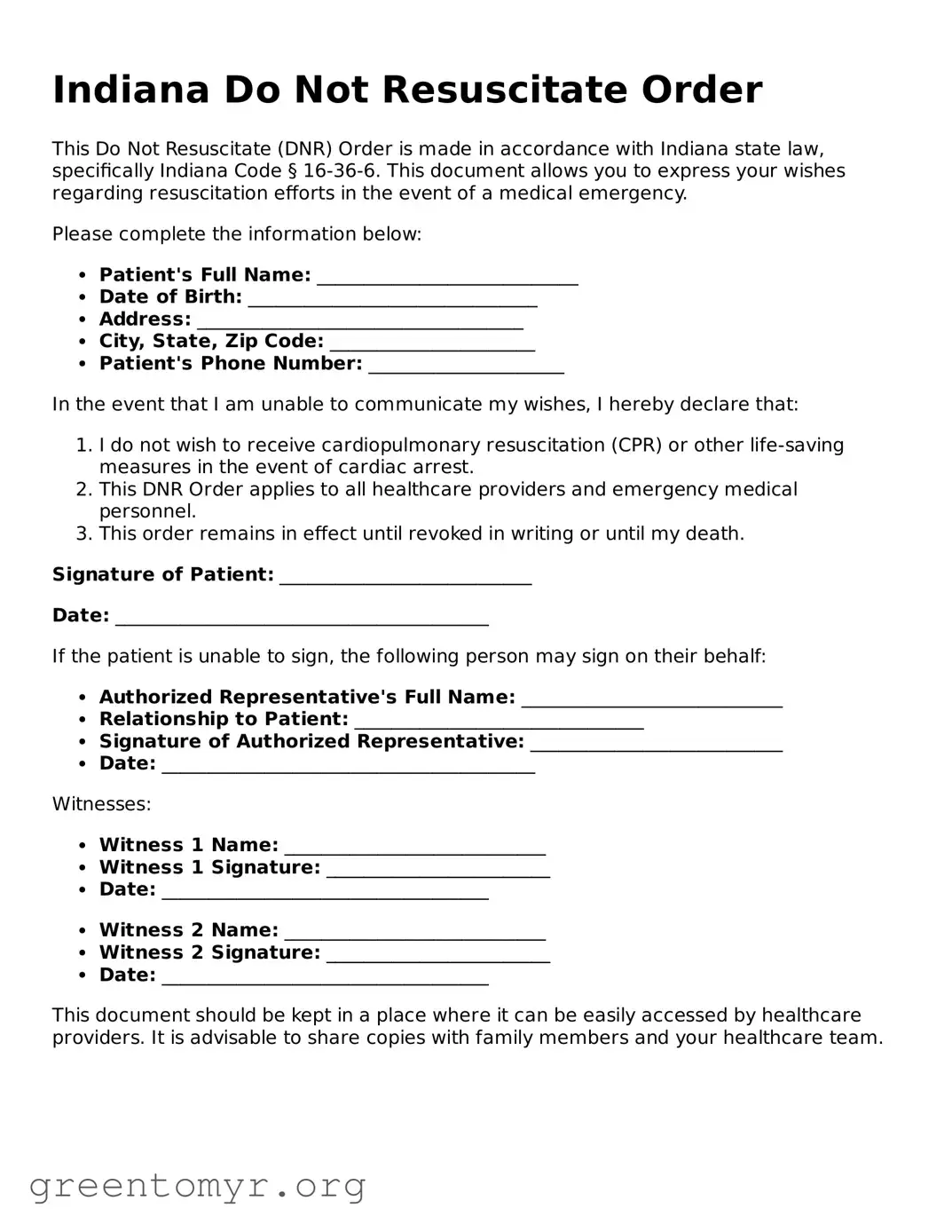
In Indiana, the Do Not Resuscitate (DNR) Order form serves as a critical document for individuals who wish to express their preferences regarding medical treatment in the event of a life-threatening situation. This form allows a person to indicate that they do not want resuscitation efforts, such as CPR or advanced cardiac life support, to be performed if their heart stops beating or they stop breathing. It is essential for this decision to be respected by healthcare providers, ensuring that a person's wishes are honored during vulnerable moments. The DNR form must be completed and signed by the patient or their legal representative, and it typically requires a physician's signature to validate its authenticity. This document is not just a piece of paper; it reflects deeply personal choices about end-of-life care and can alleviate the burden on family members during difficult times. Understanding the implications of a DNR order, including its legal standing and the circumstances under which it applies, is vital for anyone considering this option. By having open discussions with loved ones and healthcare professionals, individuals can make informed decisions that align with their values and beliefs.
Indiana Do Not Resuscitate Order
This Do Not Resuscitate (DNR) Order is made in accordance with Indiana state law, specifically Indiana Code § 16-36-6. This document allows you to express your wishes regarding resuscitation efforts in the event of a medical emergency.
Please complete the information below:
In the event that I am unable to communicate my wishes, I hereby declare that:
Signature of Patient: ___________________________
Date: ________________________________________
If the patient is unable to sign, the following person may sign on their behalf:
Witnesses:
This document should be kept in a place where it can be easily accessed by healthcare providers. It is advisable to share copies with family members and your healthcare team.
| Fact Name | Description |
|---|---|
| Definition | The Indiana Do Not Resuscitate (DNR) Order form allows individuals to refuse resuscitation efforts in case of cardiac or respiratory arrest. |
| Governing Law | This form is governed by Indiana Code § 16-36-6, which outlines the legal framework for advance directives and DNR orders. |
| Eligibility | Any adult, or a minor with parental consent, can complete a DNR order to express their wishes regarding resuscitation. |
| Signature Requirement | The DNR order must be signed by the individual or their legally authorized representative, along with a physician's signature. |
| Revocation | A DNR order can be revoked at any time by the individual, either verbally or in writing, ensuring that their wishes can be updated as needed. |
Filling out the Indiana Do Not Resuscitate Order form is a straightforward process. Once completed, this form allows you to communicate your preferences regarding resuscitation efforts in a medical emergency. Follow the steps below to ensure you fill it out correctly.
After completing these steps, store the form in a safe place where it can be easily accessed. It's important to discuss your choices with your healthcare team to ensure they are aware of your wishes.
A Do Not Resuscitate Order (DNR) is a legal document that instructs medical personnel not to perform cardiopulmonary resuscitation (CPR) if a person's heart stops beating or if they stop breathing. In Indiana, this order is specifically designed for individuals who wish to avoid aggressive medical interventions in the event of a medical emergency. It reflects the patient’s wishes regarding end-of-life care.
In Indiana, a DNR order can be requested by an adult patient who is capable of making informed decisions about their healthcare. Additionally, if the patient is unable to make decisions, a legally authorized representative, such as a family member or a designated healthcare proxy, may request the order on their behalf. It is essential that the individual requesting the DNR understands the implications of the order.
To obtain a DNR Order form in Indiana, you can follow these steps:
The DNR Order form in Indiana typically requires the following information:
Yes, a properly executed DNR Order is legally binding in Indiana. Once the form is signed by the patient or their authorized representative and the physician, it must be honored by all healthcare providers. However, it is crucial to ensure that the form is easily accessible and readily available to emergency medical personnel, as they must be aware of the patient's wishes in an emergency situation.
Absolutely. A DNR Order can be revoked or changed at any time by the patient or their authorized representative. To revoke the order, the individual simply needs to inform their healthcare provider and may also want to complete a new form if they wish to change their preferences. It’s important to communicate any changes clearly to ensure that all medical personnel are aware of the updated wishes.
Filling out the Indiana Do Not Resuscitate Order (DNR) form is a critical step for individuals who wish to communicate their medical preferences. However, many make mistakes that can lead to confusion or even unwanted medical interventions. Understanding these common errors is essential for ensuring that your wishes are respected.
One significant mistake is failing to include the required signatures. The form must be signed by the patient, or their legal representative, and a physician. Omitting any of these signatures can render the document invalid. This oversight can lead to emergency personnel performing resuscitation against the patient’s wishes.
Another common error is not clearly identifying the patient. It’s vital to provide accurate personal information, including the full name and date of birth. If this information is incomplete or incorrect, it may cause issues in confirming the patient's identity during a medical emergency.
People often neglect to discuss their wishes with family members or healthcare providers before filling out the form. This lack of communication can create confusion among loved ones during a crisis. It is crucial to ensure that everyone involved understands the patient's preferences to avoid conflicts or misunderstandings.
Additionally, some individuals fail to review the form thoroughly before submission. Mistakes in the details, such as incorrect dates or missing information, can compromise the document’s effectiveness. Taking the time to double-check the form can prevent potential issues down the line.
Another mistake is not keeping the DNR form accessible. Once completed, it should be placed in a location where it can be easily found by medical personnel, such as on the refrigerator or in a medical alert system. If the form is not readily available, emergency responders may not be aware of the patient’s wishes.
Lastly, people sometimes overlook the importance of updating the DNR form. Life circumstances change, and so do preferences. It is essential to review and, if necessary, revise the form periodically to ensure that it accurately reflects the individual’s current wishes.
When considering end-of-life care and medical decisions, the Indiana Do Not Resuscitate (DNR) Order form is an essential document. However, several other forms and documents complement the DNR to ensure that an individual’s healthcare preferences are respected. Here is a list of common forms often used alongside the Indiana DNR Order.
Each of these documents plays a significant role in ensuring that a person's healthcare preferences are understood and respected. By having these forms in place, individuals can navigate complex medical situations with greater confidence and clarity.
When filling out the Indiana Do Not Resuscitate Order (DNR) form, it is crucial to approach the process with care and consideration. Here are some important dos and don'ts to keep in mind.
By following these guidelines, individuals can ensure that their wishes regarding resuscitation are respected and understood by their healthcare providers and family members.
Understanding the Indiana Do Not Resuscitate (DNR) Order form is crucial for making informed healthcare decisions. However, several misconceptions can cloud people's understanding of this important document. Here are five common misconceptions:
This is false. A DNR specifically pertains to resuscitation efforts in the event of cardiac arrest. Patients with a DNR can still receive other forms of medical treatment, including pain management and comfort care.
This misconception overlooks the fact that a DNR can be appropriate for anyone who wishes to decline resuscitation, regardless of their current health status. It’s a personal choice based on individual values and preferences.
In Indiana, a DNR order is valid in various settings, including at home, nursing homes, and other healthcare facilities. It’s important to ensure that the order is properly documented and communicated to all healthcare providers.
This is not true. Individuals can revoke or modify their DNR orders at any time, as long as they are competent to do so. It’s essential to communicate any changes to healthcare providers to ensure that your wishes are respected.
This misconception can lead to confusion. Each state has its own regulations and forms regarding DNR orders. In Indiana, it’s important to use the specific DNR form that complies with state laws to ensure its validity.
By dispelling these misconceptions, individuals can better navigate their healthcare choices and ensure their preferences are honored.
When considering the Indiana Do Not Resuscitate (DNR) Order form, it’s essential to understand its purpose and proper usage. Here are some key takeaways:
Always consult with a healthcare professional when making decisions regarding a DNR order to ensure that it aligns with personal values and medical needs.