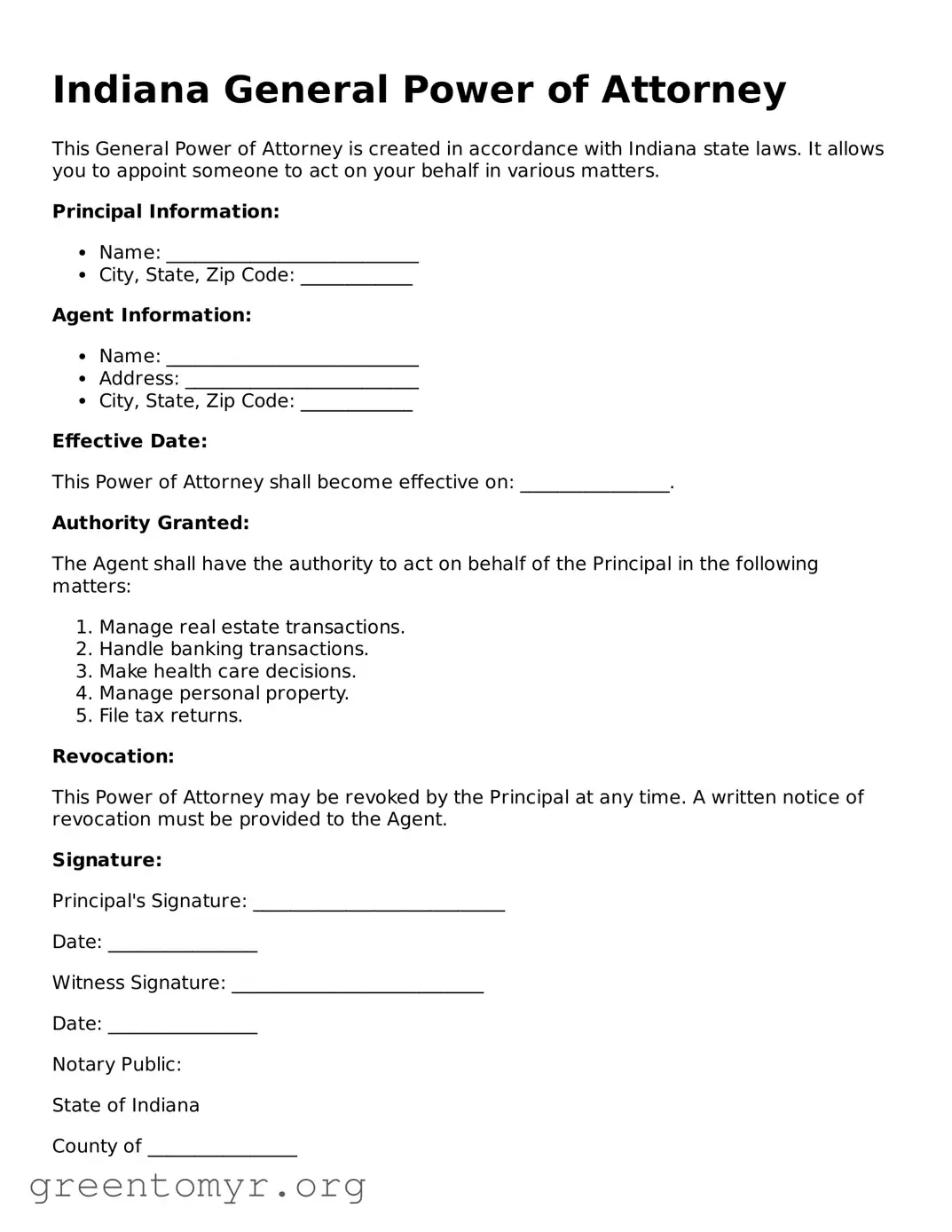
The Indiana General Power of Attorney form serves as a crucial legal document that empowers individuals to designate a trusted person, often referred to as an agent or attorney-in-fact, to manage their financial and legal affairs. This form is particularly significant for those who wish to ensure their interests are represented in various situations, such as medical emergencies or extended absences from their usual residence. Key aspects of the form include the ability to grant broad authority, allowing the agent to handle tasks ranging from banking transactions and real estate management to tax matters and business operations. Furthermore, the form can be tailored to fit the specific needs of the principal, providing options for limited or durable powers. It is important to note that the authority granted can be revoked at any time by the principal, as long as they are competent to do so. Understanding the implications and responsibilities associated with this form is essential for both the principal and the appointed agent, ensuring that the legal framework supports the principal's wishes effectively.
Indiana General Power of Attorney
This General Power of Attorney is created in accordance with Indiana state laws. It allows you to appoint someone to act on your behalf in various matters.
Principal Information:
Agent Information:
Effective Date:
This Power of Attorney shall become effective on: ________________.
Authority Granted:
The Agent shall have the authority to act on behalf of the Principal in the following matters:
Revocation:
This Power of Attorney may be revoked by the Principal at any time. A written notice of revocation must be provided to the Agent.
Signature:
Principal's Signature: ___________________________
Date: ________________
Witness Signature: ___________________________
Date: ________________
Notary Public:
State of Indiana
County of ________________
Subscribed and sworn to before me on this __ day of ________________, 20__.
Notary Public Signature: ___________________________
My Commission Expires: ________________
| Fact Name | Description |
|---|---|
| Definition | The Indiana General Power of Attorney form allows an individual to designate another person to act on their behalf in various matters. |
| Governing Law | The form is governed by Indiana Code Title 30, Article 5, which outlines the rules for powers of attorney in the state. |
| Durability | The General Power of Attorney can be made durable, meaning it remains effective even if the principal becomes incapacitated. |
| Principal and Agent | The individual granting authority is called the principal, while the person receiving authority is referred to as the agent or attorney-in-fact. |
| Scope of Authority | The form allows the agent to manage financial matters, including banking, real estate, and business transactions. |
| Revocation | The principal can revoke the General Power of Attorney at any time, provided they are mentally competent. |
| Signature Requirement | The form must be signed by the principal and, in some cases, by a notary public to be legally binding. |
| Use Cases | Common uses include managing finances during travel, handling business affairs, or making healthcare decisions if specified. |
Filling out the Indiana General Power of Attorney form is a straightforward process that requires careful attention to detail. Once completed, the form will enable you to designate someone to act on your behalf in various financial and legal matters.
A General Power of Attorney (GPOA) is a legal document that allows one person, known as the "principal," to grant another person, referred to as the "agent," the authority to act on their behalf. This authority can cover a wide range of financial and legal matters, including managing bank accounts, signing checks, selling property, and making healthcare decisions. In Indiana, this document must be signed by the principal and can be effective immediately or upon a specific event, such as the principal's incapacitation.
Creating a General Power of Attorney in Indiana involves several steps:
Yes, you can revoke a General Power of Attorney in Indiana at any time, as long as you are mentally competent. To do so, you should follow these steps:
It is advisable to keep a copy of the revocation document for your records.
If you become incapacitated and have a General Power of Attorney in place, your agent will be able to step in and manage your affairs as specified in the document. This can include making financial decisions, handling legal matters, and even making healthcare decisions if those powers are included in the GPOA. It is crucial that your agent is someone you trust, as they will have significant authority over your affairs during your incapacitation. If the GPOA is durable, it remains effective even if you lose the ability to make decisions for yourself.
Filling out the Indiana General Power of Attorney form can be a straightforward process, but there are common mistakes that people often make. One significant error is not specifying the powers granted. It’s crucial to clearly outline what authority you are giving to your agent. Without this clarity, your agent may not be able to act in your best interest.
Another mistake involves failing to date the document. A date is essential as it indicates when the powers take effect. Without a date, there could be confusion about the validity of the document, which may lead to complications down the line.
Many individuals forget to sign the form in the presence of a notary. In Indiana, notarization is a requirement for the General Power of Attorney to be legally binding. Skipping this step can render the document ineffective, leaving your agent without the authority to act on your behalf.
In addition, some people neglect to discuss their intentions with the person they are appointing as their agent. It’s important to have an open conversation about the responsibilities and expectations involved. This ensures that both parties understand the role and can work together effectively.
Another common oversight is not considering alternate agents. Life can be unpredictable, and your first choice may not always be available to act when needed. Designating an alternate agent can provide peace of mind and ensure that your affairs are managed without interruption.
Lastly, individuals sometimes overlook the need to review and update the document regularly. Changes in personal circumstances, such as marriage, divorce, or relocation, may require updates to the Power of Attorney. Regular reviews help ensure that the document remains relevant and effective.
When creating a General Power of Attorney in Indiana, several other forms and documents may be useful to ensure comprehensive management of your affairs. Each document serves a specific purpose and can complement the power of attorney effectively.
These documents can help streamline the management of personal and financial affairs. It is essential to consider which forms best suit individual needs and circumstances when preparing for future planning.
A General Power of Attorney (GPOA) is a powerful legal document that grants someone the authority to act on your behalf in various matters. It shares similarities with several other legal documents. Here are nine documents that are comparable to a General Power of Attorney:
Understanding these documents can help you make informed decisions about how to manage your affairs and plan for the future. Each document serves a unique purpose and can be tailored to meet your specific needs.
When filling out the Indiana General Power of Attorney form, it is important to follow specific guidelines to ensure the document is valid and effective. Here is a list of things to do and avoid:
When dealing with the Indiana General Power of Attorney form, several misconceptions can lead to confusion. Understanding these myths can help individuals make informed decisions about their legal rights and responsibilities.
This is not true. A General Power of Attorney becomes invalid if the principal becomes incapacitated, while a Durable Power of Attorney remains effective even if the principal loses the ability to make decisions.
This is misleading. The agent must act in the best interest of the principal and follow the specific instructions outlined in the document. They cannot use the principal's assets for personal gain.
While notarization is recommended for authenticity, Indiana law allows for a General Power of Attorney to be valid even without a notary, as long as it is signed by the principal and two witnesses.
This is accurate. The authority granted to the agent ceases immediately upon the principal's death. The agent cannot make decisions or act on behalf of the deceased.
This is incorrect. A General Power of Attorney does not grant authority for medical decisions. For that purpose, a separate document called a Health Care Power of Attorney is required.
This is false. The principal can revoke the General Power of Attorney at any time as long as they are mentally competent. This can be done through a written notice to the agent and any relevant institutions.
Filling out and using the Indiana General Power of Attorney form is an important step in managing your financial and legal affairs. Here are some key takeaways to keep in mind:
By following these takeaways, you can confidently fill out and utilize the Indiana General Power of Attorney form to protect your interests.