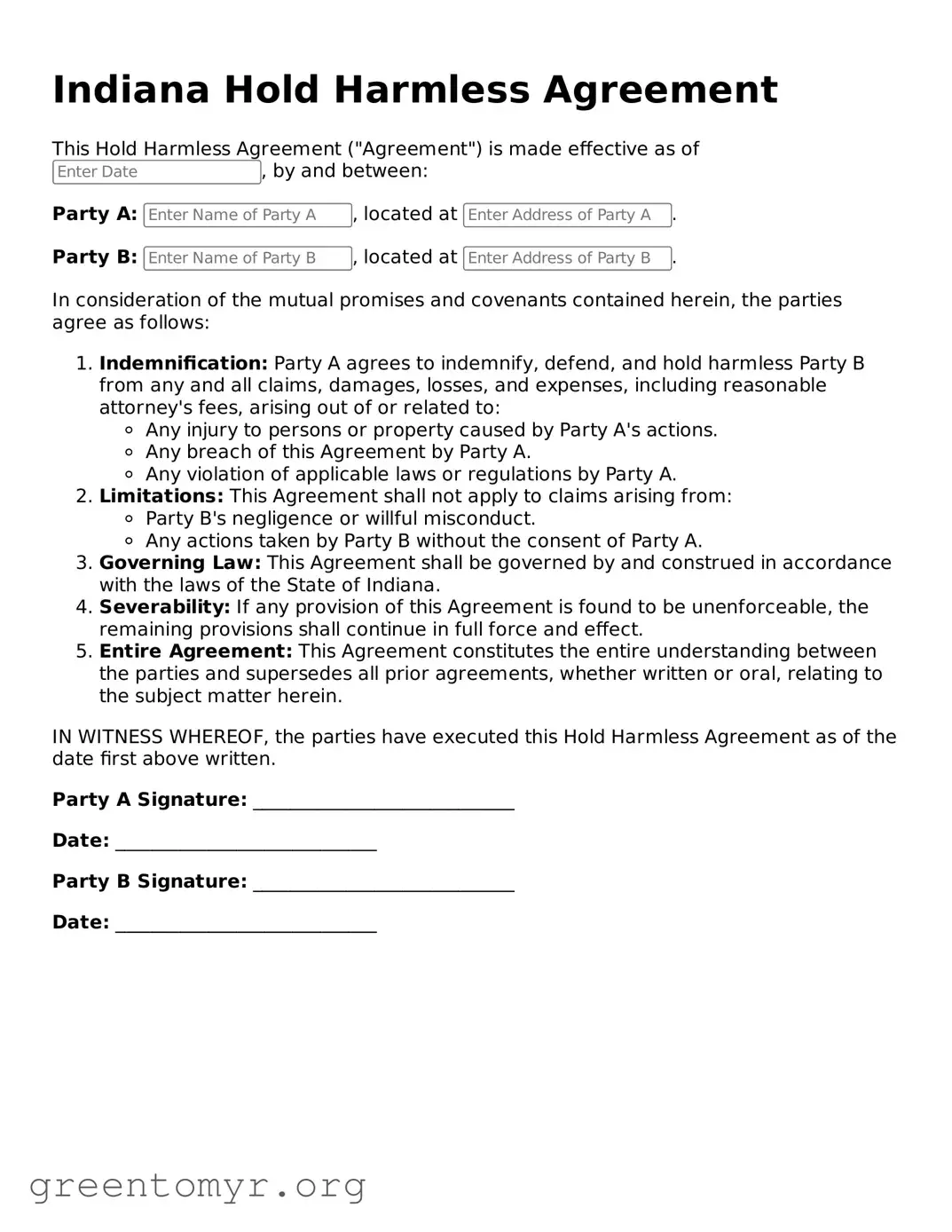
The Indiana Hold Harmless Agreement form is an essential legal document designed to protect parties from liability in various situations, such as events, activities, or agreements. This form outlines the responsibilities of each party involved, ensuring that one party agrees to indemnify and hold harmless the other from any claims, damages, or losses that may arise. By clearly stating the terms of liability, the agreement helps to mitigate risks associated with injuries or damages that could occur during the specified activity or event. It is vital for individuals and organizations to understand the implications of this form, as it not only safeguards their interests but also establishes a mutual understanding of liability. Whether you are organizing an event, renting a facility, or entering into a contractual agreement, utilizing the Indiana Hold Harmless Agreement can provide peace of mind and clarify expectations between all parties involved.
Indiana Hold Harmless Agreement
This Hold Harmless Agreement ("Agreement") is made effective as of , by and between:
Party A: , located at .
Party B: , located at .
In consideration of the mutual promises and covenants contained herein, the parties agree as follows:
IN WITNESS WHEREOF, the parties have executed this Hold Harmless Agreement as of the date first above written.
Party A Signature: ____________________________
Date: ____________________________
Party B Signature: ____________________________
Date: ____________________________
| Fact Name | Description |
|---|---|
| Purpose | The Indiana Hold Harmless Agreement form is designed to protect one party from legal liability for any injuries or damages that may occur during a specific activity or event. |
| Governing Law | This agreement is governed by Indiana state law, specifically under the principles of contract law and tort law. |
| Parties Involved | Typically, the agreement involves at least two parties: the indemnitor (the party assuming the risk) and the indemnitee (the party being protected). |
| Enforceability | For the agreement to be enforceable, it must be clear, specific, and signed by all parties involved, ensuring mutual understanding of the terms. |
Filling out the Indiana Hold Harmless Agreement form is a straightforward process. Once you have completed the form, it will be ready for submission or further processing as required by your specific situation.
An Indiana Hold Harmless Agreement is a legal document that protects one party from liability for any damages or injuries that may occur during a specific activity or event. This agreement is often used in situations where one party is taking on a risk on behalf of another, such as in rental agreements, construction projects, or events. The purpose is to ensure that if an incident occurs, the party being held harmless will not be financially responsible for any resulting claims or damages.
Various individuals and organizations use Hold Harmless Agreements in Indiana. Common users include:
This agreement serves to clarify responsibilities and protect against potential legal claims.
A Hold Harmless Agreement generally includes several essential elements:
Yes, a Hold Harmless Agreement can be legally enforceable in Indiana, provided it meets specific criteria. The agreement must be clear, unambiguous, and voluntarily entered into by both parties. Courts generally uphold these agreements unless they are found to be unconscionable or against public policy. It is advisable to consult with a legal professional to ensure that the agreement complies with all applicable laws and is appropriately drafted.
Typically, Hold Harmless Agreements do not protect against gross negligence or willful misconduct. Courts may refuse to enforce such agreements if they attempt to waive liability for these serious forms of negligence. The intent behind this limitation is to ensure that parties cannot completely escape responsibility for reckless or intentional actions that cause harm.
To create a Hold Harmless Agreement in Indiana, follow these steps:
Consulting with a legal professional can help ensure that the agreement is valid and comprehensive.
Filling out the Indiana Hold Harmless Agreement form can be a straightforward process, but many individuals make common mistakes that can lead to complications. Understanding these pitfalls can help ensure that the form is completed correctly and serves its intended purpose.
One frequent mistake is failing to provide accurate personal information. It is crucial to include the correct names, addresses, and contact details of all parties involved. Incorrect information can lead to disputes later on, making it difficult to enforce the agreement.
Another common error is not clearly identifying the scope of the agreement. The form should explicitly outline what activities or situations the hold harmless clause covers. If this information is vague or missing, it may not protect the parties as intended.
Some individuals neglect to read the entire agreement before signing. This oversight can result in misunderstandings about the terms and conditions. Taking the time to review the document ensures that all parties are aware of their rights and responsibilities.
Additionally, people often forget to date the agreement. A missing date can create confusion regarding when the agreement takes effect. This is especially important if there are deadlines or time-sensitive obligations involved.
Another mistake is not having the agreement witnessed or notarized when required. Depending on the situation, a signature from a witness or a notary public may be necessary to validate the agreement. Failing to include this step can weaken the document's enforceability.
Some individuals may also overlook the need for legal counsel. While not always required, having a lawyer review the agreement can help identify potential issues and ensure that it complies with Indiana laws.
Another common error is using outdated or incorrect versions of the form. Laws and regulations can change, so it is essential to use the most current version of the Hold Harmless Agreement to avoid legal complications.
Moreover, people sometimes fail to discuss the agreement with all parties involved. Open communication is key to ensuring that everyone understands and agrees to the terms. Without this dialogue, misunderstandings can arise, leading to disputes.
Finally, individuals may not keep a copy of the signed agreement for their records. Retaining a copy is important for reference in case any issues arise in the future. Without documentation, proving the terms of the agreement can become challenging.
A Hold Harmless Agreement is a crucial document that protects one party from liability for certain actions or events. When utilizing this agreement in Indiana, several other forms and documents may also be relevant. Below is a list of commonly associated documents that can complement the Hold Harmless Agreement.
Understanding these documents can help ensure that all parties are adequately protected and aware of their responsibilities. Each document plays a vital role in minimizing risk and fostering a clear understanding of liability in various situations.
The Hold Harmless Agreement is a vital document in various legal and business contexts. It shares similarities with several other documents that also aim to protect parties from liability. Below is a list of seven documents that are similar to the Hold Harmless Agreement, along with a brief explanation of how they relate.
Understanding these documents can help individuals and businesses navigate liability and risk management more effectively.
When filling out the Indiana Hold Harmless Agreement form, it's important to follow certain guidelines to ensure accuracy and compliance. Here’s a list of things you should and shouldn't do:
Understanding the Indiana Hold Harmless Agreement is crucial for anyone entering into contracts or agreements in the state. However, several misconceptions can lead to confusion. Below is a list of common misconceptions about this form.
Being aware of these misconceptions can help individuals and businesses make informed decisions when utilizing Hold Harmless Agreements in Indiana.
When dealing with the Indiana Hold Harmless Agreement form, it’s important to understand its purpose and implications. Here are some key takeaways to keep in mind: