Homeschooling in Indiana offers families the opportunity to tailor education to their children's unique needs and learning styles. One of the first steps in this process is the completion of the Indiana Homeschool Letter of Intent form. This essential document notifies the local school district of your intention to homeschool your child. It requires basic information, such as the names and ages of the children being homeschooled, as well as the address of your residence. Additionally, the form serves to establish your commitment to providing an educational environment that meets state requirements. By submitting this letter, you not only comply with Indiana's educational regulations but also lay the groundwork for a fulfilling homeschooling journey. Understanding the nuances of this form can help ensure a smooth transition into homeschooling, allowing you to focus on what truly matters: your child's education.
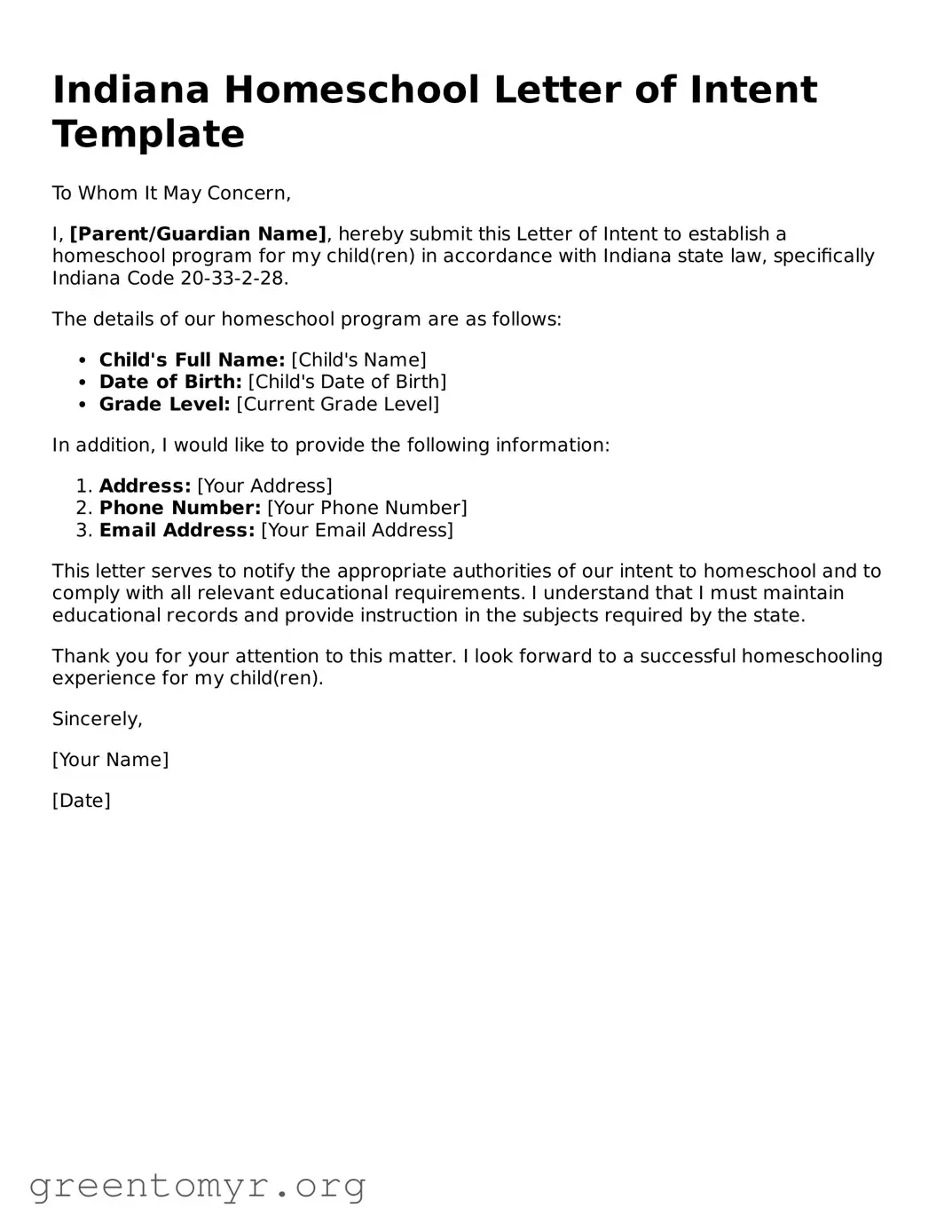
Indiana Homeschool Letter of Intent Template
To Whom It May Concern,
I, [Parent/Guardian Name], hereby submit this Letter of Intent to establish a homeschool program for my child(ren) in accordance with Indiana state law, specifically Indiana Code 20-33-2-28.
The details of our homeschool program are as follows:
In addition, I would like to provide the following information:
This letter serves to notify the appropriate authorities of our intent to homeschool and to comply with all relevant educational requirements. I understand that I must maintain educational records and provide instruction in the subjects required by the state.
Thank you for your attention to this matter. I look forward to a successful homeschooling experience for my child(ren).
Sincerely,
[Your Name]
[Date]
| Fact Name | Description |
|---|---|
| Governing Law | The Indiana Homeschool Letter of Intent is governed by Indiana Code § 20-33-2-28. |
| Submission Requirement | Parents must submit the Letter of Intent to the local school corporation within 10 days of beginning homeschooling. |
| Content of the Letter | The letter must include the names and ages of the children being homeschooled. |
| Annual Notification | Parents are not required to submit the Letter of Intent annually; it is only needed when starting homeschooling. |
| Record Keeping | While the form is not required annually, parents must maintain educational records for their homeschooled children. |
| Local School Corporation | Parents should send the Letter of Intent to the school corporation where they reside, which can vary by county. |
Once you have your Indiana Homeschool Letter of Intent form ready, you will need to complete it to officially notify the state of your intention to homeschool your child. This process is straightforward and requires specific information about your child and your educational plans. Follow the steps below to fill out the form correctly.
The Indiana Homeschool Letter of Intent form is a document that parents or guardians must submit to formally notify the state of Indiana that they are choosing to homeschool their children. This letter serves as an official declaration of your intent to provide an educational program at home, ensuring compliance with state regulations regarding homeschooling.
Any parent or guardian who wishes to homeschool a child in Indiana must submit the Letter of Intent. This includes families with children of compulsory school age, which is generally between ages 7 and 18. If you have multiple children who will be homeschooled, you will need to list each child in the letter.
The Letter of Intent should be submitted at the beginning of the school year or as soon as you decide to homeschool your child. It is advisable to send the letter at least 14 days before you start your homeschooling program to ensure that you meet any state requirements and avoid any potential issues.
The Letter of Intent typically requires the following information:
Make sure all details are accurate and complete to avoid delays or complications.
You can submit the Letter of Intent by mailing it to your local school corporation. It’s a good idea to send it via certified mail to have proof of submission. Some parents also choose to hand-deliver the letter, ensuring they receive confirmation from the school office.
Once you submit your Letter of Intent, the local school corporation will acknowledge receipt. There is no formal approval process, but they may contact you for clarification or additional information. After submission, you can begin your homeschooling program. It’s important to keep records of your educational activities and progress, as you may need to provide documentation in the future.
When parents decide to homeschool their children in Indiana, they must fill out the Homeschool Letter of Intent form. However, many make mistakes that can lead to unnecessary complications. Here are seven common errors to avoid.
First, many people forget to include their contact information. This may seem minor, but without a way to reach you, the local school district may have difficulty processing your intent. Always ensure your phone number and email address are clearly listed.
Second, some parents do not provide the names and ages of their children. This information is crucial for the school district to understand who will be homeschooled. Omitting it can lead to delays or questions that could have been easily avoided.
Another common mistake is not signing the form. It’s surprising how often this happens. A signature indicates that you are serious about your intent to homeschool. Without it, the form is incomplete.
Additionally, people sometimes fail to submit the form within the required timeframe. Indiana law states that you must submit your Letter of Intent within a certain period. Missing this deadline can create legal issues, so always check the dates.
Some parents also mistakenly believe that they need to provide a detailed curriculum plan with the form. While having a plan is important for your homeschooling journey, it is not required at the time of submission. Focus on the essentials first.
Another error involves not keeping a copy of the submitted form. It’s wise to have your own records. If questions arise later, having a copy can help clarify any misunderstandings.
Finally, some individuals forget to update their Letter of Intent if there are changes. If you move or if your child’s educational needs change, it’s important to notify the school district. Keeping your information current helps maintain a smooth homeschooling experience.
When you decide to homeschool in Indiana, several documents may accompany your Homeschool Letter of Intent. These documents help ensure that your homeschooling experience is well-organized and compliant with state regulations. Below is a list of commonly used forms and documents.
These documents play a vital role in supporting your homeschooling efforts. Each one serves a unique purpose, contributing to a well-rounded educational experience for your child. Being organized and prepared will help you navigate the homeschooling process with confidence.
When filling out the Indiana Homeschool Letter of Intent form, there are some important things to keep in mind. Here’s a simple list of what you should and shouldn’t do:
Following these guidelines will help ensure your form is completed correctly. Taking the time to double-check your information can save you from potential issues down the road.
Many people have misunderstandings about the Indiana Homeschool Letter of Intent form. Here are seven common misconceptions:
This is false. Homeschooling is legal in Indiana. Parents have the right to educate their children at home, provided they follow the state's guidelines.
Actually, submitting a Letter of Intent is a requirement in Indiana. Parents must file this form to officially notify the state of their decision to homeschool.
This is not true. Parents can update their Letter of Intent if there are changes in their homeschooling plans or if they move to a different address.
In reality, parents can file the Letter of Intent at any time. There is no specific deadline, but it is best to submit it before starting the homeschooling year.
This is a misconception. Indiana does not require parents to submit lesson plans or curriculum details with the Letter of Intent.
In fact, some public schools offer resources and support to homeschoolers. This may include access to extracurricular activities and special education services.
This is misleading. While the Letter of Intent is necessary, parents must also comply with other homeschooling regulations, such as keeping educational records.
Understanding these misconceptions can help parents navigate the homeschooling process in Indiana more effectively.
When considering homeschooling in Indiana, it’s important to understand the process of filling out and submitting the Homeschool Letter of Intent form. Here are some key takeaways to keep in mind:
By keeping these takeaways in mind, you can navigate the process of submitting the Indiana Homeschool Letter of Intent with confidence and clarity.