Creating a Last Will and Testament is an essential step in ensuring that your wishes are honored after your passing. In Indiana, this legal document outlines how your assets will be distributed and who will manage your estate. It allows you to designate beneficiaries, appoint an executor, and even specify guardianship for minor children. The form requires clear identification of the testator—the person making the will—and must be signed in the presence of at least two witnesses to be valid. Additionally, it’s important to note that Indiana recognizes both handwritten and typed wills, provided they meet specific criteria. Understanding these aspects can help individuals navigate the process of estate planning with confidence and clarity.
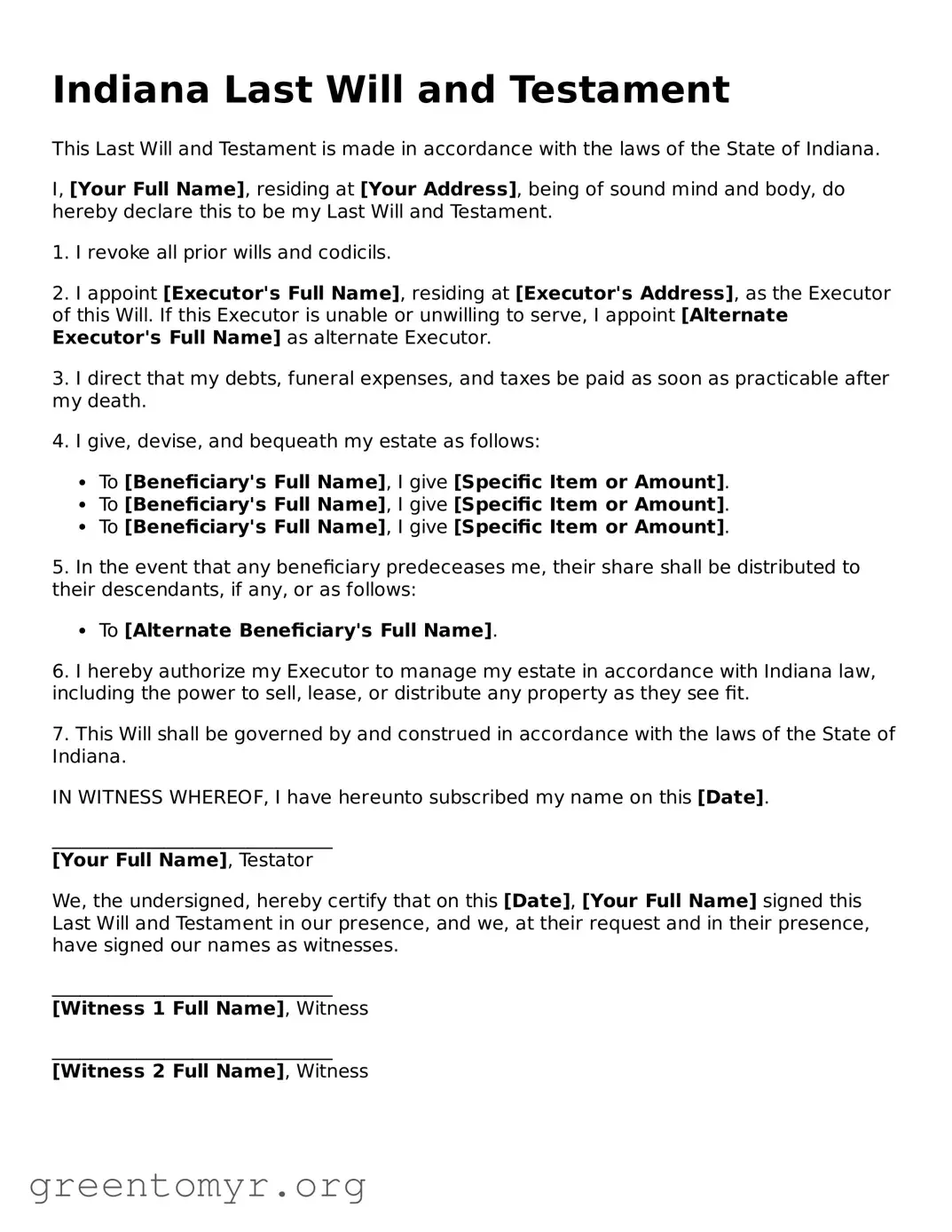
Indiana Last Will and Testament
This Last Will and Testament is made in accordance with the laws of the State of Indiana.
I, [Your Full Name], residing at [Your Address], being of sound mind and body, do hereby declare this to be my Last Will and Testament.
1. I revoke all prior wills and codicils.
2. I appoint [Executor's Full Name], residing at [Executor's Address], as the Executor of this Will. If this Executor is unable or unwilling to serve, I appoint [Alternate Executor's Full Name] as alternate Executor.
3. I direct that my debts, funeral expenses, and taxes be paid as soon as practicable after my death.
4. I give, devise, and bequeath my estate as follows:
5. In the event that any beneficiary predeceases me, their share shall be distributed to their descendants, if any, or as follows:
6. I hereby authorize my Executor to manage my estate in accordance with Indiana law, including the power to sell, lease, or distribute any property as they see fit.
7. This Will shall be governed by and construed in accordance with the laws of the State of Indiana.
IN WITNESS WHEREOF, I have hereunto subscribed my name on this [Date].
______________________________
[Your Full Name], Testator
We, the undersigned, hereby certify that on this [Date], [Your Full Name] signed this Last Will and Testament in our presence, and we, at their request and in their presence, have signed our names as witnesses.
______________________________
[Witness 1 Full Name], Witness
______________________________
[Witness 2 Full Name], Witness
| Fact Name | Details |
|---|---|
| Governing Law | The Indiana Last Will and Testament is governed by Indiana Code Title 29, Article 1. |
| Age Requirement | To create a valid will in Indiana, the testator must be at least 18 years old. |
| Witness Requirement | Indiana requires that a will be signed in the presence of at least two witnesses who are not beneficiaries. |
| Revocation | A will can be revoked by the testator at any time through a subsequent will or by destroying the original document. |
| Self-Proving Wills | Indiana allows for self-proving wills, which can simplify the probate process by including notarized witness statements. |
| Holographic Wills | Holographic wills, which are handwritten and signed by the testator, are recognized in Indiana but must meet specific criteria. |
Filling out the Indiana Last Will and Testament form is an important step in planning for the distribution of your assets after your passing. Once you complete the form, it is advisable to have it signed and witnessed according to Indiana law to ensure its validity.
A Last Will and Testament is a legal document that outlines how a person's assets and affairs should be handled after their death. In Indiana, this document allows individuals to specify their wishes regarding the distribution of property, the care of minor children, and the appointment of an executor to manage the estate. Having a will ensures that your intentions are honored and can help prevent disputes among heirs.
In Indiana, any person who is at least 18 years old and of sound mind can create a Last Will and Testament. This means that the individual must understand the nature of the document and the consequences of their decisions. Additionally, individuals must be free from undue influence or coercion when drafting their will.
For a will to be considered valid in Indiana, it must meet several requirements:
It is also advisable to have the will notarized, although it is not a legal requirement in Indiana. Notarization can help streamline the probate process.
Yes, individuals can change their Last Will and Testament at any time while they are alive and of sound mind. This can be done by creating a new will or by adding a codicil, which is an amendment to the existing will. It is important to ensure that any changes comply with Indiana's legal requirements to avoid confusion or disputes later on.
If a person dies without a will in Indiana, their estate will be distributed according to the state's intestacy laws. This means that the distribution of assets will follow a predetermined order based on familial relationships. Typically, this can lead to outcomes that may not align with the deceased's wishes, and it may result in complications or disputes among surviving family members.
To ensure that your Last Will and Testament is executed properly, consider the following steps:
Consulting with an attorney can also provide guidance to ensure that your will meets all legal requirements and reflects your wishes accurately.
Filling out an Indiana Last Will and Testament form can be a straightforward process, but there are common mistakes that people often make. One frequent error is failing to clearly identify the testator. The testator is the person creating the will. It is essential to provide full legal names and any relevant identifying information to avoid confusion later. If the testator is not properly identified, it could lead to challenges in validating the will.
Another mistake involves not properly witnessing the document. Indiana law requires that a will be signed in the presence of at least two witnesses. These witnesses must also sign the will. Skipping this step or having witnesses who do not meet the legal requirements can invalidate the will. Always ensure that the witnesses are not beneficiaries of the will, as this could also create complications.
People sometimes overlook the importance of being specific about asset distribution. Vague language can lead to misunderstandings among beneficiaries. Clearly stating who gets what can prevent disputes among family members and ensure that the testator's wishes are honored. It’s crucial to detail specific items or percentages rather than using general terms.
Additionally, some individuals forget to update their will after major life events. Changes such as marriage, divorce, or the birth of a child can significantly affect how assets should be distributed. Failing to revise the will to reflect these changes can lead to unintended consequences, such as excluding loved ones or not honoring the testator's current wishes.
Finally, neglecting to store the will in a safe and accessible location is a common oversight. A will should be kept where it can be easily found after the testator's passing. If the will is lost or inaccessible, the testator's wishes may not be carried out as intended. Consider informing trusted family members or friends about the location of the will to ensure it can be located when needed.
In the estate planning process, individuals in Indiana often utilize various forms and documents in conjunction with a Last Will and Testament. These documents serve different purposes, helping to ensure that an individual's wishes are honored and that their estate is managed according to their preferences. Below is a list of common forms and documents that may accompany a Last Will and Testament.
These documents, when used in conjunction with a Last Will and Testament, can provide a comprehensive approach to estate planning. It is advisable for individuals to consider their unique circumstances and consult with legal professionals to ensure that their estate planning documents align with their intentions.
When completing the Indiana Last Will and Testament form, it is important to follow certain guidelines to ensure that your wishes are clearly expressed and legally valid. Here are some dos and don'ts to keep in mind:
By adhering to these guidelines, you can help ensure that your Last Will and Testament accurately reflects your intentions and meets legal requirements.
Understanding the Indiana Last Will and Testament form can be challenging. Here are ten common misconceptions that people often have about this important legal document:
In Indiana, a will does not need to be notarized to be valid. However, having it notarized can simplify the probate process.
While it is advisable to consult with a lawyer, individuals can create their own wills using templates, as long as they meet state requirements.
Oral wills, or nuncupative wills, are not recognized in Indiana. A written document is necessary for a valid will.
Wills can be amended or revoked at any time, as long as the person is of sound mind and follows the proper legal procedures.
It is not mandatory to list every asset in the will. However, it is important to clearly state how major assets should be distributed.
Even if you are married, having a will is essential. It allows you to specify how you want your assets distributed, rather than relying on state laws.
Beneficiaries can be anyone, including friends, charities, or organizations. You have the freedom to choose who receives your assets.
Wills are important for everyone, regardless of wealth. They help ensure that your wishes are honored and can simplify the distribution of your estate.
Life changes, such as marriage, divorce, or the birth of children, may require updates to your will. Regular reviews are essential.
While a living trust can help manage your assets, a will is still important for any assets not included in the trust and to name guardians for minor children.
When preparing to fill out and use the Indiana Last Will and Testament form, several important points should be kept in mind. These takeaways can help ensure that the document meets legal requirements and accurately reflects the individual's wishes.
By following these key points, individuals can create a will that serves their needs and complies with Indiana law.