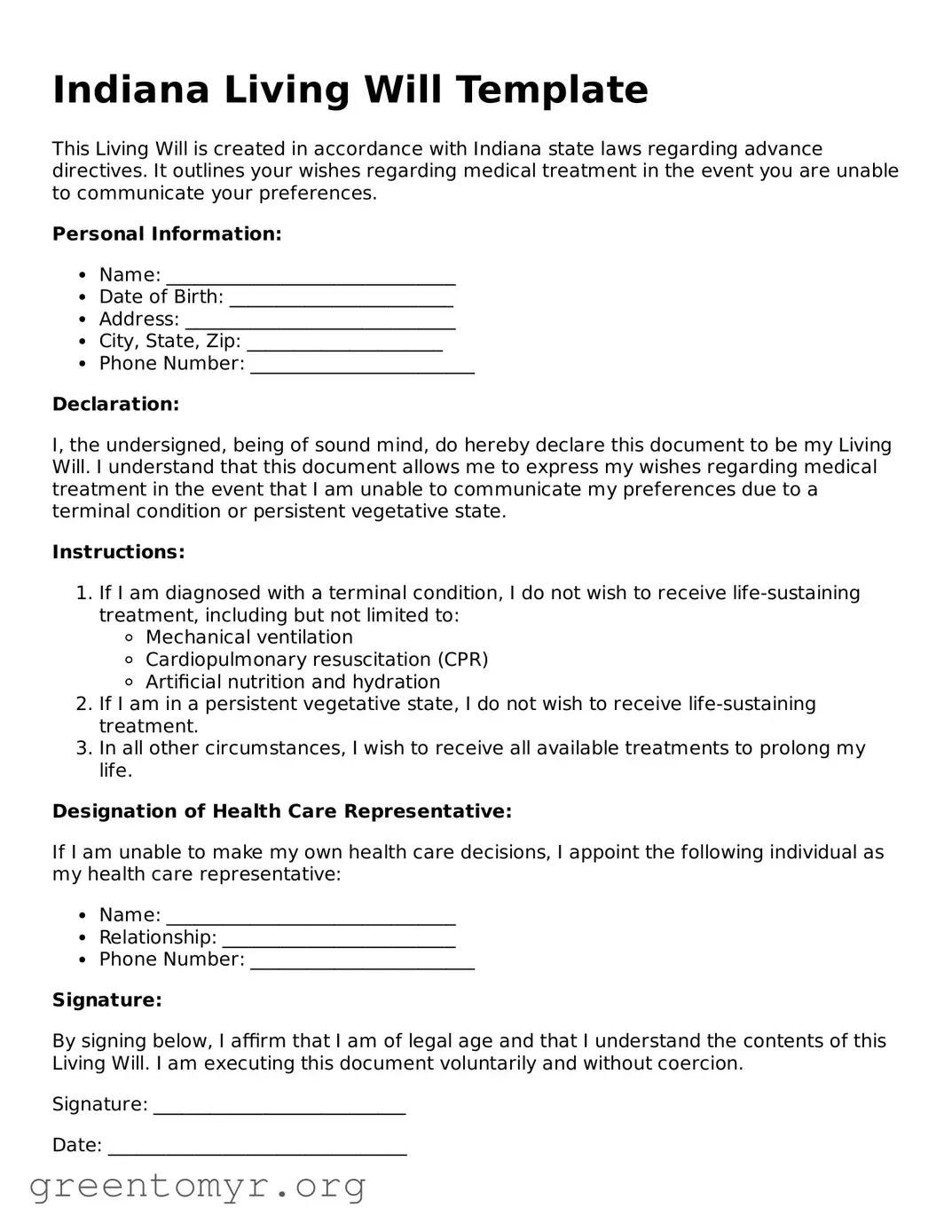
In Indiana, the Living Will form is an essential document that allows individuals to express their wishes regarding medical treatment in the event they become unable to communicate those preferences. This form plays a crucial role in guiding healthcare providers and loved ones in making decisions that align with the individual's values and desires. It typically outlines specific medical interventions that a person may or may not want, such as life-sustaining treatments, resuscitation efforts, and palliative care options. By completing this document, individuals can ensure that their choices are respected, even when they cannot speak for themselves. The Living Will is not just a legal form; it is a powerful tool for personal autonomy, providing peace of mind to both the individual and their family during challenging times. Understanding the key components of the Indiana Living Will form can help individuals navigate the process of advance care planning effectively.
Indiana Living Will Template
This Living Will is created in accordance with Indiana state laws regarding advance directives. It outlines your wishes regarding medical treatment in the event you are unable to communicate your preferences.
Personal Information:
Declaration:
I, the undersigned, being of sound mind, do hereby declare this document to be my Living Will. I understand that this document allows me to express my wishes regarding medical treatment in the event that I am unable to communicate my preferences due to a terminal condition or persistent vegetative state.
Instructions:
Designation of Health Care Representative:
If I am unable to make my own health care decisions, I appoint the following individual as my health care representative:
Signature:
By signing below, I affirm that I am of legal age and that I understand the contents of this Living Will. I am executing this document voluntarily and without coercion.
Signature: ___________________________
Date: ________________________________
Witnesses:
This Living Will must be signed in the presence of two witnesses, neither of whom is my health care representative or related to me by blood, marriage, or adoption.
| Fact Name | Description |
|---|---|
| Purpose | The Indiana Living Will form allows individuals to express their wishes regarding medical treatment in case they become unable to communicate those wishes themselves. |
| Governing Law | This form is governed by Indiana Code § 16-36-4, which outlines the legal framework for advance directives in the state. |
| Eligibility | Any adult who is of sound mind can complete a Living Will in Indiana. This includes individuals aged 18 and older. |
| Witness Requirements | Two witnesses are required to sign the Living Will. These witnesses must be at least 18 years old and cannot be related to the individual or entitled to any part of their estate. |
| Revocation | An individual can revoke their Living Will at any time. This can be done verbally or in writing, and it does not require any formal process. |
| Storage | It is advisable to keep the Living Will in a safe place and to provide copies to family members and healthcare providers to ensure it is accessible when needed. |
| Advance Directive | The Living Will is a type of advance directive. It specifically addresses end-of-life medical decisions and is separate from other directives like a durable power of attorney for healthcare. |
Filling out the Indiana Living Will form is an important step in making your healthcare wishes known. Once you have completed the form, it’s essential to keep it in a safe place and share copies with your healthcare providers and loved ones.
A Living Will is a legal document that allows individuals to express their wishes regarding medical treatment in the event they become unable to communicate their preferences. This document specifically addresses end-of-life care and decisions related to life-sustaining treatment.
Any competent adult, aged 18 or older, can create a Living Will in Indiana. It is important that the individual understands the implications of the document and is making decisions free from coercion.
A Living Will should clearly outline your wishes regarding medical treatment. Key points to consider include:
To create a Living Will in Indiana, follow these steps:
Yes, Indiana law requires that your Living Will be signed in the presence of two witnesses or notarized. Witnesses cannot be related to you, cannot be entitled to any part of your estate, and must be at least 18 years old.
Yes, you can change or revoke your Living Will at any time, as long as you are competent. To revoke, you may simply destroy the document or create a new one that states your current wishes. It is advisable to inform your healthcare providers and family members of any changes.
No, a Living Will and a Power of Attorney are different documents. A Living Will focuses on your medical treatment preferences, while a Power of Attorney allows you to designate someone to make healthcare decisions on your behalf if you are unable to do so. Both documents can work together to ensure your wishes are honored.
Keep your Living Will in a safe but accessible place. Inform your family members, healthcare providers, and anyone who may be involved in your care about its location. Consider giving copies to those individuals to ensure your wishes are known and respected.
If you do not have a Living Will, medical decisions may be made by your family members or legal representatives according to state law. This can lead to uncertainty and disagreements among loved ones about your wishes. Having a Living Will provides clarity and peace of mind for both you and your family.
Filling out the Indiana Living Will form is an important step in expressing your healthcare preferences. However, many people make mistakes that can lead to confusion or complications later. Understanding these common errors can help ensure that your wishes are clearly communicated.
One frequent mistake is leaving the form incomplete. Individuals may forget to fill in crucial sections, such as their name, date, or signature. An incomplete form can render it invalid, which defeats the purpose of having a Living Will in the first place.
Another common error involves using vague language. When stating your wishes regarding medical treatment, it's essential to be specific. Phrases like "do everything possible" can lead to misunderstandings. Clear and direct language helps healthcare providers understand your preferences without ambiguity.
Some people overlook the importance of witnesses. In Indiana, the Living Will must be signed in the presence of two witnesses who are not related to you or beneficiaries of your estate. Failing to have the proper witnesses can make the document invalid.
Additionally, individuals often forget to update their Living Will after major life changes. Events such as marriage, divorce, or the birth of a child may influence your healthcare decisions. Regularly reviewing and updating the document ensures it reflects your current wishes.
Another mistake is not discussing the Living Will with family members or healthcare providers. Open conversations about your wishes can prevent confusion and conflict during difficult times. It is crucial that those close to you understand your preferences.
Some people neglect to consider alternative scenarios. A Living Will should address various medical situations, not just end-of-life care. Thinking through different scenarios can help ensure your wishes are comprehensive and clear.
Using outdated forms is another issue. Laws and regulations can change, so it's important to use the most current version of the Indiana Living Will form. An outdated document may not comply with current legal standards.
Failing to sign and date the form properly is a common oversight. The signature should be clear and dated to confirm when the document was completed. Without a signature, the Living Will lacks validity.
Lastly, some individuals do not keep copies of their Living Will. It's important to retain copies for yourself and provide them to your healthcare provider and family members. This ensures that your wishes are accessible when needed.
A Living Will is an important document that outlines a person's wishes regarding medical treatment in case they become unable to communicate those wishes themselves. In Indiana, individuals often use additional forms and documents alongside the Living Will to ensure their healthcare preferences are clearly understood and respected. Here are five commonly associated documents:
These documents work together to provide a comprehensive approach to healthcare planning. They help ensure that an individual's wishes are honored, even when they cannot voice them directly. Understanding and utilizing these forms can significantly ease the burden on loved ones during difficult times.
A Living Will is a crucial document that outlines your preferences for medical treatment in case you become unable to communicate your wishes. However, it shares similarities with several other important legal documents. Here’s a list of nine documents that are similar to a Living Will:
Each of these documents plays a vital role in ensuring that your healthcare wishes are understood and respected, particularly when you cannot communicate them yourself.
When filling out the Indiana Living Will form, it's important to approach the process with care. Here are six things you should and shouldn't do:
Understanding the Indiana Living Will form is essential for making informed decisions about healthcare preferences. However, several misconceptions can lead to confusion. Here are seven common misconceptions about the Indiana Living Will form:
By clarifying these misconceptions, individuals can better understand the importance of a Living Will and how it can serve as a vital tool for expressing their healthcare wishes.
Here are some essential points to consider when filling out and using the Indiana Living Will form: