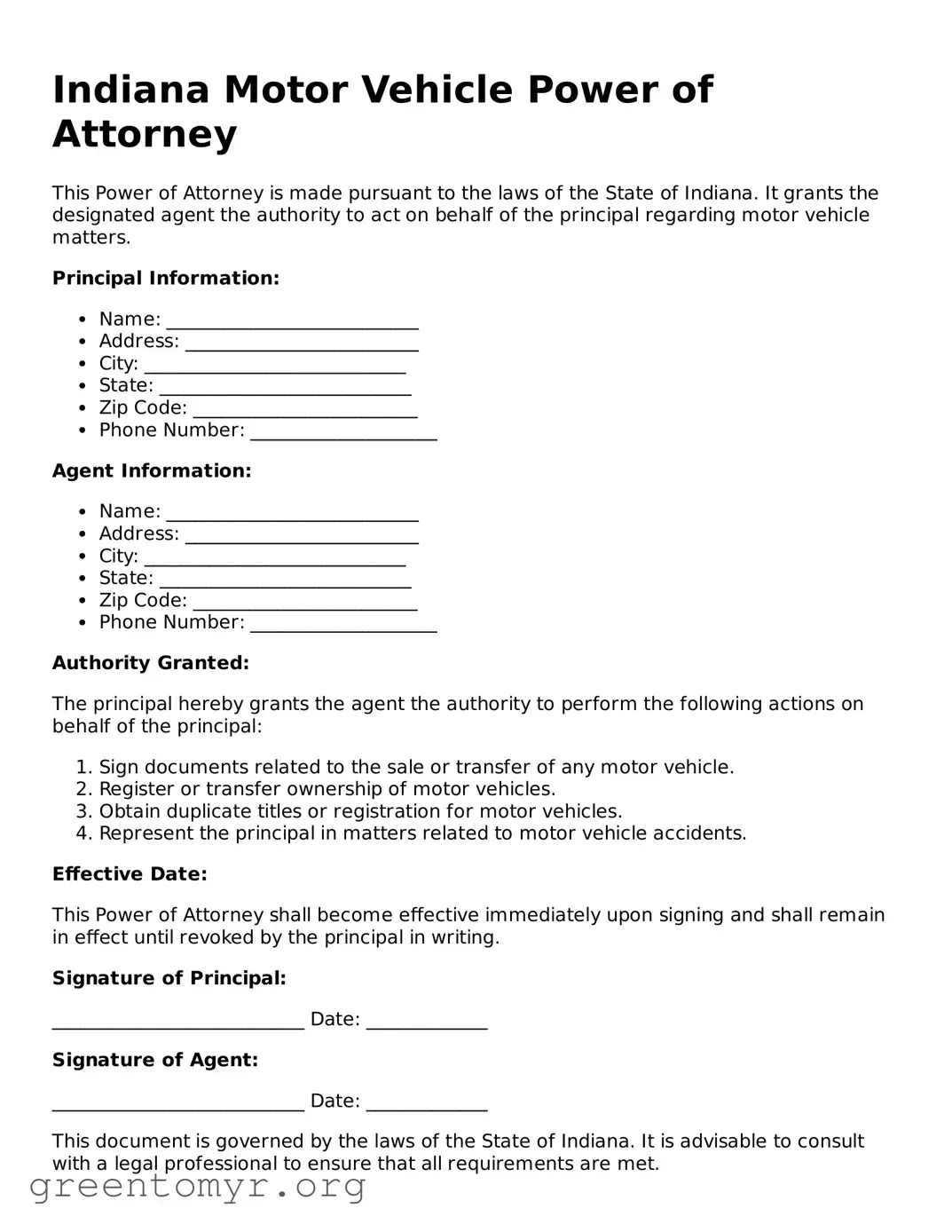
The Indiana Motor Vehicle Power of Attorney form serves as a crucial legal document that empowers an individual, known as the agent, to act on behalf of another person, referred to as the principal, in matters specifically related to motor vehicle transactions. This form is particularly useful when the principal is unable to be present for tasks such as transferring title, registering a vehicle, or handling other essential motor vehicle-related activities. By granting this authority, the principal ensures that their interests are protected and that necessary actions can be taken without delay. The form requires essential details, including the names and addresses of both the principal and the agent, a description of the vehicle in question, and the specific powers being granted. Additionally, it is important to note that the document must be signed and dated by the principal, ensuring its validity. Understanding the nuances of this form can significantly streamline the process of managing motor vehicle transactions in Indiana.
Indiana Motor Vehicle Power of Attorney
This Power of Attorney is made pursuant to the laws of the State of Indiana. It grants the designated agent the authority to act on behalf of the principal regarding motor vehicle matters.
Principal Information:
Agent Information:
Authority Granted:
The principal hereby grants the agent the authority to perform the following actions on behalf of the principal:
Effective Date:
This Power of Attorney shall become effective immediately upon signing and shall remain in effect until revoked by the principal in writing.
Signature of Principal:
___________________________ Date: _____________
Signature of Agent:
___________________________ Date: _____________
This document is governed by the laws of the State of Indiana. It is advisable to consult with a legal professional to ensure that all requirements are met.
| Fact Name | Description |
|---|---|
| Purpose | The Indiana Motor Vehicle Power of Attorney form allows an individual to appoint someone else to handle motor vehicle transactions on their behalf. |
| Governing Law | This form is governed by Indiana Code § 32-17-1-1, which outlines the authority and requirements for powers of attorney in the state. |
| Signature Requirement | The form must be signed by the person granting the power of attorney, ensuring that the appointment is valid and recognized. |
| Revocation | The power of attorney can be revoked at any time by the principal, provided that they notify the agent and any relevant parties. |
| Usage | This form is commonly used for tasks such as transferring vehicle titles, registering vehicles, and handling related paperwork. |
Filling out the Indiana Motor Vehicle Power of Attorney form is a straightforward process. This form allows you to designate someone else to handle specific tasks related to your vehicle on your behalf. After completing the form, you will need to ensure it is properly signed and submitted according to the guidelines provided by the Indiana Bureau of Motor Vehicles.
The Indiana Motor Vehicle Power of Attorney form allows an individual (the principal) to appoint another person (the agent) to handle specific motor vehicle-related tasks on their behalf. This may include signing documents, transferring titles, and registering vehicles.
Any competent adult can be designated as an agent. This includes family members, friends, or professionals such as attorneys. It is important to choose someone trustworthy, as they will have the authority to act in your best interests regarding your motor vehicle matters.
The agent can perform various tasks related to motor vehicles, including:
To complete the form, follow these steps:
Yes, the Indiana Motor Vehicle Power of Attorney form must be notarized to be valid. This step ensures that the document is legally recognized and that the signatures are authentic.
Yes, you can revoke the Power of Attorney at any time as long as you are competent. To do this, you should create a written revocation document and notify the agent and any relevant parties, such as the BMV.
The Power of Attorney remains valid until you revoke it or until the specific tasks granted to the agent are completed. If you want it to be valid for a specific period, you should indicate that in the form.
If the agent is unable to perform their duties due to illness, relocation, or other reasons, it is advisable to appoint an alternate agent. This can be done by specifying an alternate in the Power of Attorney form or by creating a new form altogether.
Keep the completed and notarized form in a safe place, such as a locked file or safe. It is also a good idea to provide copies to your agent and any institutions that may require it, like the BMV or your insurance company.
No, the Indiana Motor Vehicle Power of Attorney form is specifically designed for vehicles registered in Indiana. If you need to handle motor vehicle matters in another state, you should consult that state's regulations and forms.
Filling out the Indiana Motor Vehicle Power of Attorney form can be straightforward, but several common mistakes can lead to complications. One frequent error is not providing complete information. It’s essential to fill in all required fields accurately. Missing details can delay processing and create confusion.
Another mistake involves the selection of the agent. Some individuals choose someone who may not be suitable for the role. It’s crucial to select a trustworthy person who understands the responsibilities involved in managing vehicle transactions.
Many people overlook the importance of signatures. Failing to sign the form or having an incomplete signature can render the document invalid. Ensure that all necessary signatures are present before submission.
Incorrect dates are another common issue. The date of signing should be current and match the date on which the authority is granted. Discrepancies can lead to questions about the validity of the document.
Not understanding the scope of authority can lead to problems. Some individuals grant too much authority, while others may not provide enough. Clearly define what powers are being granted to avoid misunderstandings later.
In some cases, individuals forget to review the form before submitting it. Taking a moment to double-check for errors or omissions can save time and prevent potential issues.
Another mistake is failing to provide identification. Some may assume that the form alone is sufficient. Including a copy of identification can help verify the identity of the person granting power of attorney.
Ignoring state-specific requirements can also be problematic. Each state may have unique rules regarding power of attorney forms. Familiarizing oneself with Indiana’s specific requirements is essential for compliance.
Lastly, not keeping a copy of the completed form is a common oversight. Retaining a copy ensures that all parties involved have access to the same information and can refer back to it if needed.
When dealing with motor vehicle transactions in Indiana, the Motor Vehicle Power of Attorney form is often accompanied by several other important documents. These forms help facilitate various aspects of vehicle ownership, registration, and transfer. Below is a list of commonly used documents that may be required alongside the Power of Attorney.
Each of these documents plays a crucial role in ensuring that vehicle transactions are conducted smoothly and legally. Understanding their purposes can help streamline the process of buying, selling, or transferring a vehicle in Indiana.
The Motor Vehicle Power of Attorney form allows an individual to designate another person to act on their behalf regarding vehicle-related matters. Several other documents serve similar purposes in different contexts. Below are seven documents that share similarities with the Motor Vehicle Power of Attorney form:
When filling out the Indiana Motor Vehicle Power of Attorney form, it's important to follow certain guidelines. Here are seven things to keep in mind:
Understanding the Indiana Motor Vehicle Power of Attorney form is essential for anyone looking to manage vehicle-related transactions on behalf of another person. However, several misconceptions can lead to confusion. Here are six common misunderstandings:
The Indiana Motor Vehicle Power of Attorney form is specifically designed for vehicle-related matters. It does not cover other legal or financial decisions.
While notarization can add an extra layer of authenticity, it is not a requirement for the Indiana Motor Vehicle Power of Attorney form. The form can be signed without a notary, as long as it meets the state's requirements.
This is not true. Anyone can fill out the Indiana Motor Vehicle Power of Attorney form as long as they understand the information required and the responsibilities involved.
This misconception is misleading. The power of attorney can be revoked at any time by the person who granted it, as long as they are mentally competent to do so.
While the form is commonly used for vehicle sales, it can also be utilized for other transactions, such as registering a vehicle or transferring ownership.
Although the Indiana Motor Vehicle Power of Attorney form is specific to Indiana, it may be recognized in other states under certain conditions. However, it is advisable to check local laws before using it outside Indiana.
By clarifying these misconceptions, individuals can better navigate the process of using the Indiana Motor Vehicle Power of Attorney form and ensure that their vehicle-related transactions are handled smoothly.
When filling out and using the Indiana Motor Vehicle Power of Attorney form, consider the following key takeaways: