Content Navigation

When buying or selling a motorcycle in Indiana, a Motorcycle Bill of Sale form serves as an essential document to finalize the transaction. This form captures crucial details, such as the names and addresses of both the buyer and seller, along with the motorcycle's make, model, year, and Vehicle Identification Number (VIN). It also outlines the sale price, ensuring both parties agree on the terms. Importantly, the form may include a section for any disclosures about the motorcycle's condition, helping to protect the seller from future liability. By documenting the sale, this form not only provides proof of ownership transfer but also helps facilitate the registration process with the Indiana Bureau of Motor Vehicles. Having a properly completed Motorcycle Bill of Sale can prevent disputes and misunderstandings, making it a vital step in the motorcycle buying and selling process.

Indiana Motorcycle Bill of Sale Example

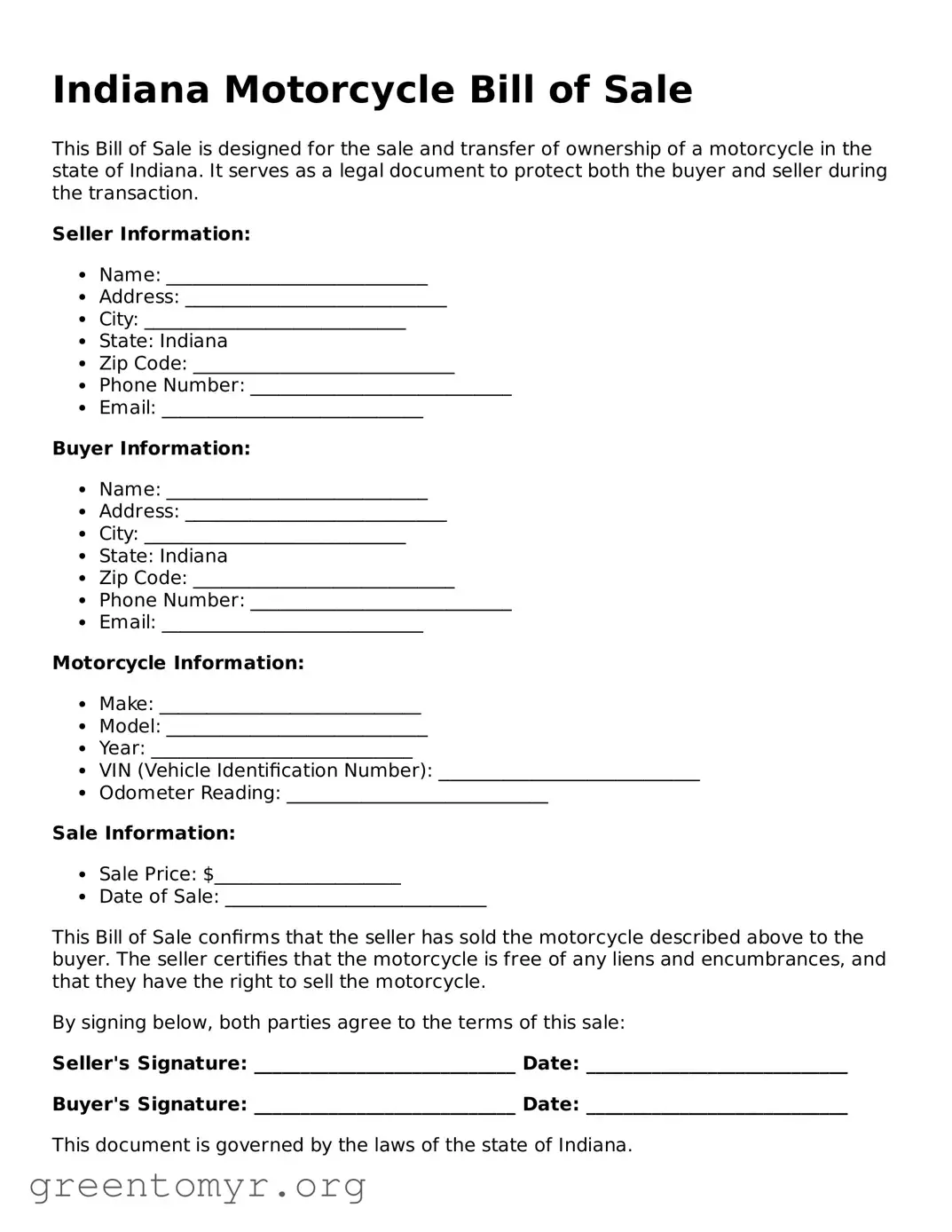
Indiana Motorcycle Bill of Sale

This Bill of Sale is designed for the sale and transfer of ownership of a motorcycle in the state of Indiana. It serves as a legal document to protect both the buyer and seller during the transaction.

Seller Information:

  • Name: ____________________________
  • Address: ____________________________
  • City: ____________________________
  • State: Indiana
  • Zip Code: ____________________________
  • Phone Number: ____________________________
  • Email: ____________________________

Buyer Information:

  • Name: ____________________________
  • Address: ____________________________
  • City: ____________________________
  • State: Indiana
  • Zip Code: ____________________________
  • Phone Number: ____________________________
  • Email: ____________________________

Motorcycle Information:

  • Make: ____________________________
  • Model: ____________________________
  • Year: ____________________________
  • VIN (Vehicle Identification Number): ____________________________
  • Odometer Reading: ____________________________

Sale Information:

  • Sale Price: $____________________
  • Date of Sale: ____________________________

This Bill of Sale confirms that the seller has sold the motorcycle described above to the buyer. The seller certifies that the motorcycle is free of any liens and encumbrances, and that they have the right to sell the motorcycle.

By signing below, both parties agree to the terms of this sale:

Seller's Signature: ____________________________ Date: ____________________________

Buyer's Signature: ____________________________ Date: ____________________________

This document is governed by the laws of the state of Indiana.

PDF Form Features

Fact Name Description
Purpose The Indiana Motorcycle Bill of Sale form is used to document the sale and transfer of ownership of a motorcycle between a buyer and a seller.
Governing Law This form is governed by Indiana state law, specifically the Indiana Code Title 9, Article 22, which pertains to motor vehicles.
Required Information The form typically requires details such as the motorcycle's make, model, year, Vehicle Identification Number (VIN), and the names and addresses of both the buyer and the seller.
Signatures Both the buyer and the seller must sign the form to validate the transaction and confirm the transfer of ownership.
Usage The completed Bill of Sale serves as a legal record of the transaction and may be required for registration and titling purposes with the Indiana Bureau of Motor Vehicles (BMV).

Guide to Using Indiana Motorcycle Bill of Sale

After obtaining the Indiana Motorcycle Bill of Sale form, you will need to complete it accurately to ensure a smooth transaction. This document serves as a record of the sale and includes important details about the motorcycle and the parties involved. Below are the steps to fill out the form.

  1. Start by entering the date of the sale at the top of the form.
  2. Provide the full name and address of the seller in the designated fields.
  3. Next, enter the full name and address of the buyer.
  4. Fill in the motorcycle's details, including the make, model, year, and Vehicle Identification Number (VIN).
  5. Indicate the sale price of the motorcycle clearly in the appropriate section.
  6. Both the seller and buyer should sign and date the form at the bottom.
  7. Make sure to keep a copy of the completed form for your records.

Get Answers on Indiana Motorcycle Bill of Sale

What is a Motorcycle Bill of Sale in Indiana?

A Motorcycle Bill of Sale is a legal document that records the transfer of ownership of a motorcycle from one party to another in Indiana. It serves as proof of the transaction and includes essential details about the motorcycle and the parties involved.

Why do I need a Motorcycle Bill of Sale?

The Motorcycle Bill of Sale is important for several reasons:

  • It provides legal proof of ownership.
  • It helps prevent disputes regarding the sale.
  • It is often required for registration and titling of the motorcycle with the Indiana Bureau of Motor Vehicles (BMV).

What information should be included in the Bill of Sale?

A complete Motorcycle Bill of Sale should include:

  1. The names and addresses of both the buyer and seller.
  2. The motorcycle's make, model, year, and Vehicle Identification Number (VIN).
  3. The sale price of the motorcycle.
  4. The date of the sale.
  5. Signatures of both the buyer and seller.

Is a Bill of Sale required for all motorcycle sales in Indiana?

While a Bill of Sale is not legally required for every motorcycle sale in Indiana, it is highly recommended. Having this document can protect both parties and simplify the registration process at the BMV.

Can I create my own Motorcycle Bill of Sale?

Yes, you can create your own Motorcycle Bill of Sale. Ensure that it includes all the necessary information and is signed by both parties. There are also templates available online that can help you draft a compliant document.

Do I need to have the Bill of Sale notarized?

Notarization is not required for a Motorcycle Bill of Sale in Indiana. However, having it notarized can add an extra layer of authenticity and may help in case of disputes in the future.

What should I do with the Bill of Sale after the sale?

After the sale, both the buyer and seller should keep a copy of the Bill of Sale for their records. The buyer will need it when registering the motorcycle with the BMV.

Where can I find a Motorcycle Bill of Sale form?

You can find Motorcycle Bill of Sale forms online through various legal websites, or you can create your own using templates. Ensure that the form you choose complies with Indiana state requirements.

Common mistakes

Filling out the Indiana Motorcycle Bill of Sale form might seem straightforward, but many people trip up along the way. One common mistake is failing to provide complete information about the motorcycle. The form requires details like the make, model, year, and Vehicle Identification Number (VIN). Omitting any of this information can lead to complications down the line, especially when registering the motorcycle or transferring ownership.

Another frequent error is not including the seller's and buyer's full names and addresses. The form is designed to create a clear record of the transaction, and missing this information can create confusion. Both parties should ensure that their names are spelled correctly and that addresses are up to date. This helps avoid any potential disputes later.

People also often forget to sign and date the form. Without signatures, the Bill of Sale is essentially incomplete. Both the buyer and seller must sign to confirm that they agree to the terms of the sale. Dates are equally important; they establish when the transaction took place, which can be crucial for legal purposes.

Another mistake is not keeping a copy of the completed Bill of Sale. After filling out the form, it’s wise for both parties to retain a copy for their records. This document serves as proof of the transaction and can be vital if any issues arise in the future. Without a copy, one party may find themselves at a disadvantage if questions about the sale come up later.

In addition, people sometimes fail to mention any liens or loans on the motorcycle. If the seller still owes money on the bike, it’s important to disclose this on the Bill of Sale. Buyers need to know if they are purchasing a motorcycle that has financial obligations attached. Transparency in this area helps build trust and ensures a smoother transaction.

Lastly, individuals might overlook the need for witnesses or notarization. While Indiana doesn’t require a Bill of Sale to be notarized, having a witness present can add an extra layer of security. It’s always a good idea to have someone else verify the transaction, especially for high-value items like motorcycles. This can provide additional peace of mind for both the buyer and seller.

Documents used along the form

When buying or selling a motorcycle in Indiana, several important documents often accompany the Motorcycle Bill of Sale. These documents help to ensure a smooth transaction and provide necessary information for both the buyer and the seller. Below is a list of commonly used forms.

  • Title Transfer Form: This document is essential for transferring ownership of the motorcycle from the seller to the buyer. It includes details such as the vehicle identification number (VIN) and the names of both parties.
  • Odometer Disclosure Statement: This statement verifies the motorcycle's mileage at the time of sale. Federal law requires this disclosure to prevent odometer fraud.
  • Bill of Sale for Personal Property: While the Motorcycle Bill of Sale is specific to motorcycles, a general Bill of Sale can be used for other personal property. It serves as a receipt for the transaction.
  • Application for Title: After the sale, the buyer may need to complete this application to obtain a new title in their name. This form is submitted to the Indiana Bureau of Motor Vehicles (BMV).
  • Proof of Insurance: Before registering the motorcycle, the buyer must provide proof of insurance. This documentation ensures that the motorcycle is covered in case of accidents or damages.
  • Sales Tax Form: Indiana requires the payment of sales tax on vehicle purchases. This form helps calculate the tax owed based on the sale price of the motorcycle.

These documents play a vital role in the motorcycle buying and selling process in Indiana. Having them prepared and organized can help facilitate a successful transaction and ensure compliance with state regulations.

Similar forms

The Motorcycle Bill of Sale form serves as an important document in the transaction of motorcycle ownership. It shares similarities with several other documents that facilitate the transfer of ownership for various types of property. Here’s a list of nine documents that are similar to the Motorcycle Bill of Sale:

  • Vehicle Bill of Sale: Like the Motorcycle Bill of Sale, this document is used to transfer ownership of a car or truck. It includes details about the vehicle, the buyer, and the seller.
  • Boat Bill of Sale: This form functions similarly for boats. It records the sale and transfer of ownership, capturing essential details about the boat and the parties involved.
  • ATV Bill of Sale: For all-terrain vehicles, this document serves the same purpose as the Motorcycle Bill of Sale, ensuring a legal record of the transaction.
  • Trailer Bill of Sale: When buying or selling a trailer, this form provides proof of ownership transfer, much like the Motorcycle Bill of Sale does for motorcycles.
  • Real Estate Purchase Agreement: While this document pertains to property rather than vehicles, it similarly outlines the terms of a sale and includes details about the buyer and seller.
  • Personal Property Bill of Sale: This document can be used for various items, such as furniture or electronics. It confirms the sale and transfer of ownership, similar to the Motorcycle Bill of Sale.
  • Gun Bill of Sale: This document is used to transfer ownership of firearms. It contains buyer and seller information and details about the firearm, paralleling the motorcycle sale process.
  • Business Asset Purchase Agreement: When purchasing a business, this agreement outlines the terms of sale and the assets being transferred, resembling the structure of a Motorcycle Bill of Sale.
  • Lease Agreement: Although primarily used for rental situations, this document also specifies the terms of use and responsibilities, similar to how a bill of sale outlines ownership transfer.

Each of these documents plays a crucial role in establishing a clear record of ownership transfer, ensuring that both parties understand their rights and responsibilities in the transaction.

Dos and Don'ts

When filling out the Indiana Motorcycle Bill of Sale form, it is essential to follow specific guidelines to ensure the document is valid and clear. Below is a list of things you should and shouldn't do.

  • Do provide accurate information about the motorcycle, including the VIN, make, model, and year.
  • Do include the full names and addresses of both the buyer and the seller.
  • Do sign and date the form to validate the transaction.
  • Do keep a copy of the completed Bill of Sale for your records.
  • Don't leave any fields blank; fill out all required sections completely.
  • Don't use nicknames or abbreviations for names; use full legal names instead.
  • Don't forget to mention any liens on the motorcycle, if applicable.
  • Don't alter the form after it has been signed by both parties.

Misconceptions

Many people have misunderstandings about the Indiana Motorcycle Bill of Sale form. Here are ten common misconceptions that can lead to confusion.

  1. It is not necessary for a bill of sale. Some believe a bill of sale is optional. In Indiana, it is crucial for documenting the sale and protecting both the buyer and seller.
  2. Only the seller needs to sign it. Both the buyer and seller should sign the bill of sale. This ensures that both parties agree to the terms of the sale.
  3. It can be a verbal agreement. A verbal agreement is not sufficient. Written documentation is essential for legal protection.
  4. It is only for new motorcycles. This form is applicable to both new and used motorcycles. Any transfer of ownership requires a bill of sale.
  5. It does not need to include the purchase price. The purchase price is a vital part of the bill of sale. It helps establish the value of the motorcycle for tax purposes.
  6. It is not needed if the motorcycle is a gift. Even if the motorcycle is a gift, a bill of sale is recommended. It provides a record of the transfer and protects both parties.
  7. It must be notarized. Notarization is not required in Indiana. However, having it notarized can add an extra layer of security.
  8. It is only for private sales. This form is used for both private and dealer sales. Any change of ownership requires documentation.
  9. It can be a handwritten note. While it can be handwritten, it should include specific information. A proper form helps ensure that all necessary details are covered.
  10. Once signed, it cannot be changed. If both parties agree, changes can be made before finalizing the sale. Just be sure to document any changes clearly.

Understanding these misconceptions can help ensure a smooth transaction when buying or selling a motorcycle in Indiana. Always prioritize clear documentation to protect your interests.

Key takeaways

When it comes to filling out and using the Indiana Motorcycle Bill of Sale form, there are several important points to keep in mind. This document serves as proof of the transaction between the buyer and seller. Here are key takeaways to ensure a smooth process:

  • Accurate Information: Ensure that all details, such as the names, addresses, and motorcycle identification number (VIN), are filled out correctly.
  • Signatures Required: Both the buyer and seller must sign the form to validate the sale. Without these signatures, the document may not hold up legally.
  • Notarization Optional: While notarization is not mandatory, having the bill of sale notarized can add an extra layer of authenticity and protection for both parties.
  • Payment Details: Clearly indicate the purchase price and payment method. This helps avoid any disputes later on.
  • Record Keeping: Keep a copy of the bill of sale for your records. This document is essential for future reference, especially for registration and title transfer.
  • Transfer of Ownership: The bill of sale is crucial for transferring ownership. It should be presented when applying for a new title or registration with the Indiana Bureau of Motor Vehicles (BMV).
  • Additional Documentation: Be prepared to provide additional documents, such as the motorcycle title and proof of insurance, when completing the registration process.

By following these guidelines, you can ensure that the sale of your motorcycle is handled properly and legally in Indiana.