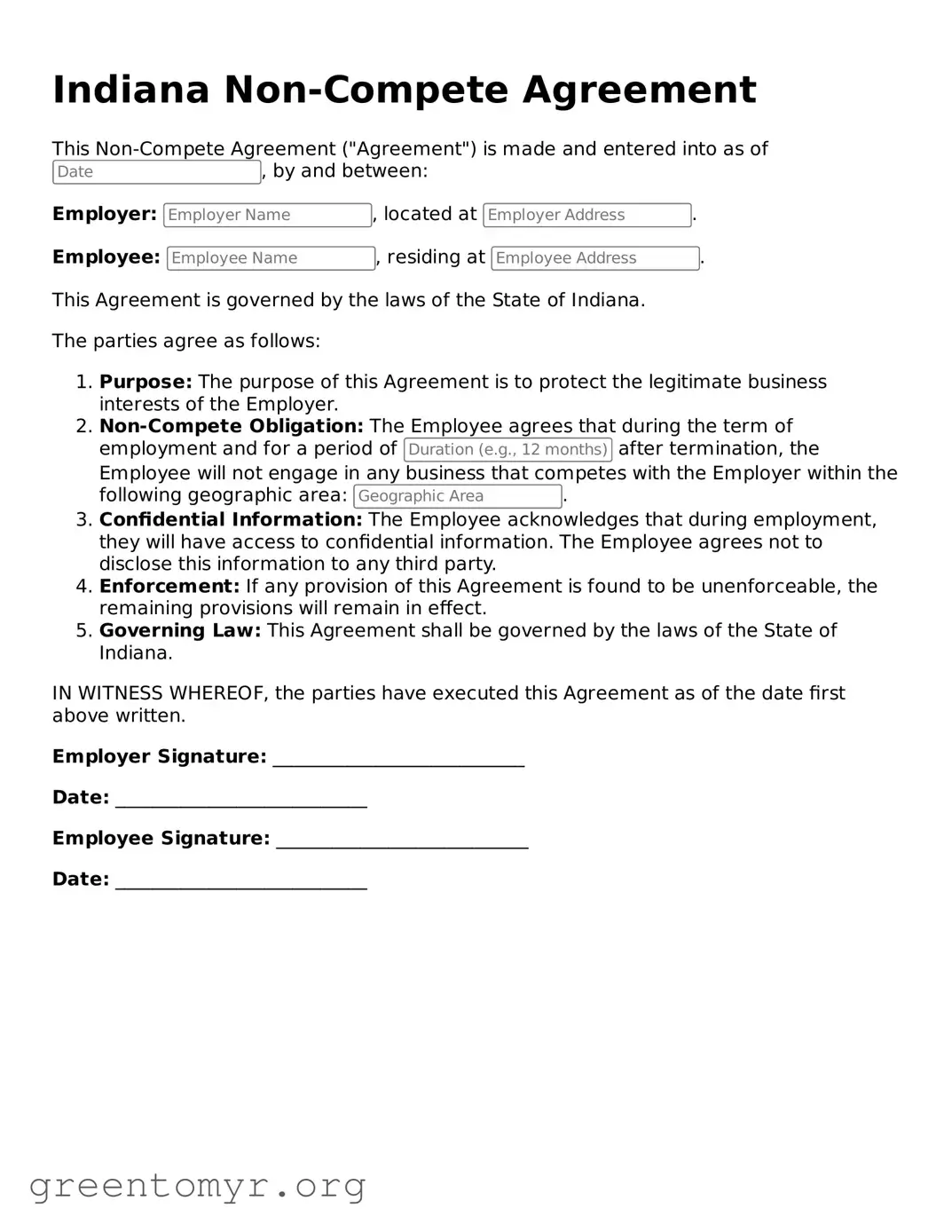
In the competitive landscape of Indiana's job market, the Non-compete Agreement form plays a crucial role in protecting the interests of employers while also outlining the rights of employees. This document is designed to limit an employee's ability to work for competitors or start a competing business for a specified period after leaving their current position. Key aspects of the form include the duration of the restriction, the geographical area it covers, and the specific activities that are prohibited. By clearly defining these parameters, both parties can establish expectations and reduce the potential for disputes in the future. It’s essential for individuals to understand the implications of signing such an agreement, as it can significantly impact their career mobility and opportunities. Employers, on the other hand, benefit from a clear framework that safeguards their proprietary information and trade secrets. Thus, the Indiana Non-compete Agreement form serves as a vital tool in balancing the interests of both employers and employees in a fair and transparent manner.
Indiana Non-Compete Agreement
This Non-Compete Agreement ("Agreement") is made and entered into as of , by and between:
Employer: , located at .
Employee: , residing at .
This Agreement is governed by the laws of the State of Indiana.
The parties agree as follows:
IN WITNESS WHEREOF, the parties have executed this Agreement as of the date first above written.
Employer Signature: ___________________________
Date: ___________________________
Employee Signature: ___________________________
Date: ___________________________
| Fact Name | Description |
|---|---|
| Governing Law | The Indiana Non-compete Agreement is governed by Indiana state law, which outlines the enforceability of such agreements. |
| Duration | Typically, non-compete agreements in Indiana are limited to a reasonable duration, often not exceeding two years. |
| Geographic Scope | These agreements must specify a geographic area where the restrictions apply, which should be reasonable and not overly broad. |
| Consideration | For a non-compete agreement to be enforceable in Indiana, there must be adequate consideration, such as a job offer or promotion. |
After you have gathered the necessary information, you will need to complete the Indiana Non-compete Agreement form. Carefully follow the steps outlined below to ensure that the form is filled out correctly.
Once you have completed these steps, the form should be ready for submission. Ensure that all parties retain a copy for their records.
A Non-compete Agreement is a legal contract between an employer and an employee. It restricts the employee from working for competitors or starting a competing business for a specified period after leaving the company. In Indiana, these agreements must be reasonable in scope and duration to be enforceable.
For a Non-compete Agreement to be valid in Indiana, it must meet several criteria:
The duration of a Non-compete Agreement in Indiana varies but generally should not exceed two years. Courts often consider the reasonableness of the duration based on the nature of the business and the role of the employee.
Yes, employees can negotiate the terms before signing. It is advisable to discuss any concerns regarding duration, geographic scope, or specific restrictions. Employers may be open to adjustments, especially for high-level positions.
If you violate a Non-compete Agreement, the employer may take legal action against you. This could result in a court injunction preventing you from working for a competitor, and you may also face financial penalties or damages for breach of contract.
Yes, Non-compete Agreements can be enforceable in Indiana if they meet the necessary legal requirements. Courts will evaluate the reasonableness of the agreement and the interests it aims to protect.
Before signing, carefully read the document. Consider consulting with a legal professional to understand the implications fully. Ensure that you are comfortable with the terms and that they are reasonable based on your position and industry.
Yes, a Non-compete Agreement can be voided if it is deemed unreasonable or overly restrictive by a court. Factors such as duration, geographic scope, and the nature of the business will be considered in this determination.
Alternatives to Non-compete Agreements include Non-solicitation Agreements and Non-disclosure Agreements. These can protect an employer’s interests without imposing broad restrictions on an employee’s ability to work in their field.
Filling out the Indiana Non-compete Agreement form can be a daunting task, and many individuals make common mistakes that can have significant implications. One prevalent error is not clearly defining the scope of the non-compete. It’s essential to specify what types of activities are restricted after leaving a job. Vague language can lead to misunderstandings and potential legal disputes down the line. Without clarity, both parties may have different interpretations of what constitutes a violation.
Another frequent mistake is overlooking the geographical limitations of the agreement. Indiana courts typically require that the area in which the non-compete applies be reasonable and justifiable. Failing to set appropriate boundaries can render the agreement unenforceable. A non-compete that covers an excessively broad area may be challenged in court, leading to wasted time and resources.
Additionally, many individuals neglect to consider the duration of the non-compete. While it may seem straightforward, setting a time frame that is too long can be problematic. Courts often favor agreements that are reasonable in duration. A non-compete lasting several years may be viewed as overly restrictive, risking its validity. It’s crucial to strike a balance between protecting business interests and allowing former employees the opportunity to work elsewhere.
Finally, a common oversight is failing to seek legal advice before signing the agreement. Many individuals assume that they fully understand the terms, but this can lead to unintended consequences. Consulting with a legal professional can provide valuable insights into the implications of the agreement. A well-informed decision can help prevent future disputes and ensure that the rights of all parties are respected.
In the context of employment relationships, various forms and documents often accompany the Indiana Non-compete Agreement. Each of these documents serves a specific purpose and plays a critical role in defining the terms of the employment arrangement, protecting business interests, and ensuring compliance with legal standards.
These documents collectively help to establish clear expectations and protect the interests of both employers and employees. Understanding each of these forms can aid in navigating the complexities of employment law in Indiana.
A Non-compete Agreement is a common legal document, but it shares similarities with several other forms. Here’s a list of documents that are comparable:
When filling out the Indiana Non-compete Agreement form, it’s important to approach the process with care. Here are ten things you should and shouldn't do:
Taking these steps can help ensure that you fully understand your rights and obligations under the Indiana Non-compete Agreement.
Non-compete agreements can be a source of confusion for many people. Here are eight common misconceptions about the Indiana Non-compete Agreement form that you should be aware of:
Many people believe that if an employer has a non-compete agreement, it will automatically be enforceable. However, Indiana courts will only enforce these agreements if they are reasonable in scope, duration, and geographic area.
Not every employee is required to sign a non-compete agreement. These agreements are typically reserved for employees in key positions or those with access to sensitive information.
Some individuals think that non-compete agreements can last forever. In Indiana, agreements that are overly lengthy may be deemed unenforceable. A reasonable duration is usually considered to be one to two years.
This is a significant misconception. A non-compete agreement restricts you from working for a specific competitor or within a certain area, but it does not completely ban you from your profession.
Once you sign a non-compete agreement, the terms are typically set. Employers cannot arbitrarily change the agreement without your consent.
While it's common for executives to sign these agreements, non-compete clauses can also apply to lower-level employees, especially if they have access to trade secrets or proprietary information.
Many individuals feel they have no power to negotiate. In reality, you can and should discuss the terms with your employer before signing to ensure they are fair and reasonable.
Each state has its own laws regarding non-compete agreements. What may be enforceable in one state could be completely invalid in another. Indiana has specific criteria that must be met for these agreements to be upheld.
Understanding these misconceptions can help you navigate the complexities of non-compete agreements in Indiana. Always consider seeking advice if you're unsure about your rights and obligations.
When filling out and using the Indiana Non-compete Agreement form, keep these key takeaways in mind: