In Indiana, the Notary Acknowledgment form plays a crucial role in various legal and financial transactions, ensuring that documents are executed with authenticity and integrity. This form serves as a formal declaration that the signer of a document has willingly and knowingly provided their signature in the presence of a notary public. The form typically requires essential information, including the name of the signer, the date of the acknowledgment, and the notary’s details, such as their signature and seal. It is important to note that the form must be completed correctly to uphold its validity, as any errors could lead to complications in the legal process. Understanding the specific requirements and implications of the Notary Acknowledgment form is essential for individuals and businesses alike, as it safeguards against potential disputes and enhances the credibility of executed documents. As legal matters often hinge on the proper execution of such forms, timely attention to detail is imperative for all parties involved.
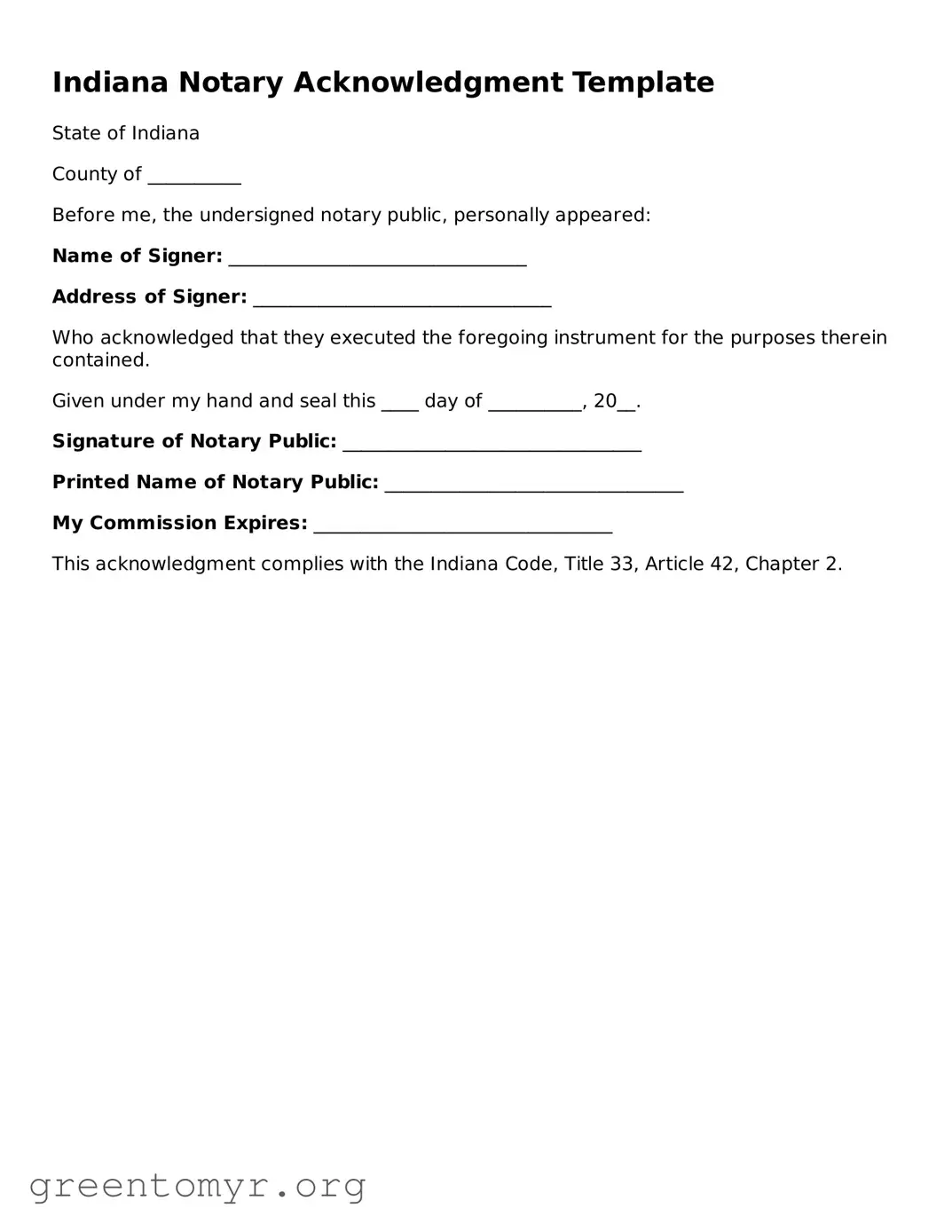
Indiana Notary Acknowledgment Template
State of Indiana
County of __________
Before me, the undersigned notary public, personally appeared:
Name of Signer: ________________________________
Address of Signer: ________________________________
Who acknowledged that they executed the foregoing instrument for the purposes therein contained.
Given under my hand and seal this ____ day of __________, 20__.
Signature of Notary Public: ________________________________
Printed Name of Notary Public: ________________________________
My Commission Expires: ________________________________
This acknowledgment complies with the Indiana Code, Title 33, Article 42, Chapter 2.
| Fact Name | Description |
|---|---|
| Purpose | The Indiana Notary Acknowledgment form is used to verify the identity of a signer and their willingness to sign a document. |
| Governing Law | This form is governed by Indiana Code Title 33, Article 42, which outlines the duties and powers of notaries public in Indiana. |
| Signature Requirement | The signer must personally appear before the notary and provide a valid form of identification. |
| Notary's Role | The notary public is responsible for ensuring that the signer understands the document they are signing and is doing so voluntarily. |
| Record Keeping | Notaries in Indiana are required to keep a record of each acknowledgment performed, including details about the signer and the document. |
| Expiration | Notary acknowledgments do not expire, but the notary's commission must be active for the acknowledgment to be valid. |
After you have gathered the necessary information, you can proceed to fill out the Indiana Notary Acknowledgement form. This form is essential for verifying the identity of the signer and ensuring the document's authenticity. Follow these steps carefully to complete the form accurately.
Once you have completed these steps, the form will be ready for submission or filing as needed. Make sure to keep a copy for your records, as it may be required for future reference.
The Indiana Notary Acknowledgement form is a legal document used to verify that a signature on a document is authentic. This form is typically completed by a notary public, who confirms the identity of the signer and witnesses the signing of the document. It serves as proof that the document was signed willingly and without coercion.
A Notary Acknowledgement is often required when a document is being submitted for legal purposes, such as property deeds, contracts, or other official documents. It provides assurance to the parties involved and any third parties that the signatures are valid.
In Indiana, a notary public must be at least 18 years old, a resident of Indiana or have a place of employment in the state, and must complete the required training and certification process. Notaries are appointed by the state and must adhere to specific laws and regulations.
The Notary Acknowledgement typically includes:
To complete the form, follow these steps:
Yes, notaries in Indiana may charge a fee for their services. The maximum fee a notary can charge for an acknowledgement is set by state law. It's important to check with the notary beforehand to understand any applicable fees.
While a Notary Acknowledgement can be used for many types of documents, it is not suitable for all situations. Some documents may require additional forms or different types of notarization. Always confirm the requirements for the specific document you are working with.
The Notary Acknowledgement itself does not expire; however, the document it is attached to may have its own validity period. It is essential to ensure that the document is used within the timeframe specified for its intended purpose.
If a Notary Acknowledgement is rejected, first determine the reason for the rejection. Common issues may include missing information, an incomplete signature, or an improperly affixed seal. Once the issue is identified, you may need to have the document notarized again correctly.
Notaries can be found in various locations, including banks, law offices, and public libraries. Additionally, many notaries offer mobile services, traveling to meet clients at their convenience. Online directories and state resources can also assist in locating a notary public in your area.
Filling out the Indiana Notary Acknowledgment form correctly is essential to ensure that documents are legally binding. However, many individuals make common mistakes that can lead to complications. One frequent error is failing to include the correct date. The date of the acknowledgment must match the date the notary witnesses the signing. An incorrect date can invalidate the document.
Another common mistake is neglecting to identify the signer clearly. The form requires the full name of the individual signing the document. Omitting a middle name or using initials can create confusion. Always provide the complete name to avoid any issues with identification.
People often forget to include the notary's seal. The seal is a crucial part of the acknowledgment. Without it, the document may not be accepted by the intended recipient. Ensure that the notary's seal is affixed properly and is legible.
Some individuals mistakenly think that the acknowledgment can be signed before the notary arrives. This is incorrect. The signer must sign the document in the presence of the notary. If the notary does not witness the signature, the acknowledgment is not valid.
Another mistake involves not checking the form for completeness. Leaving any section blank can lead to problems. Review the entire form to ensure that all required information is filled out accurately before submission.
Additionally, using the wrong type of acknowledgment can be problematic. Indiana has specific wording requirements for notary acknowledgments. Using outdated or incorrect language can render the acknowledgment ineffective. Always use the current form and language specified by Indiana law.
People sometimes forget to include the notary's commission expiration date. This date is essential as it indicates the validity of the notary's authority. Without this information, the acknowledgment may be questioned.
Lastly, individuals often overlook the importance of signing in the correct location. The signer must sign in the designated area of the acknowledgment form. A signature placed outside the specified area can cause confusion and may not be recognized as valid.
In Indiana, a Notary Acknowledgment form is often used to verify the identity of individuals signing important documents. However, there are several other forms and documents that frequently accompany this acknowledgment. Each serves a unique purpose in the legal process, ensuring that all parties involved are protected and informed.
Understanding these documents can help individuals navigate legal processes with greater confidence. Each form plays a vital role in ensuring that agreements are clear, enforceable, and legally sound.
The Notary Acknowledgment form serves a specific purpose in the realm of legal documents, primarily confirming that a signature was made in the presence of a notary public. However, several other documents share similarities with it, often in terms of their function or the process involved. Below is a list of eight documents that are comparable to the Notary Acknowledgment form:
Understanding these documents and their similarities to the Notary Acknowledgment can help individuals navigate legal processes more effectively. Each serves to confirm identity and intentions, ensuring that agreements and statements hold up in legal contexts.
When filling out the Indiana Notary Acknowledgment form, it is important to follow specific guidelines to ensure the document is valid and legally binding. Here are seven things you should and shouldn't do:
Following these guidelines will help ensure that your Indiana Notary Acknowledgment form is completed correctly and is legally effective.
Understanding the Indiana Notary Acknowledgement form can be challenging. Here are ten common misconceptions about this important document:
By understanding these misconceptions, individuals can better navigate the notarization process in Indiana and ensure their documents are properly handled.
When using the Indiana Notary Acknowledgment form, it's essential to understand its purpose and how to fill it out correctly. Here are some key takeaways: