When starting a business in Indiana, particularly a limited liability company (LLC), one of the most crucial documents to consider is the Operating Agreement form. This form outlines the management structure and operational guidelines of the LLC, serving as a foundational blueprint for how the business will function. It typically includes details such as the roles and responsibilities of members, the distribution of profits and losses, and procedures for adding new members or handling disputes. By clearly defining these aspects, the Operating Agreement helps prevent misunderstandings and conflicts among members. Additionally, while Indiana law does not mandate an Operating Agreement for LLCs, having one in place can provide significant legal protections and enhance the credibility of the business. Understanding the major components of this form is essential for any entrepreneur looking to establish a solid framework for their company’s operations and governance.
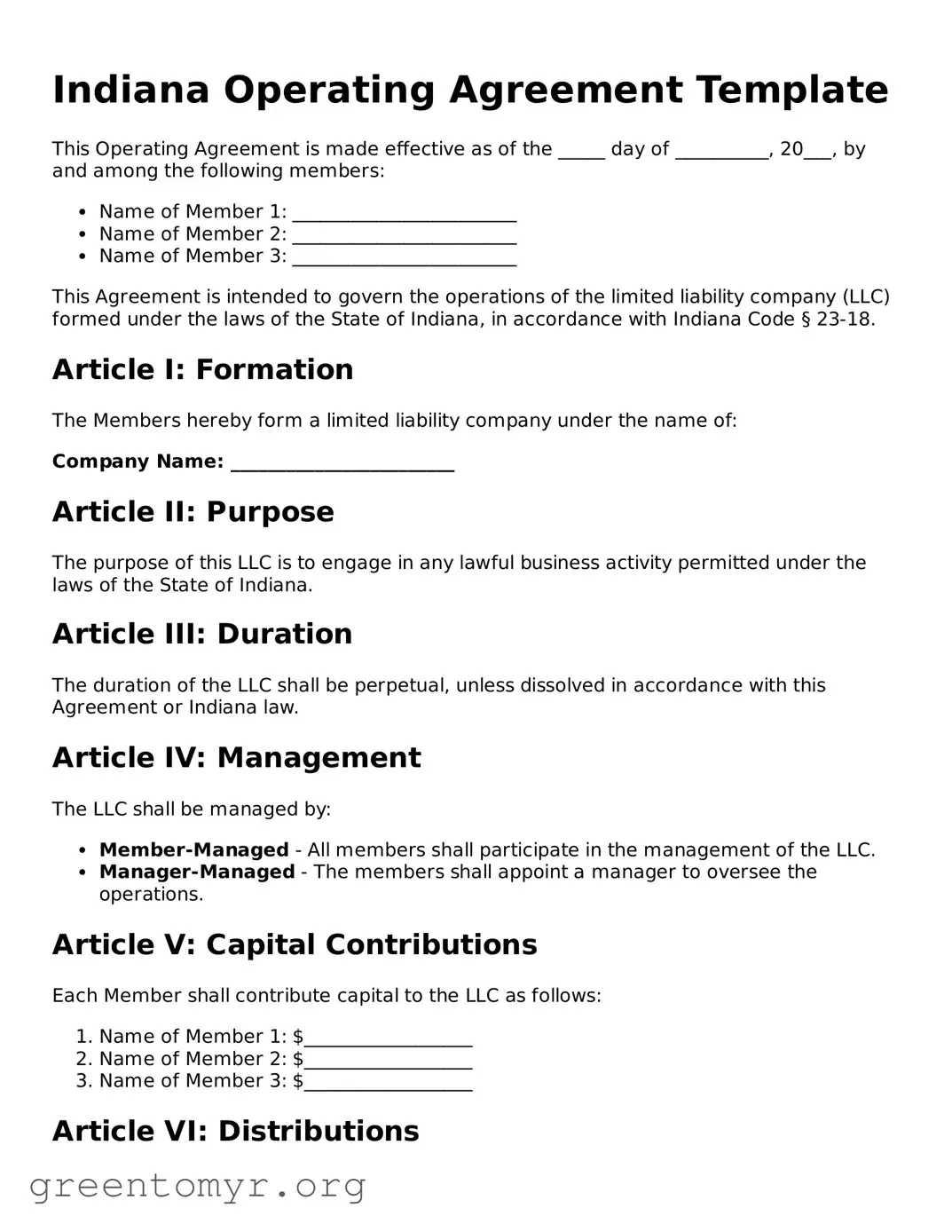
Indiana Operating Agreement Template
This Operating Agreement is made effective as of the _____ day of __________, 20___, by and among the following members:
This Agreement is intended to govern the operations of the limited liability company (LLC) formed under the laws of the State of Indiana, in accordance with Indiana Code § 23-18.
Article I: Formation
The Members hereby form a limited liability company under the name of:
Company Name: ________________________
Article II: Purpose
The purpose of this LLC is to engage in any lawful business activity permitted under the laws of the State of Indiana.
Article III: Duration
The duration of the LLC shall be perpetual, unless dissolved in accordance with this Agreement or Indiana law.
Article IV: Management
The LLC shall be managed by:
Article V: Capital Contributions
Each Member shall contribute capital to the LLC as follows:
Article VI: Distributions
Distributions of profits and losses shall be allocated to the Members in proportion to their respective capital contributions, unless otherwise agreed upon in writing.
Article VII: Meetings
Meetings of the Members shall be held at least annually, or as necessary. Notice of meetings shall be provided at least _____ days in advance.
Article VIII: Amendments
This Operating Agreement may be amended only by a written agreement signed by all Members.
Article IX: Governing Law
This Agreement shall be governed by and construed in accordance with the laws of the State of Indiana.
IN WITNESS WHEREOF, the undersigned Members have executed this Operating Agreement as of the date first above written.
| Fact Name | Description |
|---|---|
| Purpose | The Indiana Operating Agreement outlines the management structure and operational procedures of a limited liability company (LLC). |
| Governing Law | The agreement is governed by the Indiana Code Title 23, Article 18, which covers the Indiana LLC Act. |
| Member Rights | It defines the rights and responsibilities of the members, ensuring clarity in ownership and profit distribution. |
| Flexibility | Indiana allows for flexibility in the agreement, enabling members to customize terms to fit their needs. |
| Filing Requirement | While the Operating Agreement is not required to be filed with the state, it is essential for internal governance. |
| Amendments | Members can amend the agreement as needed, ensuring it remains relevant to the company’s evolving needs. |
Completing the Indiana Operating Agreement form is an important step for anyone establishing a business in the state. This document outlines the management structure, responsibilities, and ownership of the company. Once the form is filled out, it will need to be signed by all members and kept with your business records.
An Indiana Operating Agreement is a legal document that outlines the ownership and operating procedures of a Limited Liability Company (LLC) in Indiana. This agreement serves as a foundational contract between the members of the LLC, detailing their rights, responsibilities, and the management structure of the business.
While Indiana law does not mandate that LLCs have an Operating Agreement, it is highly recommended. Having this document can help clarify the roles and expectations of each member, reduce potential disputes, and provide a clear framework for decision-making. Additionally, banks and investors may require an Operating Agreement to open business accounts or provide funding.
An effective Operating Agreement typically includes the following key components:
Creating an Indiana Operating Agreement can be done in several ways. Members can draft the agreement themselves using templates available online. Alternatively, hiring a legal professional to ensure that the document meets all legal requirements and addresses specific business needs is a prudent choice. This can help avoid potential issues in the future.
Yes, an Operating Agreement can be amended. The process for making changes should be clearly outlined in the original document. Typically, all members must agree to any amendments, and it is advisable to document these changes in writing to maintain clarity and avoid misunderstandings.
If an LLC does not have an Operating Agreement, it will be governed by Indiana's default LLC laws. This may lead to unintended consequences, such as default management structures or profit-sharing arrangements that do not reflect the members' intentions. Without a tailored agreement, members may face challenges in decision-making and conflict resolution.
Templates for Indiana Operating Agreements can be found through various online legal resources, including websites specializing in business formation. Additionally, legal software platforms often provide customizable templates. However, it is advisable to review any template carefully and consider consulting a legal professional to ensure it meets the specific needs of the LLC.
Filling out the Indiana Operating Agreement form can be a straightforward process, but many individuals make common mistakes that can lead to complications down the line. One frequent error is failing to include all necessary members of the LLC. Each member's name, address, and percentage of ownership should be clearly stated. Omitting any member can create confusion regarding ownership rights and responsibilities.
Another mistake often made is not specifying the management structure of the LLC. Whether the company will be managed by its members or by appointed managers should be clearly outlined. If this detail is left vague or unaddressed, it can lead to disputes and mismanagement in the future.
Additionally, many people neglect to include provisions for decision-making processes. The Operating Agreement should specify how decisions will be made, including voting procedures and what constitutes a quorum. Without these guidelines, disagreements may arise, making it difficult to reach consensus on important matters.
People also frequently overlook the importance of detailing the process for adding or removing members. The Operating Agreement should outline how new members can join and under what circumstances existing members can exit. This clarity helps to avoid potential conflicts and ensures smooth transitions within the LLC.
Another common oversight is failing to address the distribution of profits and losses. It is essential to specify how profits will be divided among members. If this is not clearly stated, misunderstandings can occur, leading to dissatisfaction among members.
Some individuals make the mistake of not including a buy-sell agreement. This provision is crucial in the event that a member wishes to sell their interest in the LLC or passes away. Without a buy-sell agreement, the remaining members may face challenges in managing the ownership transition.
Inaccurate or incomplete information can also be a significant issue. Members should double-check that all details, such as names and addresses, are correct. Errors can create legal complications and may even invalidate the agreement.
People often forget to sign and date the Operating Agreement. An unsigned document may not hold up in court if disputes arise. Each member should ensure that they sign and date the agreement to affirm their acceptance of its terms.
Finally, failing to review and update the Operating Agreement regularly can lead to outdated provisions that no longer reflect the current state of the LLC. As circumstances change, it is important to revisit the agreement and make necessary amendments to ensure it remains relevant and effective.
When forming a limited liability company (LLC) in Indiana, an Operating Agreement is a crucial document. However, several other forms and documents are often used alongside it to ensure that the LLC operates smoothly and in compliance with state laws. Below is a list of important documents that are commonly associated with the Indiana Operating Agreement.
These documents work together with the Operating Agreement to create a comprehensive framework for the LLC. Each serves a specific purpose and contributes to the overall governance and operation of the business. Understanding these documents can help ensure that your LLC is set up correctly and operates smoothly.
When filling out the Indiana Operating Agreement form, it’s important to follow certain guidelines to ensure accuracy and compliance. Here’s a helpful list of things you should and shouldn’t do:
Many people have misunderstandings about the Indiana Operating Agreement form. Here are five common misconceptions:
When filling out and utilizing the Indiana Operating Agreement form, it is essential to keep several key points in mind. These points will help ensure that the agreement is both effective and compliant with state laws.
By carefully considering these takeaways, members can create a robust Operating Agreement that supports the long-term success of their business in Indiana.