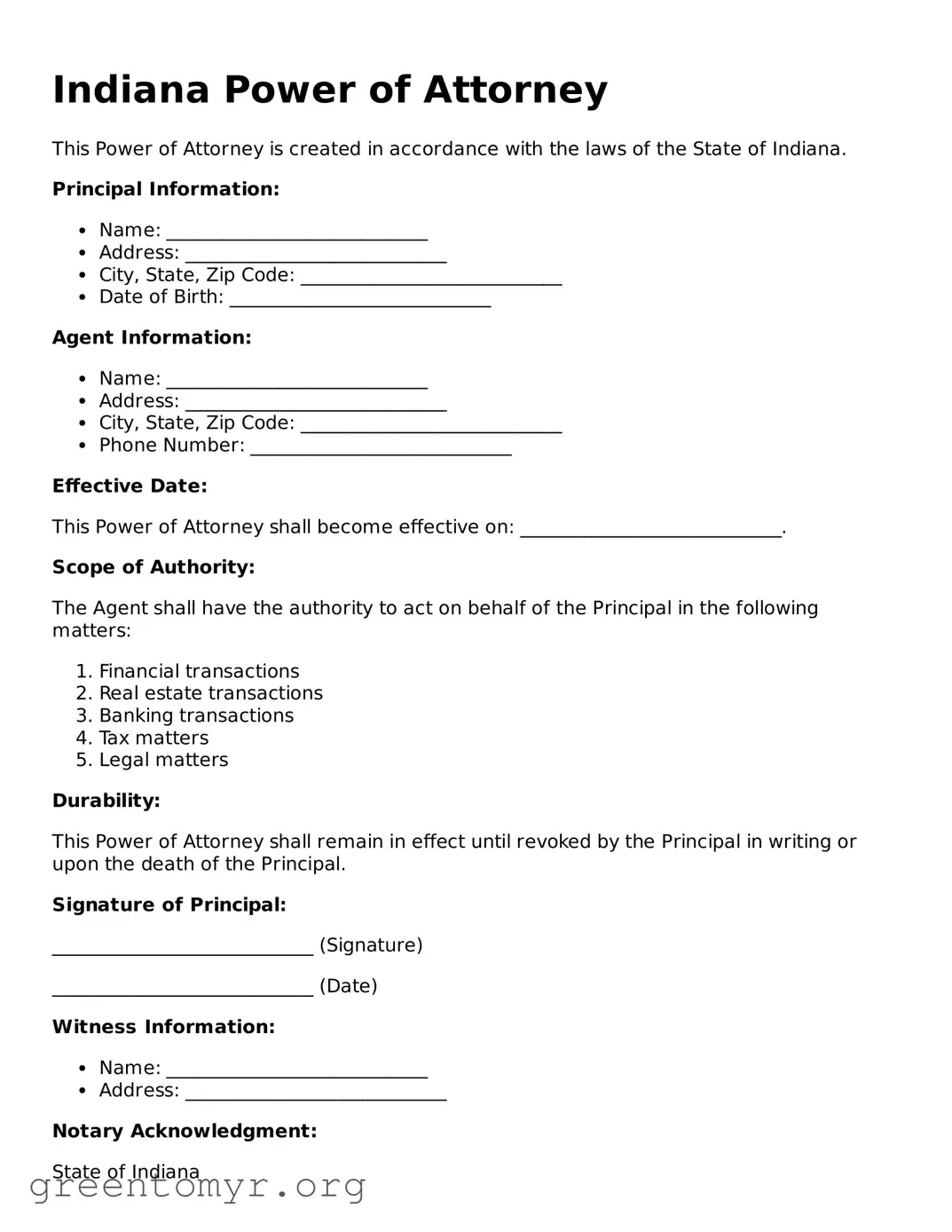
In Indiana, the Power of Attorney form serves as a vital legal tool that allows individuals to designate someone else to make decisions on their behalf, particularly in matters related to finances, healthcare, and property management. This form is especially important for those who may become incapacitated or wish to delegate authority for specific tasks while they are still able to make decisions. The document can be tailored to fit the individual's needs, whether it is granting broad powers or limiting authority to specific actions. Additionally, it is essential to understand the responsibilities that come with this designation, as the appointed agent must act in the best interest of the principal. The Indiana Power of Attorney form must be signed and dated, and it is often recommended to have it notarized to ensure its validity. By understanding the nuances of this form, individuals can better prepare for the future and ensure that their wishes are honored, even when they are unable to communicate them directly.
Indiana Power of Attorney
This Power of Attorney is created in accordance with the laws of the State of Indiana.
Principal Information:
Agent Information:
Effective Date:
This Power of Attorney shall become effective on: ____________________________.
Scope of Authority:
The Agent shall have the authority to act on behalf of the Principal in the following matters:
Durability:
This Power of Attorney shall remain in effect until revoked by the Principal in writing or upon the death of the Principal.
Signature of Principal:
____________________________ (Signature)
____________________________ (Date)
Witness Information:
Notary Acknowledgment:
State of Indiana
County of ____________________________
Subscribed and sworn to before me on this ____ day of ____________, 20__.
____________________________ (Notary Public)
My commission expires: ____________________________
| Fact Name | Details |
|---|---|
| Definition | The Indiana Power of Attorney form allows an individual to appoint someone else to make decisions on their behalf regarding financial and legal matters. |
| Governing Law | This form is governed by Indiana Code Title 30, Article 5, which outlines the requirements and regulations for powers of attorney in the state. |
| Durability | The Indiana Power of Attorney can be durable, meaning it remains effective even if the principal becomes incapacitated, unless stated otherwise in the document. |
| Agent's Authority | The appointed agent can perform various tasks, including managing bank accounts, signing checks, and handling real estate transactions, depending on the powers granted. |
| Revocation | The principal can revoke the Power of Attorney at any time, as long as they are mentally competent to do so, by providing written notice to the agent. |
| Witness and Notarization | In Indiana, the form must be signed in the presence of a notary public or two witnesses to be legally valid. |
Filling out the Indiana Power of Attorney form is an important step in designating someone to act on your behalf in legal and financial matters. Once you have completed the form, you will need to ensure it is signed and notarized to be legally binding.
After completing these steps, your Power of Attorney will be ready for use. Ensure that all parties involved understand the authority granted and the responsibilities entailed.
A Power of Attorney (POA) is a legal document that allows one person to act on behalf of another person in legal or financial matters. In Indiana, this document can grant broad or limited powers, depending on the needs of the principal (the person granting authority).
Any adult who is of sound mind can create a Power of Attorney in Indiana. This includes individuals who are at least 18 years old and capable of understanding the nature and consequences of the document they are signing.
An agent is the person designated to act on behalf of the principal. In Indiana, the agent must be at least 18 years old and should be trustworthy, as they will have significant authority over the principal's affairs.
The powers granted can vary widely. They may include:
It is important to specify the powers clearly in the document to avoid any confusion.
Yes, in Indiana, a Power of Attorney must be signed in the presence of a notary public. This ensures that the document is legally valid and that the principal's signature is authentic.
Yes, a principal can revoke a Power of Attorney at any time as long as they are of sound mind. The revocation should be made in writing, and it is advisable to notify the agent and any relevant third parties of the revocation.
If the principal becomes incapacitated, the Power of Attorney remains in effect unless it is a "springing" Power of Attorney, which only takes effect upon incapacitation. The agent will then have the authority to make decisions on behalf of the principal, as outlined in the document.
Filling out the Indiana Power of Attorney form can be a straightforward process, but many individuals make common mistakes that can lead to complications. One frequent error is failing to specify the powers granted to the agent. Without clear instructions, the agent may not have the authority to act in certain situations, which can create confusion and delays.
Another mistake is not signing the document in front of a notary public. Indiana law requires that the Power of Attorney be notarized to be valid. Neglecting this step can render the document ineffective, leaving the principal without the intended legal support.
Some individuals overlook the importance of naming an alternate agent. If the primary agent is unable or unwilling to serve, having a backup ensures that the principal’s wishes can still be carried out. Failing to include an alternate can leave the principal in a difficult position.
People often forget to date the document. A Power of Attorney should include the date it was signed to establish when the authority was granted. Without a date, questions may arise regarding the validity of the document over time.
Additionally, individuals may not consider the implications of granting broad powers. While it may seem convenient to give an agent general authority, this can lead to misuse or abuse. It is important to carefully consider what specific powers are necessary and to limit them accordingly.
Another common oversight is neglecting to inform the agent of their responsibilities. An agent should be aware of their duties and the expectations that come with the role. Failing to communicate this can lead to misunderstandings and potential legal issues.
Some people mistakenly believe that the Power of Attorney remains valid indefinitely. In reality, the authority can be revoked at any time by the principal. Not understanding this can lead to complications if circumstances change.
Moreover, individuals sometimes forget to review and update the Power of Attorney as life circumstances change. Major life events, such as marriage, divorce, or the birth of a child, may necessitate changes to the document. Regular reviews can help ensure that the Power of Attorney reflects current wishes.
Another mistake involves not keeping copies of the document. It is crucial for both the principal and the agent to have copies of the Power of Attorney. This ensures that everyone involved is aware of the authority granted and can refer to the document when needed.
Lastly, individuals may fail to consider the potential for conflicts of interest. Choosing an agent who has a vested interest in the principal's affairs can lead to disputes. It is essential to select someone who is trustworthy and has the principal's best interests in mind.
When considering a Power of Attorney in Indiana, it’s important to recognize that this document often works in tandem with other legal forms. Each of these documents serves a unique purpose and can help ensure that your wishes are honored and that your affairs are managed effectively.
Understanding these documents can greatly enhance your ability to manage your personal and financial affairs. By preparing them in conjunction with a Power of Attorney, you can provide clarity and direction for your loved ones during difficult times.
The Power of Attorney (POA) form is an important legal document that grants someone the authority to act on another person's behalf. Several other documents share similarities with a Power of Attorney, as they also involve the delegation of authority or decision-making power. Here are four such documents:
Understanding these documents can help individuals make informed decisions about their legal and medical preferences. It is crucial to choose trusted individuals to act on one's behalf, as these documents can significantly impact personal and financial well-being.
When filling out the Indiana Power of Attorney form, it is important to follow certain guidelines. Here are six things to keep in mind:
Understanding the Indiana Power of Attorney form is crucial for effective estate planning and financial management. However, several misconceptions exist that can lead to confusion. Here are eight common misconceptions:
Awareness of these misconceptions can help individuals make informed decisions about their legal documents and ensure that their wishes are honored.
Filling out and using the Indiana Power of Attorney form can be a straightforward process, but it is essential to understand its key components. Here are some important takeaways to keep in mind:
Being informed about these aspects can help you navigate the process of creating and using a Power of Attorney in Indiana effectively.