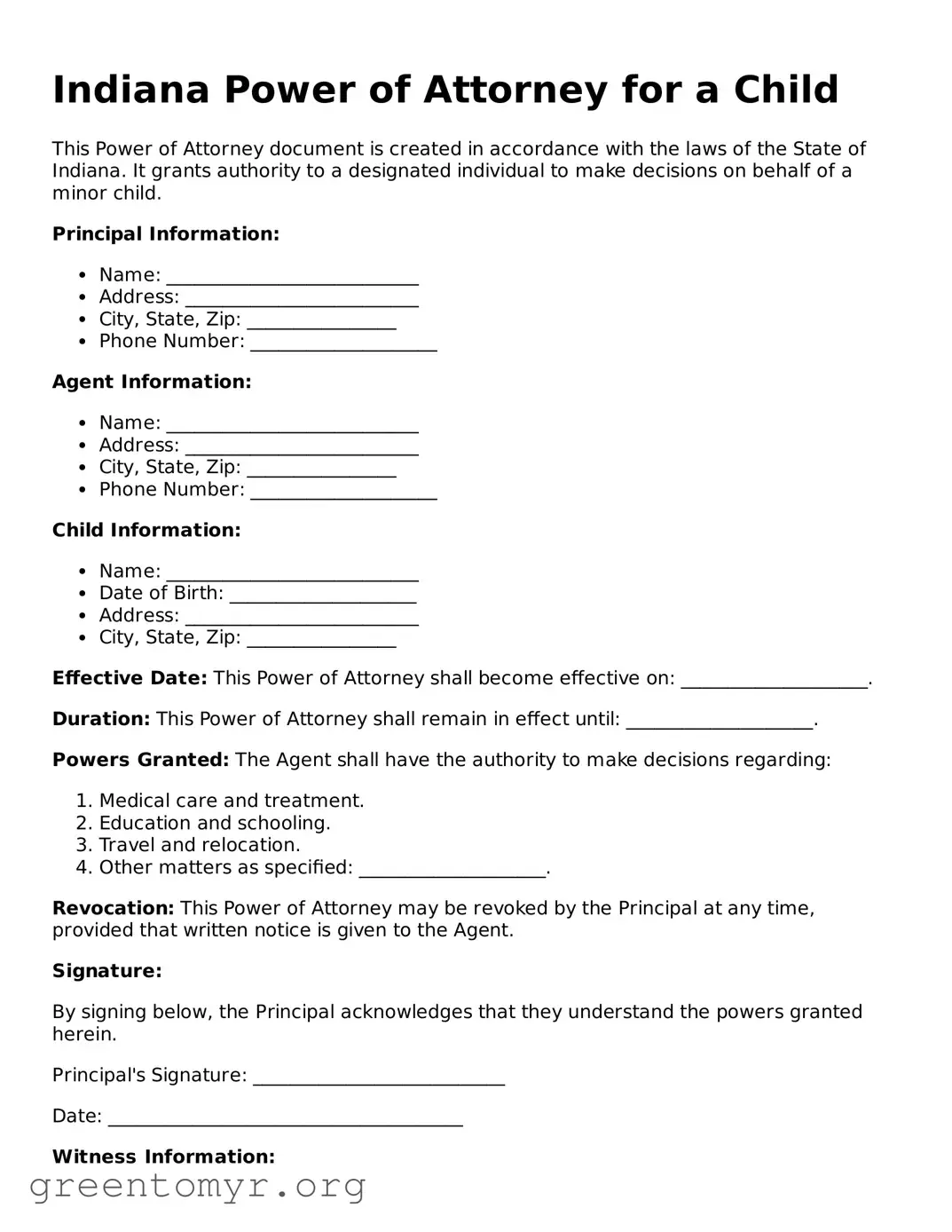
In Indiana, the Power of Attorney for a Child form serves as a crucial legal instrument that allows parents or guardians to delegate specific parental rights to another adult, often in situations where the parent may be unable to fulfill their responsibilities temporarily. This form is particularly beneficial for families facing unique circumstances, such as military deployment, extended travel, or medical emergencies. By completing this document, a parent can grant authority for a designated individual—often a relative or close family friend—to make important decisions regarding the child's welfare, education, and healthcare. The form outlines the scope of the powers granted, which can include decisions about schooling, medical care, and even consent for certain activities. Importantly, the Power of Attorney for a Child is designed to be flexible, allowing parents to specify the duration of the authority and any limitations they wish to impose. This ensures that while the designated individual has the necessary authority to act in the child’s best interests, the parent's overarching rights remain intact. Understanding this form is essential for any parent looking to ensure their child's needs are met during unforeseen circumstances.
Indiana Power of Attorney for a Child
This Power of Attorney document is created in accordance with the laws of the State of Indiana. It grants authority to a designated individual to make decisions on behalf of a minor child.
Principal Information:
Agent Information:
Child Information:
Effective Date: This Power of Attorney shall become effective on: ____________________.
Duration: This Power of Attorney shall remain in effect until: ____________________.
Powers Granted: The Agent shall have the authority to make decisions regarding:
Revocation: This Power of Attorney may be revoked by the Principal at any time, provided that written notice is given to the Agent.
Signature:
By signing below, the Principal acknowledges that they understand the powers granted herein.
Principal's Signature: ___________________________
Date: ______________________________________
Witness Information:
Witness Name: ___________________________
Witness Signature: ________________________
Date: ______________________________________
Notary Public:
State of Indiana, County of ____________________.
Subscribed and sworn to before me this ____ day of __________, 20__.
Notary Public Signature: ________________________
My Commission Expires: ______________________
| Fact Name | Details |
|---|---|
| Definition | The Indiana Power of Attorney for a Child form allows a parent or guardian to grant another adult authority to make decisions on behalf of their child. |
| Governing Law | This form is governed by Indiana Code § 30-5-1-1 et seq., which outlines the requirements and limitations of powers of attorney in Indiana. |
| Duration | The authority granted through this form can be limited to a specific period or event, such as a vacation or medical emergency. |
| Eligibility | Any adult may be appointed as an agent, provided they are willing to accept the responsibilities associated with the role. |
| Revocation | The parent or guardian can revoke the power of attorney at any time, as long as they provide written notice to the agent. |
| Notarization | While notarization is not strictly required, having the form notarized can help validate the document and prevent disputes. |
Filling out the Indiana Power of Attorney for a Child form requires careful attention to detail. After completing the form, you will need to ensure that it is properly signed and witnessed to be legally valid. This process may involve discussing the arrangement with relevant parties, including the child's parents and the designated agent.
A Power of Attorney for a Child in Indiana is a legal document that allows a parent or guardian to appoint another adult to make decisions on behalf of their child. This can include decisions about medical care, education, and general welfare. It is especially useful for temporary situations, such as when a parent is traveling or unable to care for the child for a period of time.
The agent, or the person appointed to act on behalf of the child, must be at least 18 years old and capable of making responsible decisions. This person can be a family member, friend, or trusted adult. It is crucial to choose someone who understands the child’s needs and can act in their best interest.
The Power of Attorney for a Child remains valid until the specified expiration date in the document or until it is revoked by the parent or guardian. If no expiration date is mentioned, it typically lasts until the child reaches the age of 18. It is important to review and update the document as necessary.
The agent can make a variety of decisions, including:
However, the agent cannot make decisions that are contrary to the wishes of the parent or guardian unless specified in the document.
Yes, in Indiana, the Power of Attorney for a Child must be signed by the parent or guardian in the presence of a notary public. This ensures that the document is legally binding and helps prevent any disputes regarding its validity.
Absolutely. A parent or guardian can revoke the Power of Attorney at any time by providing written notice to the agent and any relevant parties, such as schools or healthcare providers. It’s advisable to keep a record of the revocation for future reference.
If you need to use the Power of Attorney, present the document to the relevant parties, such as schools or healthcare providers. Ensure that the agent carries a copy of the document at all times. This will help facilitate any necessary decisions regarding the child’s care or education.
Power of Attorney for a Child forms can often be found online through legal websites, state government resources, or local legal aid organizations. It’s important to use a form that complies with Indiana law to ensure its validity.
When filling out the Indiana Power of Attorney for a Child form, many individuals inadvertently make mistakes that can lead to complications later on. Understanding these common pitfalls can help ensure that the form is completed correctly and that the intended legal authority is granted without issue.
One common mistake is failing to specify the duration of the power of attorney. It is crucial to indicate how long the authority will be in effect. Without a clear timeframe, the document may be deemed invalid or may lead to misunderstandings about when the authority begins and ends.
Another frequent error involves not identifying the child clearly. The form should include the child’s full name, date of birth, and any other identifying information. Omitting these details can create confusion and may hinder the ability of the designated agent to act on the child’s behalf.
People often neglect to sign the document in the presence of a notary. In Indiana, notarization is a critical step in validating the power of attorney. Failing to have the document notarized can render it unenforceable, leaving the agent without the legal authority they need.
Additionally, some individuals mistakenly assume that verbal agreements are sufficient. It is essential to have a written document that is properly filled out and signed. Relying on verbal discussions can lead to disputes and misunderstandings later on.
Another mistake is not discussing the arrangement with the child. While the child may not have a legal say in the process, ensuring they understand what is happening can help ease any anxiety or confusion. Open communication fosters trust and understanding.
People sometimes forget to list alternative agents. If the primary agent is unable to fulfill their duties, having a backup can be crucial. This step ensures that there is always someone available to make decisions in the child's best interest.
Moreover, failing to review the form for accuracy can lead to problems. Typos or incorrect information can invalidate the document or lead to legal challenges. Taking the time to double-check every detail is essential for a smooth process.
Another common oversight is not understanding the scope of authority granted. The form should clearly outline what decisions the agent can make. Ambiguities can lead to conflicts or unintended consequences, so clarity is vital.
Some individuals mistakenly assume that the power of attorney is permanent. In reality, this legal authority can be revoked at any time by the person who created it, as long as they are still capable of making decisions. Understanding this can alleviate concerns about long-term implications.
Finally, people often overlook keeping copies of the completed form. It is important to retain a copy for personal records and to provide copies to the designated agent and any relevant parties. This ensures that everyone involved is aware of the arrangement and can act accordingly.
When preparing to establish a Power of Attorney for a Child in Indiana, it is often helpful to have additional documents on hand. These documents can support the process and ensure that all necessary legal aspects are covered. Below is a list of forms and documents that may be used alongside the Power of Attorney for a Child.
Having these documents ready can streamline the process and ensure that the caregiver has all the necessary authority to act in the best interest of the child. Each form plays a role in clarifying responsibilities and ensuring smooth transitions in care.
Filling out the Indiana Power of Attorney for a Child form requires careful attention to detail. Here are five important dos and don'ts to consider.
Many people have misunderstandings about the Indiana Power of Attorney for a Child form. Clarifying these misconceptions can help ensure that individuals make informed decisions. Here are four common misconceptions:
In reality, the Power of Attorney for a Child form specifies the powers granted to the agent. It does not provide unrestricted authority. Parents can choose which decisions the agent can make, such as medical care or educational decisions.
This is not true. The Power of Attorney for a Child is typically temporary. It can be revoked at any time by the parent or guardian. Additionally, it may have a specific expiration date, depending on how it is drafted.
This misconception overlooks the fact that any parent can designate an agent using the form. Legal guardianship is not a requirement for appointing someone to make decisions for a child.
Some believe the form is only relevant for extended periods. However, it can also be useful for short-term situations, such as when a parent is traveling or temporarily unable to care for their child.
Filling out and using the Indiana Power of Attorney for a Child form is an important step for parents and guardians who need to delegate authority for the care of their child. Here are key takeaways to consider:
By keeping these key points in mind, you can effectively use the Indiana Power of Attorney for a Child form to ensure your child's needs are met during your absence.