In Indiana, a prenuptial agreement serves as a critical tool for couples preparing for marriage, allowing them to outline their financial rights and responsibilities should the relationship end in divorce or separation. This legally binding document can address a variety of aspects, including the division of property, management of debts, and the distribution of assets acquired during the marriage. Couples may also use the agreement to protect individual assets brought into the marriage, ensuring that each party’s financial interests are safeguarded. Furthermore, the form typically requires both parties to provide full disclosure of their financial situations, thus fostering transparency and mutual understanding. It is important to note that while prenuptial agreements can cover many financial matters, they cannot dictate terms related to child custody or child support, as these issues are subject to the court's discretion. With the proper execution of this form, couples can enter into marriage with a clearer understanding of their financial landscape, potentially reducing conflict and uncertainty in the future.
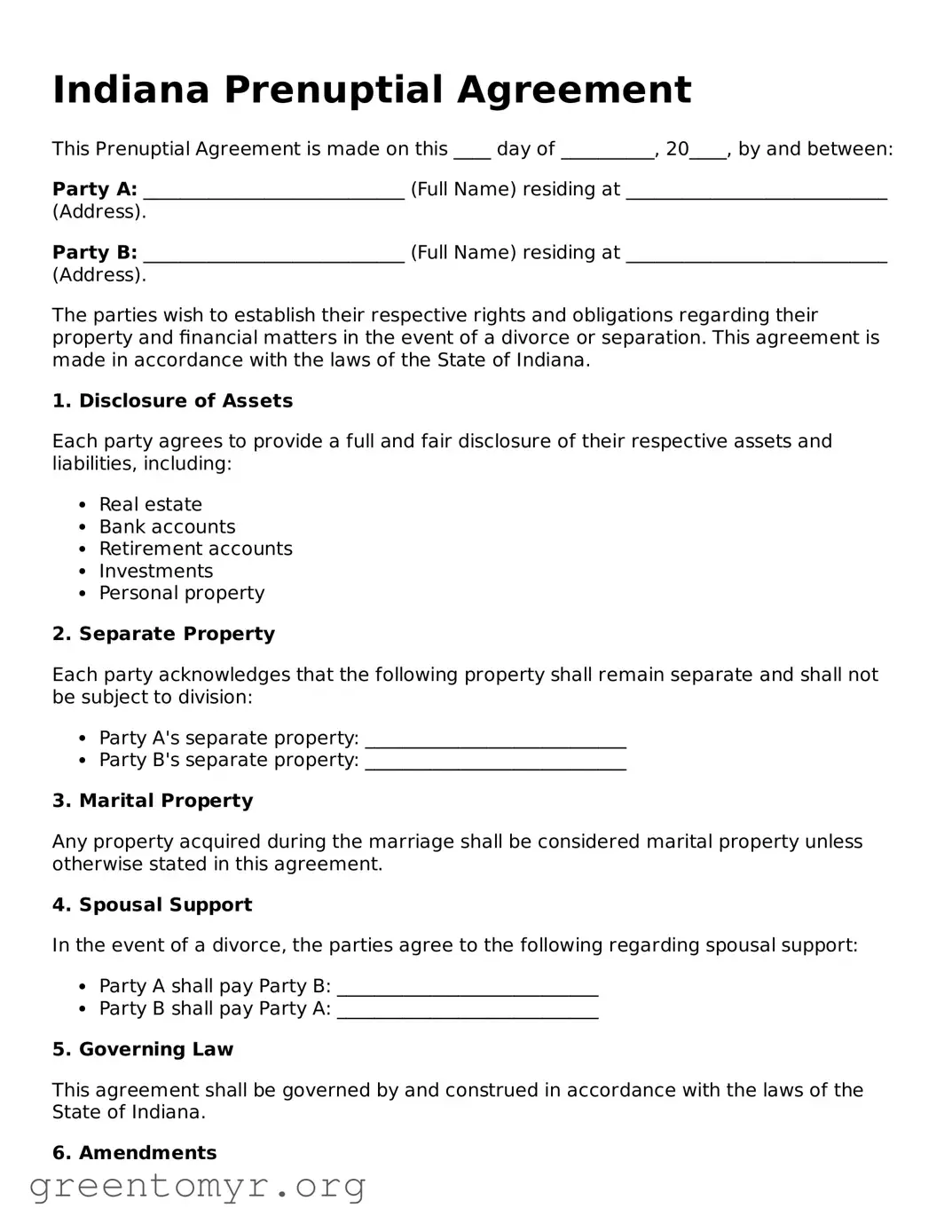
Indiana Prenuptial Agreement
This Prenuptial Agreement is made on this ____ day of __________, 20____, by and between:
Party A: ____________________________ (Full Name) residing at ____________________________ (Address).
Party B: ____________________________ (Full Name) residing at ____________________________ (Address).
The parties wish to establish their respective rights and obligations regarding their property and financial matters in the event of a divorce or separation. This agreement is made in accordance with the laws of the State of Indiana.
1. Disclosure of Assets
Each party agrees to provide a full and fair disclosure of their respective assets and liabilities, including:
2. Separate Property
Each party acknowledges that the following property shall remain separate and shall not be subject to division:
3. Marital Property
Any property acquired during the marriage shall be considered marital property unless otherwise stated in this agreement.
4. Spousal Support
In the event of a divorce, the parties agree to the following regarding spousal support:
5. Governing Law
This agreement shall be governed by and construed in accordance with the laws of the State of Indiana.
6. Amendments
This agreement may be amended only by a written document signed by both parties.
7. Severability
If any provision of this agreement is found to be invalid or unenforceable, the remaining provisions shall continue in full force and effect.
Signatures
By signing below, both parties agree to the terms outlined in this Prenuptial Agreement.
______________________________
Party A Signature
______________________________
Party B Signature
______________________________
Date
| Fact Name | Description |
|---|---|
| Definition | A prenuptial agreement is a contract between two individuals before they marry, outlining the division of assets and financial responsibilities in the event of divorce or separation. |
| Governing Law | Indiana law governs prenuptial agreements, specifically under Indiana Code § 31-11-3. |
| Enforceability | For a prenuptial agreement to be enforceable in Indiana, it must be in writing and signed by both parties. |
| Full Disclosure | Both parties are required to provide a full and fair disclosure of their financial situations prior to signing the agreement. |
| Voluntary Agreement | The agreement must be entered into voluntarily, without coercion or undue influence from either party. |
| Legal Representation | While not required, it is highly recommended that both parties seek independent legal advice before signing the agreement. |
| Modification | Prenuptial agreements can be modified or revoked after marriage, but this must be done in writing and signed by both parties. |
| Limitations | Indiana courts will not enforce provisions that are deemed to be unconscionable or violate public policy. |
| Children's Rights | Agreements cannot adversely affect the rights of children, such as child support or custody arrangements. |
| Common Misconceptions | Many believe prenuptial agreements are only for the wealthy, but they can benefit anyone who wants to clarify financial expectations. |
Completing the Indiana Prenuptial Agreement form requires careful attention to detail. This document outlines the financial rights and responsibilities of each party before marriage. Following these steps will help ensure that the form is filled out correctly and meets the necessary requirements.
A prenuptial agreement, often referred to as a "prenup," is a legal contract created by two individuals before they get married. In Indiana, this agreement outlines how assets and debts will be handled in the event of a divorce or separation. It can also specify other matters, such as spousal support and property rights. The agreement must be in writing and signed by both parties to be enforceable.
While each prenuptial agreement can be tailored to the couple's needs, some common elements include:
Yes, prenuptial agreements are generally enforceable in Indiana, provided they meet certain legal requirements. To be valid, the agreement must be in writing, signed by both parties, and entered into voluntarily. Additionally, it should not be unconscionable, meaning that it should not be excessively unfair to one party. Courts will review the agreement's terms and the circumstances under which it was created to determine its enforceability.
Creating a prenuptial agreement involves several steps:
Yes, a prenuptial agreement can be modified or revoked in Indiana. Both parties must agree to any changes, and these modifications should be documented in writing and signed by both individuals. It is advisable to consult with a legal professional when making changes to ensure that the updated agreement remains valid and enforceable.
When filling out the Indiana Prenuptial Agreement form, individuals often overlook crucial details that can lead to complications later on. One common mistake is not clearly defining the assets and debts each party is bringing into the marriage. It is essential to provide a comprehensive list of all financial interests, as vague descriptions can create confusion and potential disputes in the future. Both parties should take the time to discuss and agree upon what constitutes their individual and joint assets.
Another frequent error involves failing to update the agreement as circumstances change. Life events such as the birth of children, changes in income, or acquiring new assets should prompt a review and possible amendment of the prenuptial agreement. If these changes are not documented, the original agreement may not reflect the current financial situation, which could lead to misunderstandings or unfair outcomes.
Additionally, many individuals neglect to seek legal advice before signing the agreement. While it may seem unnecessary, having a legal professional review the document can ensure that it complies with Indiana laws and protects both parties' interests. Without proper guidance, individuals may inadvertently agree to terms that are not in their best interest or that could be unenforceable in court.
Lastly, couples sometimes rush through the process, leading to incomplete or inaccurate information. Taking the time to carefully fill out the form and ensuring that all sections are addressed is vital. Rushing can lead to mistakes that might not be discovered until it is too late. It is important to approach this agreement with the seriousness it deserves, as it lays the groundwork for a fair and equitable relationship.
When preparing for a marriage, many couples consider a prenuptial agreement to protect their individual assets and clarify financial responsibilities. Along with the Indiana Prenuptial Agreement form, there are several other documents that can be useful in ensuring a comprehensive understanding of each partner's financial situation and obligations. Below is a list of some key forms and documents that often accompany a prenuptial agreement.
Each of these documents serves a unique purpose and can significantly enhance the clarity and security of a couple's financial and personal arrangements. By addressing these aspects, partners can build a strong foundation for their marriage, ensuring that both parties are informed and prepared for the future.
When filling out the Indiana Prenuptial Agreement form, it’s essential to approach the process with care and consideration. Here are ten important dos and don’ts to keep in mind:
By following these guidelines, you can create a prenuptial agreement that protects both parties and lays a solid foundation for your future together.
Many people have misunderstandings about prenuptial agreements in Indiana. Here are seven common misconceptions:
Many believe that only rich couples need a prenuptial agreement. In reality, anyone can benefit from one, regardless of income. It helps clarify financial responsibilities and protect assets.
Some think these agreements are only relevant if a marriage ends. However, they can also outline financial expectations and responsibilities during the marriage.
Many assume that prenuptial agreements hold no legal weight. In Indiana, if properly drafted and executed, they are legally binding.
It's a common myth that these agreements can dictate child custody arrangements. In Indiana, custody decisions are made based on the child's best interests at the time of separation or divorce.
This misconception suggests that only couples anticipating a breakup should consider a prenup. In fact, they can help couples discuss and agree on financial matters before marriage.
While some may think these agreements require extensive legal work and high costs, they can be straightforward and affordable, especially with the right guidance.
Some people view prenuptial agreements as a lack of trust or love. In truth, they can promote open communication and strengthen a relationship by addressing financial concerns proactively.
When considering a prenuptial agreement in Indiana, it is essential to understand the key aspects of the process. Here are five important takeaways:
By keeping these points in mind, individuals can better navigate the process of creating a prenuptial agreement in Indiana.