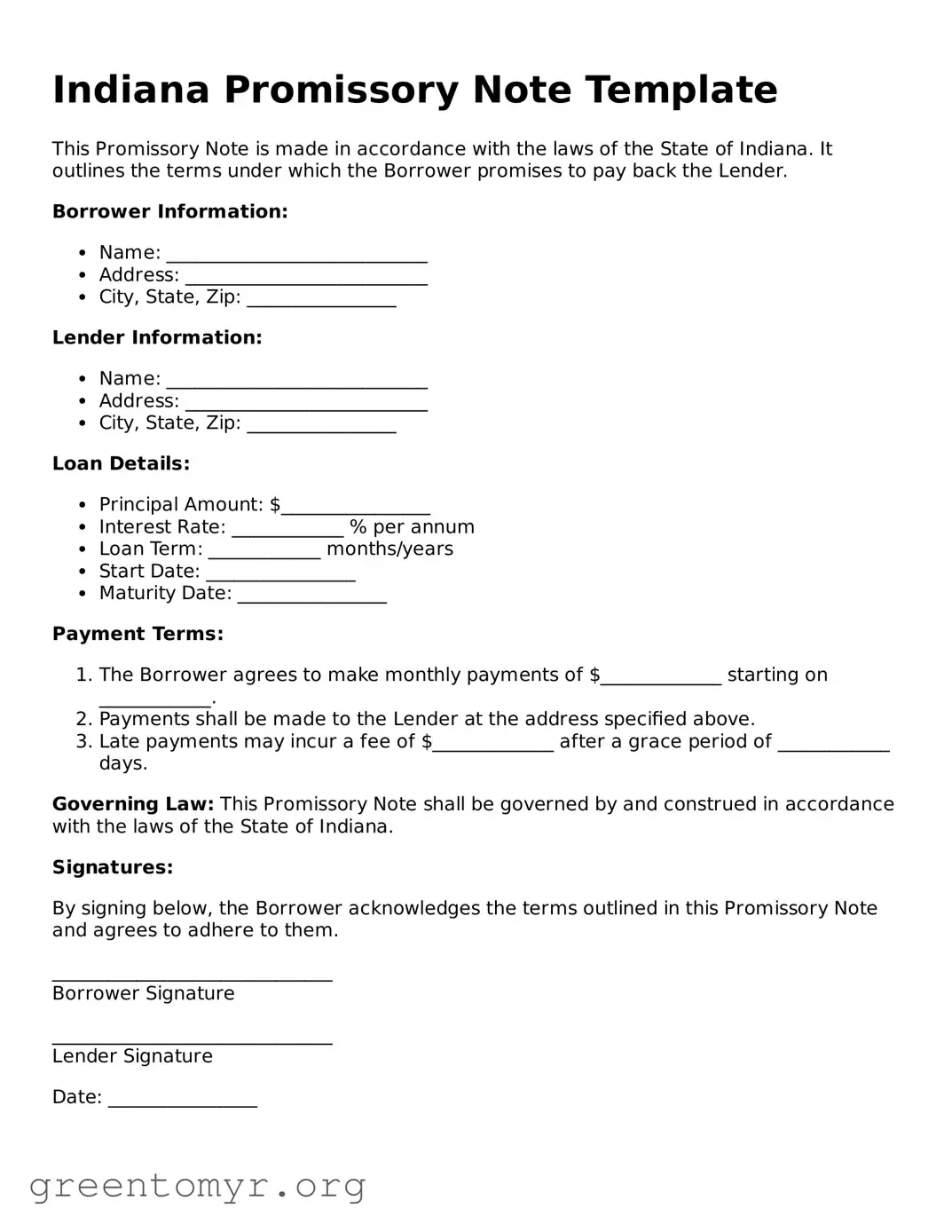
The Indiana Promissory Note form serves as a crucial document in financial transactions, facilitating the borrowing and lending of money between parties. This form outlines the borrower's commitment to repay a specified amount, including details such as the interest rate, repayment schedule, and consequences for default. It is essential for both lenders and borrowers to understand the terms laid out in the note, as it provides a clear framework for the agreement. The form can be customized to fit various lending situations, whether for personal loans, business financing, or real estate transactions. By utilizing this legal instrument, individuals can ensure that their financial agreements are documented and enforceable, minimizing potential disputes in the future. Properly executed, the Indiana Promissory Note promotes transparency and accountability, establishing a solid foundation for trust in financial relationships.
Indiana Promissory Note Template
This Promissory Note is made in accordance with the laws of the State of Indiana. It outlines the terms under which the Borrower promises to pay back the Lender.
Borrower Information:
Lender Information:
Loan Details:
Payment Terms:
Governing Law: This Promissory Note shall be governed by and construed in accordance with the laws of the State of Indiana.
Signatures:
By signing below, the Borrower acknowledges the terms outlined in this Promissory Note and agrees to adhere to them.
______________________________
Borrower Signature
______________________________
Lender Signature
Date: ________________
| Fact Name | Details |
|---|---|
| Definition | An Indiana Promissory Note is a written promise to pay a specified amount of money to a designated person or entity at a future date. |
| Governing Law | The Indiana Promissory Note is governed by Indiana Code Title 26, Article 3, which covers negotiable instruments. |
| Parties Involved | The note typically involves two parties: the borrower (maker) and the lender (payee). |
| Interest Rate | The interest rate can be specified within the note, subject to Indiana’s usury laws. |
| Payment Terms | Payment terms should be clearly outlined, including the due date and any installment schedules. |
| Signature Requirement | The promissory note must be signed by the maker to be legally binding. |
| Default Clauses | It is advisable to include clauses that outline the consequences of defaulting on the payment. |
| Transferability | Promissory notes in Indiana can be transferred or assigned to another party unless stated otherwise in the note. |
| Enforceability | To be enforceable, the note must meet the legal requirements set forth in Indiana law. |
After you have the Indiana Promissory Note form ready, you'll need to fill it out carefully. Make sure you have all necessary information on hand, including the names of the parties involved, the loan amount, and the repayment terms. Following these steps will help you complete the form correctly.
A promissory note is a written promise to pay a specific amount of money to a designated person or entity at a specified time or on demand. It serves as a formal agreement between a borrower and a lender, outlining the terms of the loan, including the interest rate, repayment schedule, and any collateral involved.
The Indiana promissory note is crucial because it provides legal protection for both the borrower and the lender. It clearly outlines the obligations of each party, helping to prevent misunderstandings or disputes. Should a disagreement arise, the note can serve as evidence in court, making it a vital document in any lending arrangement.
An Indiana promissory note typically includes the following key components:
Yes, a promissory note can be modified after it is signed, but this typically requires the agreement of both parties. Any changes should be documented in writing and signed by both the borrower and the lender to ensure that the modifications are legally binding. Verbal agreements may not hold up in court, so it’s essential to keep everything in writing.
While notarization is not strictly required for a promissory note to be valid in Indiana, it is highly recommended. Having the document notarized can add an extra layer of authenticity and can be beneficial if the note needs to be enforced in court. A notary public verifies the identities of the signers, which can help prevent disputes about the validity of the signatures.
If the borrower fails to repay the loan as outlined in the promissory note, the lender has several options. They may choose to initiate legal proceedings to recover the owed amount. In some cases, the lender may also pursue collection actions or negotiate a settlement. The specifics of these actions will depend on the terms of the note and applicable state laws.
Yes, Indiana law imposes certain limitations on interest rates. Generally, the maximum interest rate that can be charged on a promissory note is governed by state usury laws. It is essential for lenders to be aware of these limits to avoid charging excessive interest, which could lead to legal issues.
Absolutely! A promissory note is commonly used for personal loans between friends, family, or even acquaintances. It formalizes the agreement and helps ensure that both parties understand their obligations. By using a promissory note, individuals can maintain a clear record of the loan, which can help prevent misunderstandings down the line.
Templates for Indiana promissory notes can be found online through legal document websites, or you may consult with a legal professional for assistance. Many templates are customizable, allowing you to tailor the document to your specific needs. Be sure to review any template carefully to ensure it complies with Indiana laws and accurately reflects your agreement.
Filling out the Indiana Promissory Note form can seem straightforward, but many individuals make common mistakes that can lead to complications. One frequent error is failing to include all necessary parties. It is essential to clearly identify both the borrower and the lender. Omitting one party's name can create confusion and may render the document unenforceable.
Another mistake is neglecting to specify the loan amount. The amount must be clearly stated in both numerical and written form. This dual representation helps prevent disputes over the actual amount owed. If the loan amount is left blank or incorrectly filled out, it can lead to misunderstandings down the line.
Many individuals also overlook the importance of including the interest rate. Without this crucial detail, the terms of the loan can become ambiguous. An unclear interest rate may result in legal challenges if repayment issues arise. Clearly stating the interest rate ensures that both parties understand their obligations.
Additionally, people often forget to outline the repayment schedule. It is vital to specify when payments are due and the method of payment. A vague repayment schedule can lead to missed payments and potential legal consequences. By detailing the schedule, both parties can avoid future disputes.
Another common error is failing to sign the document. A Promissory Note is not valid unless it is signed by the borrower. Both parties should also consider having the document notarized to add an extra layer of legitimacy. A missing signature can invalidate the agreement.
Some individuals mistakenly assume that a verbal agreement is sufficient. However, a Promissory Note should always be documented in writing. Relying solely on verbal promises can lead to misunderstandings and disputes. Having a written record protects both parties and clarifies the terms of the loan.
Finally, individuals often neglect to keep copies of the completed Promissory Note. It is crucial for both the borrower and lender to retain a copy for their records. Without a copy, either party may struggle to prove the terms of the agreement in the future. Keeping a record ensures that both parties can refer back to the original terms if necessary.
When dealing with a Promissory Note in Indiana, several other documents may be needed to ensure a comprehensive understanding of the agreement and to protect all parties involved. Below is a list of commonly used forms and documents that complement the Indiana Promissory Note.
Understanding these documents is crucial for both lenders and borrowers. They provide clarity and legal protection throughout the lending process. Ensure all necessary forms are in place to avoid complications in the future.
When filling out the Indiana Promissory Note form, attention to detail is crucial. Here’s a helpful list of things to do and things to avoid to ensure your form is completed correctly.
Things You Should Do:
Things You Shouldn't Do:
By following these guidelines, individuals can navigate the process of filling out the Indiana Promissory Note form with confidence and clarity.
Many people hold misconceptions about the Indiana Promissory Note form. Understanding the truth can help avoid confusion and ensure proper use of this important financial document. Here are four common misconceptions:
Clarifying these misconceptions can help individuals navigate financial agreements more effectively. Always consider seeking legal advice if uncertain about any aspect of a promissory note.
When filling out and using the Indiana Promissory Note form, several important considerations should be kept in mind. The following key takeaways provide guidance on the process: