In the realm of estate planning and administration, navigating the complexities of asset distribution can often feel overwhelming, especially during times of grief. For those in Indiana, the Small Estate Affidavit offers a streamlined approach to settling the affairs of a deceased loved one without the need for a lengthy probate process. This form is particularly beneficial for estates that fall below a certain value threshold, allowing heirs to claim assets more efficiently. With the Small Estate Affidavit, individuals can assert their rights to inherit property, bank accounts, and other assets, provided they meet specific criteria set forth by Indiana law. The process not only simplifies the transfer of ownership but also empowers family members to manage their loved one's estate with dignity and ease. By understanding the requirements and implications of this form, individuals can take proactive steps to ensure a smoother transition during an already challenging time.
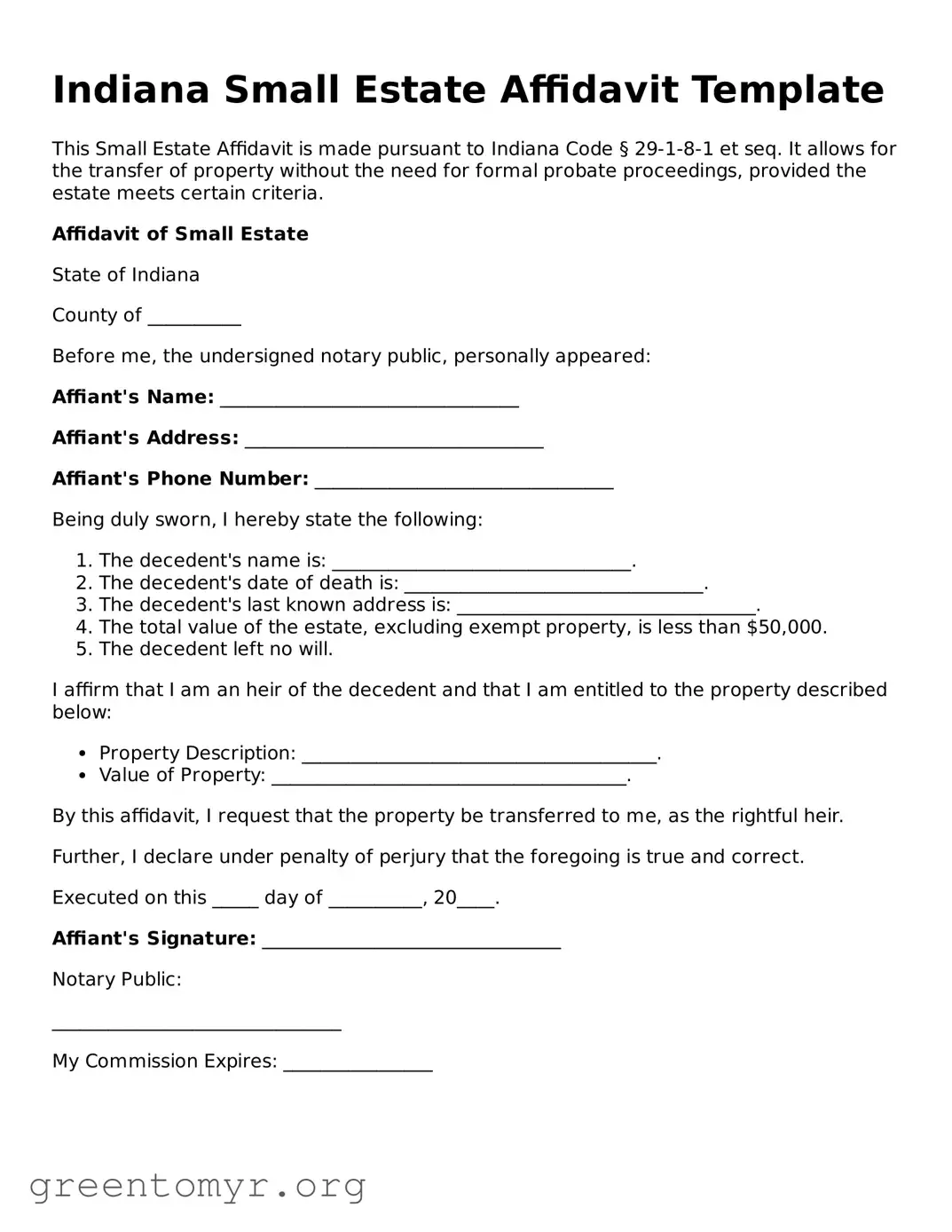
Indiana Small Estate Affidavit Template
This Small Estate Affidavit is made pursuant to Indiana Code § 29-1-8-1 et seq. It allows for the transfer of property without the need for formal probate proceedings, provided the estate meets certain criteria.
Affidavit of Small Estate
State of Indiana
County of __________
Before me, the undersigned notary public, personally appeared:
Affiant's Name: ________________________________
Affiant's Address: ________________________________
Affiant's Phone Number: ________________________________
Being duly sworn, I hereby state the following:
I affirm that I am an heir of the decedent and that I am entitled to the property described below:
By this affidavit, I request that the property be transferred to me, as the rightful heir.
Further, I declare under penalty of perjury that the foregoing is true and correct.
Executed on this _____ day of __________, 20____.
Affiant's Signature: ________________________________
Notary Public:
_______________________________
My Commission Expires: ________________
| Fact Name | Description |
|---|---|
| Purpose | The Indiana Small Estate Affidavit allows individuals to claim a deceased person's assets without going through probate if the total value is below a certain threshold. |
| Eligibility | To use this form, the estate must not exceed $50,000 in value, excluding real estate. |
| Governing Law | This form is governed by Indiana Code § 29-1-8-1, which outlines the requirements for small estates. |
| Filing Process | The affidavit must be signed by the heirs and filed with the appropriate county office to claim the assets. |
| Limitations | Only certain types of assets can be claimed using this affidavit, such as bank accounts and personal property. |
Once you have the Indiana Small Estate Affidavit form in hand, you can begin filling it out. This document is essential for managing the estate of a deceased person when the total value of their assets falls below a certain threshold. Follow the steps below to complete the form accurately.
After submitting the affidavit, you may need to follow up with the court to ensure it has been processed. Keep copies of all documents for your records.
The Indiana Small Estate Affidavit is a legal document that allows individuals to claim property or assets from a deceased person's estate without going through the formal probate process. This form is typically used when the total value of the estate is below a certain threshold, making the process simpler and quicker for heirs.
Individuals who are entitled to inherit from the deceased person can use the Small Estate Affidavit. This may include heirs such as spouses, children, or other relatives. To qualify, the total value of the estate must not exceed $50,000, excluding certain assets like real estate. It is advisable to confirm eligibility based on the specific circumstances of the estate.
To complete the Indiana Small Estate Affidavit, the following information is typically required:
The Small Estate Affidavit must be filed with the local probate court in the county where the deceased person lived at the time of death. After completing the form, individuals should submit it along with any required documentation. It is important to check with the local court for any specific filing requirements or additional forms that may be needed.
Yes, there may be filing fees associated with submitting the Small Estate Affidavit. These fees can vary by county. It is advisable to contact the local probate court for the exact fee schedule and any other potential costs related to the process.
Once the Small Estate Affidavit is filed, the court will review the document. If everything is in order, the court may issue an order allowing the transfer of the assets to the heirs. The heirs can then collect the property or assets as specified in the affidavit. It is important to keep copies of all documents for personal records.
Yes, the Small Estate Affidavit can be contested by other potential heirs or interested parties. If someone believes they have a rightful claim to the estate, they may file an objection with the court. It is advisable to consult with a legal professional if there are concerns about potential disputes.
Filling out the Indiana Small Estate Affidavit form can be straightforward, but many people make common mistakes that can delay the process. One frequent error is not providing all required information. The form requires specific details about the deceased, the estate, and the heirs. Omitting any of this information can lead to complications.
Another mistake is failing to sign the affidavit. A signature is crucial for the document to be valid. If the form is submitted without a signature, it will be rejected, causing further delays in settling the estate.
Some individuals forget to include the date of death. This information is vital as it helps establish the timeline for the estate’s administration. Without this date, the affidavit may not be accepted.
Not listing all beneficiaries accurately is another common issue. All individuals who are entitled to a share of the estate must be included. Leaving someone out can lead to disputes or legal challenges later on.
People often miscalculate the total value of the estate. The Indiana Small Estate Affidavit is only applicable if the estate is valued at $50,000 or less. Overestimating the value can disqualify the estate from using this simplified process.
Another mistake is using outdated forms. It is essential to ensure that the most current version of the Indiana Small Estate Affidavit is being used. Using an old form may lead to issues with acceptance.
Some filers neglect to provide identification. A valid form of identification for the affiant is necessary to verify their identity. Without this, the affidavit may not be processed.
Not following the instructions for notarization can also be problematic. The affidavit must be notarized to be legally binding. Skipping this step can invalidate the document.
Many people forget to make copies of the completed affidavit. Keeping copies is important for personal records and may be required for future reference during the estate settlement process.
Lastly, failing to check for errors before submission can lead to unnecessary setbacks. Simple mistakes in spelling or numbers can cause delays. It’s always best to review the form thoroughly before sending it off.
The Indiana Small Estate Affidavit is a useful document for individuals seeking to settle the estate of a deceased person without going through a full probate process. When preparing to use this affidavit, several other forms and documents may also be necessary to ensure a smooth transition of assets. Below is a list of these commonly used documents.
Gathering these documents can help streamline the process of settling an estate in Indiana. Each item plays a critical role in ensuring that all legal requirements are met and that the deceased's wishes are honored. Being organized and prepared will facilitate a smoother experience during this challenging time.
The Small Estate Affidavit form is a useful tool for settling estates with minimal assets. Several other documents serve similar purposes in estate management and probate processes. Here’s a list of nine documents that share similarities with the Small Estate Affidavit:
When filling out the Indiana Small Estate Affidavit form, it's important to follow specific guidelines to ensure accuracy and compliance. Below is a list of things you should and shouldn't do.
By adhering to these guidelines, you can ensure a smoother process when dealing with the Small Estate Affidavit in Indiana.
When dealing with the Indiana Small Estate Affidavit, several misconceptions often arise. Understanding the truth behind these myths can help individuals navigate the estate settlement process more effectively. Here are nine common misconceptions:
This is not true. The Small Estate Affidavit is designed for estates that meet specific criteria, regardless of the overall wealth of the deceased. In Indiana, if the total value of the estate is under $50,000, the affidavit can be utilized.
While it may seem daunting at first, the Small Estate Affidavit is relatively straightforward. Many individuals can complete it without needing an attorney, provided they understand the required information.
Not all debts need to be settled before utilizing the affidavit. However, the estate’s assets may need to be used to cover debts, and the affidavit should accurately reflect the estate's liabilities.
This is a misconception. The Small Estate Affidavit can be used for both personal property and real estate, as long as the total value falls within the specified limits.
While the affidavit simplifies the process, it does not eliminate all legal requirements. For example, it still requires proper filing and may involve court oversight in certain situations.
In fact, any heir or beneficiary can file the affidavit. This flexibility allows for a smoother process, especially if the executor is unavailable.
This is incorrect. While the affidavit provides a streamlined process, it can still be subject to challenge by other heirs or creditors if there are disputes regarding the estate.
While it is specific to Indiana law, individuals with property in Indiana, regardless of their residency, can utilize the Small Estate Affidavit for that property.
This is misleading. The Small Estate Affidavit is best suited for straightforward estates. Complex estates with multiple assets or significant debts may require formal probate proceedings.
By dispelling these misconceptions, individuals can better understand the Indiana Small Estate Affidavit and make informed decisions regarding estate management.
Filling out and utilizing the Indiana Small Estate Affidavit form can simplify the process of transferring assets after a loved one’s passing. Here are some essential points to keep in mind: