Content Navigation

When buying or selling a trailer in Indiana, having the right paperwork is crucial for a smooth transaction. The Indiana Trailer Bill of Sale form serves as an important document that outlines the details of the sale, ensuring both the buyer and seller are protected. This form includes key information such as the names and addresses of both parties, a description of the trailer being sold, and the sale price. It also provides space for signatures, which confirms that both parties agree to the terms of the sale. Additionally, the form may include details about any liens on the trailer, helping to clarify ownership and avoid future disputes. Understanding this form can make the buying or selling process more straightforward and help ensure that all legal requirements are met.

Indiana Trailer Bill of Sale Example

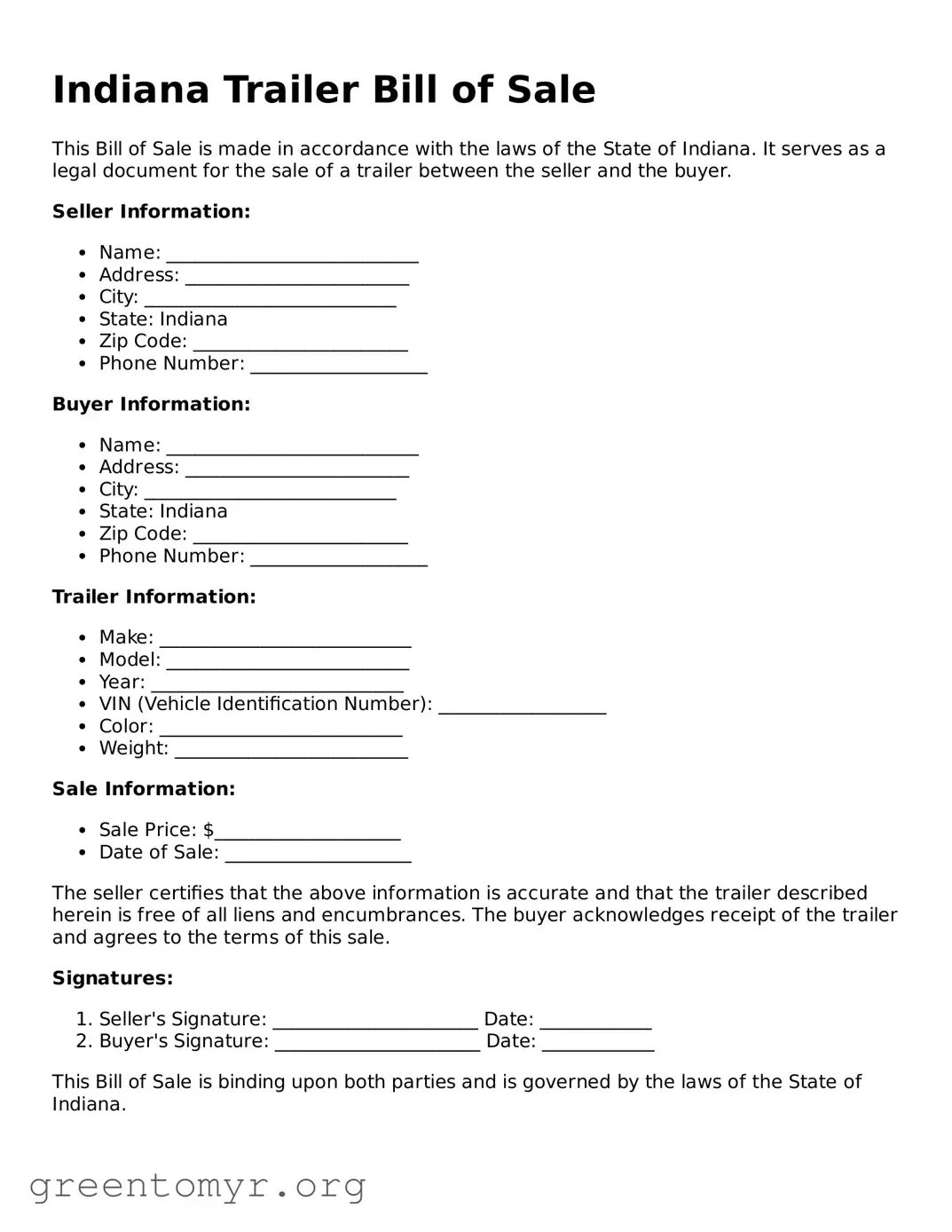
Indiana Trailer Bill of Sale

This Bill of Sale is made in accordance with the laws of the State of Indiana. It serves as a legal document for the sale of a trailer between the seller and the buyer.

Seller Information:

  • Name: ___________________________
  • Address: ________________________
  • City: ___________________________
  • State: Indiana
  • Zip Code: _______________________
  • Phone Number: ___________________

Buyer Information:

  • Name: ___________________________
  • Address: ________________________
  • City: ___________________________
  • State: Indiana
  • Zip Code: _______________________
  • Phone Number: ___________________

Trailer Information:

  • Make: ___________________________
  • Model: __________________________
  • Year: ___________________________
  • VIN (Vehicle Identification Number): __________________
  • Color: __________________________
  • Weight: _________________________

Sale Information:

  • Sale Price: $____________________
  • Date of Sale: ____________________

The seller certifies that the above information is accurate and that the trailer described herein is free of all liens and encumbrances. The buyer acknowledges receipt of the trailer and agrees to the terms of this sale.

Signatures:

  1. Seller's Signature: ______________________ Date: ____________
  2. Buyer's Signature: ______________________ Date: ____________

This Bill of Sale is binding upon both parties and is governed by the laws of the State of Indiana.

PDF Form Features

Fact Name Description
Purpose The Indiana Trailer Bill of Sale form is used to document the sale of a trailer, providing a record for both the buyer and seller.
Governing Law This form is governed by Indiana state law, specifically the Indiana Code Title 9, Article 17, which covers vehicle registration and titling.
Required Information The form typically requires details such as the buyer's and seller's names, the trailer's description, and the sale price.
Importance Completing this form is crucial for transferring ownership legally and ensuring proper registration with the Indiana Bureau of Motor Vehicles (BMV).

Guide to Using Indiana Trailer Bill of Sale

After gathering the necessary information, you will be prepared to complete the Indiana Trailer Bill of Sale form. This document is essential for transferring ownership of a trailer and requires specific details about both the seller and the buyer, as well as information about the trailer itself. Follow the steps below to ensure that you fill out the form accurately.

  1. Begin by entering the date of the sale at the top of the form.
  2. In the section for the seller's information, provide the full name and address of the seller.
  3. Next, fill in the buyer's information with the full name and address of the buyer.
  4. Identify the trailer by including its make, model, year, and Vehicle Identification Number (VIN).
  5. Indicate the sale price of the trailer clearly in the designated space.
  6. If applicable, include any additional terms of the sale or conditions that both parties have agreed upon.
  7. Both the seller and the buyer must sign and date the form to validate the transaction.

Once the form is completed, make sure to provide a copy to the buyer for their records. The original document should be kept safe, as it may be required for future reference or registration purposes.

Get Answers on Indiana Trailer Bill of Sale

What is a Trailer Bill of Sale in Indiana?

A Trailer Bill of Sale is a legal document that serves as proof of the transfer of ownership of a trailer from one person to another in Indiana. This form includes essential details such as the buyer's and seller's names, addresses, and the trailer's identification information. It acts as a receipt for the transaction and is important for both parties to keep for their records.

Why is a Trailer Bill of Sale important?

This document is crucial for several reasons:

  • It provides legal evidence of the sale, protecting both the buyer and the seller.
  • It helps in the registration of the trailer with the state, ensuring that the new owner can legally use it on the road.
  • In case of disputes, it serves as a reference point to clarify the terms of the sale.

What information is required on the Trailer Bill of Sale?

To complete the Trailer Bill of Sale, you will need to include the following information:

  1. The full names and addresses of both the buyer and the seller.
  2. A detailed description of the trailer, including the make, model, year, and Vehicle Identification Number (VIN).
  3. The sale price of the trailer.
  4. The date of the transaction.
  5. Any additional terms agreed upon by both parties, such as warranties or conditions of the sale.

Do I need to have the Trailer Bill of Sale notarized?

In Indiana, notarization of the Trailer Bill of Sale is not strictly required. However, having the document notarized can add an extra layer of security and authenticity. It may be beneficial if either party wishes to ensure that the transaction is formally recognized, especially for high-value trailers or in cases where disputes might arise.

Where can I obtain a Trailer Bill of Sale form?

You can obtain a Trailer Bill of Sale form from several sources:

  • Online legal form websites often provide downloadable templates.
  • Local DMV offices may have forms available or can guide you on how to create one.
  • Consulting with a local attorney can also help you draft a customized bill of sale that meets your specific needs.

Common mistakes

Filling out the Indiana Trailer Bill of Sale form can be straightforward, but many individuals make common mistakes that can lead to complications. One frequent error is failing to provide complete information about the trailer. This includes not listing the correct Vehicle Identification Number (VIN) or neglecting to include the make and model. Incomplete details can create issues during registration and ownership transfer.

Another mistake is not obtaining the seller's signature. The Bill of Sale requires the seller's signature to validate the transaction. Without this, the document may not be legally binding, leaving the buyer vulnerable to disputes regarding ownership.

People often forget to date the form properly. The date of the sale is crucial for establishing when the ownership transferred. An incorrect or missing date can complicate future registration and might affect tax obligations.

Some individuals overlook the importance of including the purchase price. This detail is not only necessary for the buyer and seller's records but is also essential for tax purposes. Leaving this blank can lead to confusion and potential legal issues later on.

Another common error is neglecting to provide the buyer's information accurately. This includes the buyer's full name and address. Incorrect or incomplete information can result in problems when trying to register the trailer or if disputes arise.

People sometimes fail to check the form for accuracy before submission. Simple typos or errors can lead to significant issues. It's essential to review the entire document to ensure all information is correct and complete.

Additionally, some individuals do not keep a copy of the completed Bill of Sale. This document serves as proof of purchase and ownership transfer. Without a copy, the buyer may face difficulties in the future, especially if disputes arise.

Lastly, misunderstanding the requirements for notarization can lead to issues. While notarization is not always necessary for a Bill of Sale in Indiana, certain circumstances may require it. Not knowing these requirements can result in a document that is not legally recognized.

Documents used along the form

The Indiana Trailer Bill of Sale form is an essential document for transferring ownership of a trailer. However, several other forms and documents often accompany this transaction to ensure that all legal requirements are met and that both parties are protected. Below is a list of these important documents.

  • Title Certificate: This document proves ownership of the trailer. It must be signed over by the seller to the buyer during the sale.
  • Odometer Disclosure Statement: Required for certain trailers, this statement records the mileage of the trailer at the time of sale, ensuring transparency in the transaction.
  • Bill of Sale for Personal Property: This general document serves as a receipt for the transaction and outlines the terms of the sale, including the purchase price.
  • Affidavit of Ownership: In cases where the title is lost, this affidavit helps establish the seller's ownership and can facilitate the sale process.
  • Sales Tax Exemption Certificate: If the buyer qualifies for a sales tax exemption, this certificate must be filled out to avoid unnecessary tax charges.
  • Vehicle Registration Application: After purchasing the trailer, the buyer needs to complete this application to register the trailer with the state.
  • Insurance Policy Documentation: Proof of insurance may be required before the trailer can be registered. This document verifies that the buyer has obtained coverage.
  • Inspection Certificate: If applicable, this certificate confirms that the trailer has passed any necessary safety inspections prior to sale.
  • Power of Attorney: If the seller cannot be present during the sale, this document allows another person to sign on their behalf, facilitating the transaction.
  • Notice of Transfer: This document notifies the state of the change in ownership, which is crucial for updating public records.

By utilizing these documents alongside the Indiana Trailer Bill of Sale form, both buyers and sellers can ensure a smooth and legally compliant transaction. It is advisable to keep copies of all documents for personal records and future reference.

Similar forms

  • Vehicle Bill of Sale: This document serves a similar purpose by transferring ownership of a vehicle from one party to another. It includes details like the vehicle's make, model, and VIN, ensuring both parties have a clear record of the transaction.
  • Boat Bill of Sale: Like the Trailer Bill of Sale, this form is used to document the sale of a boat. It includes information about the boat, such as its identification number and condition, providing proof of ownership transfer.
  • Motorcycle Bill of Sale: This document facilitates the sale of a motorcycle, outlining essential details such as the motorcycle's specifications and the buyer and seller's information. It acts as a legal record of the transaction.
  • RV Bill of Sale: Similar to the Trailer Bill of Sale, this form is specifically designed for recreational vehicles. It captures vital information about the RV, including its title and registration details, ensuring a smooth ownership transfer.

Dos and Don'ts

When filling out the Indiana Trailer Bill of Sale form, it's important to follow certain guidelines to ensure a smooth transaction. Here are seven things you should and shouldn't do:

  • Do provide accurate information about the trailer, including its make, model, and Vehicle Identification Number (VIN).
  • Don't leave any fields blank. Every section of the form should be completed to avoid confusion.
  • Do include the sale price clearly to document the transaction amount.
  • Don't use vague descriptions. Be specific about the trailer's condition and any included accessories.
  • Do sign and date the form to validate the sale.
  • Don't forget to have the buyer sign as well, as their signature is crucial for the transfer of ownership.
  • Do keep a copy of the completed form for your records after the sale is finalized.

Misconceptions

The Indiana Trailer Bill of Sale form is an important document for anyone buying or selling a trailer in the state of Indiana. However, several misconceptions surround this form. Understanding these misconceptions can help ensure that transactions are smooth and legally sound. Below are some common misunderstandings:

  • It is not necessary to have a bill of sale for trailers. Many people believe that a bill of sale is optional when buying or selling a trailer. In reality, having a bill of sale is crucial as it serves as proof of the transaction and can help resolve disputes in the future.
  • All trailers require a title. Some individuals think that every trailer must have a title. However, certain smaller trailers may not require a title, depending on their weight and value. It is essential to check Indiana’s specific regulations regarding title requirements.
  • Only the seller needs to sign the bill of sale. A common assumption is that only the seller's signature is required on the bill of sale. In fact, both the buyer and seller should sign the document to validate the transaction and ensure both parties agree to the terms.
  • The bill of sale is not needed for registration. Some people believe that the bill of sale is unnecessary for registering the trailer with the state. This is incorrect; the bill of sale is often required to prove ownership when registering the trailer.
  • There is no specific format for the bill of sale. Many think that any handwritten note will suffice as a bill of sale. However, using a specific format helps ensure that all necessary information is included, which can prevent issues later on.
  • Once the bill of sale is signed, the transaction is complete. Some individuals believe that signing the bill of sale finalizes the transaction. While it is an important step, the buyer must also complete the registration process and pay any applicable fees to fully transfer ownership.

By addressing these misconceptions, individuals can better navigate the process of buying or selling a trailer in Indiana. A clear understanding of the requirements and implications can lead to a more successful transaction.

Key takeaways

When filling out and using the Indiana Trailer Bill of Sale form, there are several important points to keep in mind. This document serves as proof of the sale and transfer of ownership of a trailer. Here are key takeaways to ensure a smooth process:

  1. Accurate Information: Ensure that all information, including the names, addresses, and contact details of both the seller and buyer, is accurate and up to date.
  2. Trailer Details: Include specific details about the trailer, such as the make, model, year, Vehicle Identification Number (VIN), and any other identifying features.
  3. Purchase Price: Clearly state the purchase price of the trailer. This amount should reflect the agreed-upon value between the buyer and seller.
  4. Signatures Required: Both the seller and buyer must sign the bill of sale. Without signatures, the document may not be considered valid.
  5. Date of Sale: Include the date when the sale takes place. This helps establish a timeline for ownership transfer.
  6. Notarization: While notarization is not always required, having the document notarized can add an extra layer of authenticity and protection.
  7. Keep Copies: Both parties should keep a copy of the completed bill of sale for their records. This serves as proof of the transaction.
  8. Check Local Regulations: Be aware of any local regulations or requirements that may apply to trailer sales in your area.
  9. Transfer of Title: Remember that the bill of sale is not the same as a title transfer. Ensure that the title is properly transferred through the Indiana Bureau of Motor Vehicles (BMV).
  10. Tax Implications: Understand that sales tax may apply to the purchase of a trailer, and be prepared to handle any tax obligations when registering the trailer.

By following these key takeaways, both buyers and sellers can navigate the process of completing the Indiana Trailer Bill of Sale form with confidence and clarity.