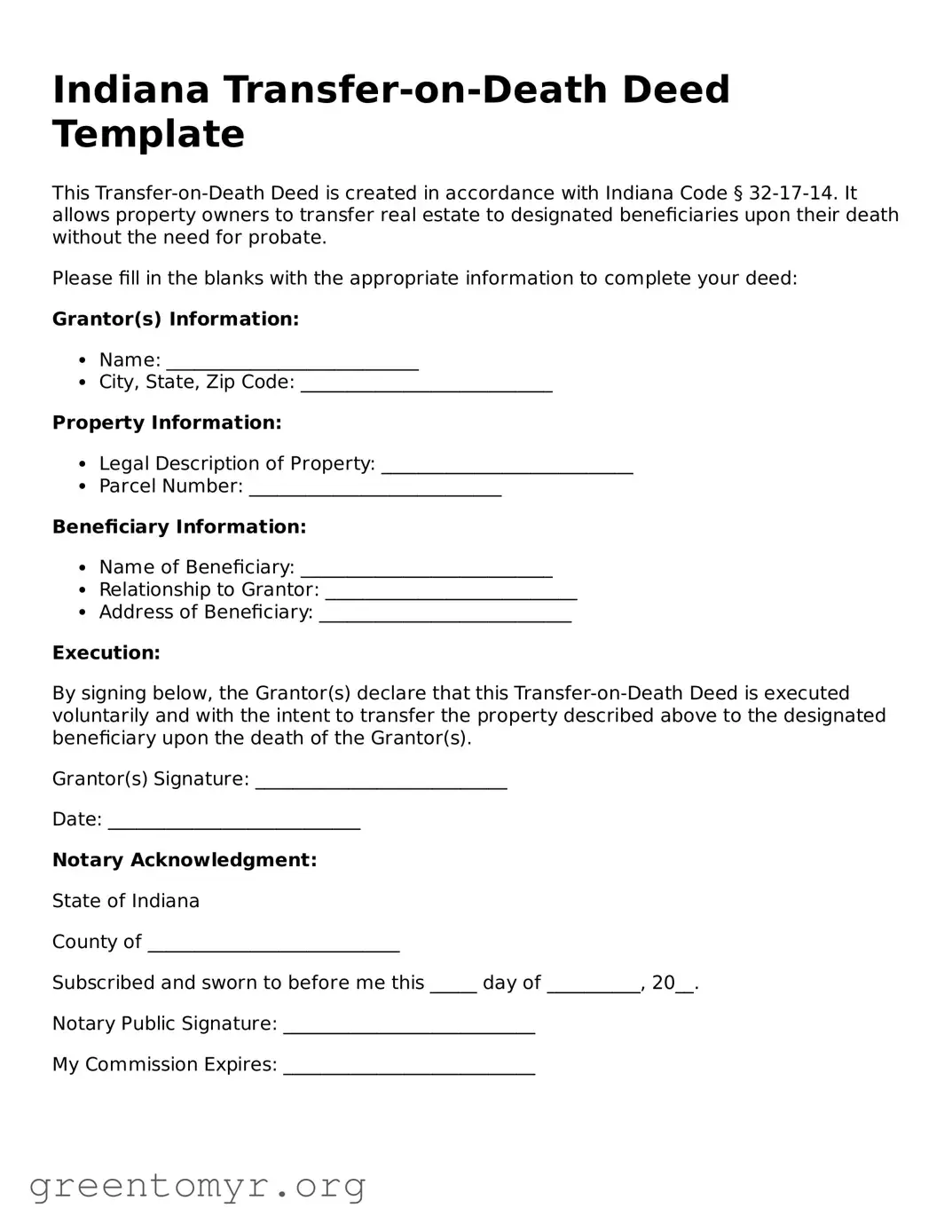
The Indiana Transfer-on-Death Deed form serves as a powerful estate planning tool that allows property owners to transfer their real estate to designated beneficiaries upon their death, without the need for probate. This straightforward process can simplify the transfer of assets, making it easier for loved ones to inherit property without the delays and costs typically associated with probate proceedings. By completing this form, individuals can maintain control over their property during their lifetime while ensuring a smooth transition of ownership after they pass away. Importantly, the deed can be revoked or altered at any time before the owner's death, offering flexibility in managing one’s estate. Additionally, this form must be properly executed and recorded with the county recorder’s office to be effective, emphasizing the importance of following legal requirements to ensure the deed's validity. Understanding the nuances of this deed can empower property owners in Indiana to make informed decisions that align with their estate planning goals.
Indiana Transfer-on-Death Deed Template
This Transfer-on-Death Deed is created in accordance with Indiana Code § 32-17-14. It allows property owners to transfer real estate to designated beneficiaries upon their death without the need for probate.
Please fill in the blanks with the appropriate information to complete your deed:
Grantor(s) Information:
Property Information:
Beneficiary Information:
Execution:
By signing below, the Grantor(s) declare that this Transfer-on-Death Deed is executed voluntarily and with the intent to transfer the property described above to the designated beneficiary upon the death of the Grantor(s).
Grantor(s) Signature: ___________________________
Date: ___________________________
Notary Acknowledgment:
State of Indiana
County of ___________________________
Subscribed and sworn to before me this _____ day of __________, 20__.
Notary Public Signature: ___________________________
My Commission Expires: ___________________________
| Fact Name | Details |
|---|---|
| Definition | An Indiana Transfer-on-Death Deed allows property owners to transfer real estate to beneficiaries upon their death without going through probate. |
| Governing Law | The Indiana Transfer-on-Death Deed is governed by Indiana Code § 32-17-14. |
| Eligibility | Any individual who owns real estate in Indiana can create a Transfer-on-Death Deed. |
| Beneficiaries | Property owners can name one or more beneficiaries in the deed. |
| Revocation | The deed can be revoked at any time by the property owner before their death. |
| Filing Requirements | The deed must be recorded with the county recorder's office where the property is located. |
| Effectiveness | The Transfer-on-Death Deed becomes effective only upon the death of the property owner. |
| Tax Implications | There are generally no immediate tax implications for the beneficiaries until they sell the property. |
After you have gathered all necessary information, you are ready to fill out the Indiana Transfer-on-Death Deed form. This process involves several clear steps to ensure accuracy and compliance with state requirements.
Once you have completed these steps, the deed will be recorded, and your wishes regarding the property will be documented. It is advisable to keep a copy of the filed deed in a safe place and inform your beneficiaries about it.
A Transfer-on-Death Deed (TODD) in Indiana allows property owners to transfer their real estate to beneficiaries upon their death without going through probate. This type of deed provides a straightforward way to pass on property while retaining control during the owner’s lifetime.
Any individual who owns real estate in Indiana can create a Transfer-on-Death Deed. The owner must be of legal age and mentally competent to make decisions regarding their property. Joint owners can also designate beneficiaries on a TODD.
To create a Transfer-on-Death Deed, follow these steps:
Yes, there may be costs involved in creating a Transfer-on-Death Deed. These can include:
Yes, you can change or revoke a Transfer-on-Death Deed at any time during your lifetime. To do so, you must create a new deed that explicitly revokes the previous one, or you can file a revocation document with the county recorder’s office.
If a designated beneficiary dies before you, their share of the property will typically pass to their heirs, unless the deed specifies otherwise. It is advisable to include alternate beneficiaries in the deed to ensure that your wishes are honored.
A Transfer-on-Death Deed does not generally impact your property taxes during your lifetime. However, when the property is transferred to the beneficiary, it may be subject to reassessment for tax purposes. Beneficiaries should consult a tax professional for specific guidance.
While a Transfer-on-Death Deed can simplify the transfer of property, it may not be suitable for everyone. Factors to consider include the complexity of your estate, potential tax implications, and your overall estate planning goals. Consulting with a legal professional can help determine if this option aligns with your needs.
For more information about Transfer-on-Death Deeds in Indiana, you can visit the Indiana government website, consult with a local attorney, or check with the county recorder’s office. These resources can provide valuable guidance and ensure you have the most accurate and up-to-date information.
Filling out the Indiana Transfer-on-Death Deed form can be straightforward, but many people make common mistakes that can lead to complications. One frequent error is not properly identifying the property. It's crucial to provide the correct legal description of the property, as vague descriptions can create confusion and may invalidate the deed.
Another mistake involves failing to include all necessary signatures. The deed must be signed by the property owner, and if there are multiple owners, all must sign. Omitting a signature can result in the deed being considered incomplete, which could delay the transfer of the property.
Many people also overlook the requirement for the deed to be notarized. Without a notary's signature, the deed may not be recognized by the county recorder's office. This step is essential to ensure that the document is legally valid.
Additionally, some individuals forget to record the deed with the county. Even if the deed is filled out correctly, it must be filed with the appropriate county office to be effective. Failing to do so can mean that the transfer does not take place as intended.
Another common error is not specifying the beneficiaries clearly. It’s important to list the beneficiaries in a way that avoids confusion. For example, using full names and, if applicable, their relationship to the owner can help prevent disputes later on.
People often neglect to consider the implications of the Transfer-on-Death Deed on their estate. While this type of deed allows for a smooth transfer of property, it may not account for other estate planning needs. Consulting with a professional can help ensure that all aspects of the estate are managed appropriately.
Some individuals also fail to update the deed after significant life changes, such as marriage, divorce, or the death of a beneficiary. Keeping the deed current is vital to ensure that it reflects the owner’s wishes accurately.
Lastly, many people do not seek legal advice before completing the deed. While it is possible to fill out the form independently, having a lawyer review it can help catch potential errors and provide peace of mind that the deed meets all legal requirements.
The Indiana Transfer-on-Death Deed is a valuable tool for individuals looking to transfer real estate upon their death without the need for probate. However, several other forms and documents often accompany this deed to ensure a smooth and legally sound transfer process. Below is a list of these important documents, each serving a unique purpose in the estate planning and property transfer process.
Incorporating these documents into an estate plan can provide clarity and security, ensuring that the wishes of the property owner are respected and that the transfer process is as seamless as possible. Understanding each of these forms can empower individuals to make informed decisions about their estate planning needs.
The Transfer-on-Death Deed (TOD Deed) is a unique legal document that allows individuals to transfer property upon their death without going through probate. However, there are several other documents that serve similar purposes in estate planning. Below is a list of these documents, each with a brief explanation of how they relate to the TOD Deed.
When filling out the Indiana Transfer-on-Death Deed form, it's essential to approach the task with care. This deed allows property owners to designate beneficiaries who will receive the property upon their death, bypassing probate. Here are five important things to keep in mind.
By following these guidelines, you can help ensure that your wishes regarding property transfer are honored and that the process is as smooth as possible for your beneficiaries.
Understanding the Indiana Transfer-on-Death Deed can be tricky, and several misconceptions often arise. Here’s a list of common misunderstandings to help clarify how this legal tool works.
By clearing up these misconceptions, you can better understand how the Indiana Transfer-on-Death Deed can work for you and your estate planning needs.
When dealing with the Indiana Transfer-on-Death Deed form, it’s important to understand the key aspects to ensure a smooth process. Here are some essential takeaways:
Understanding these points can make the process of using the Indiana Transfer-on-Death Deed form more manageable and effective for property owners.