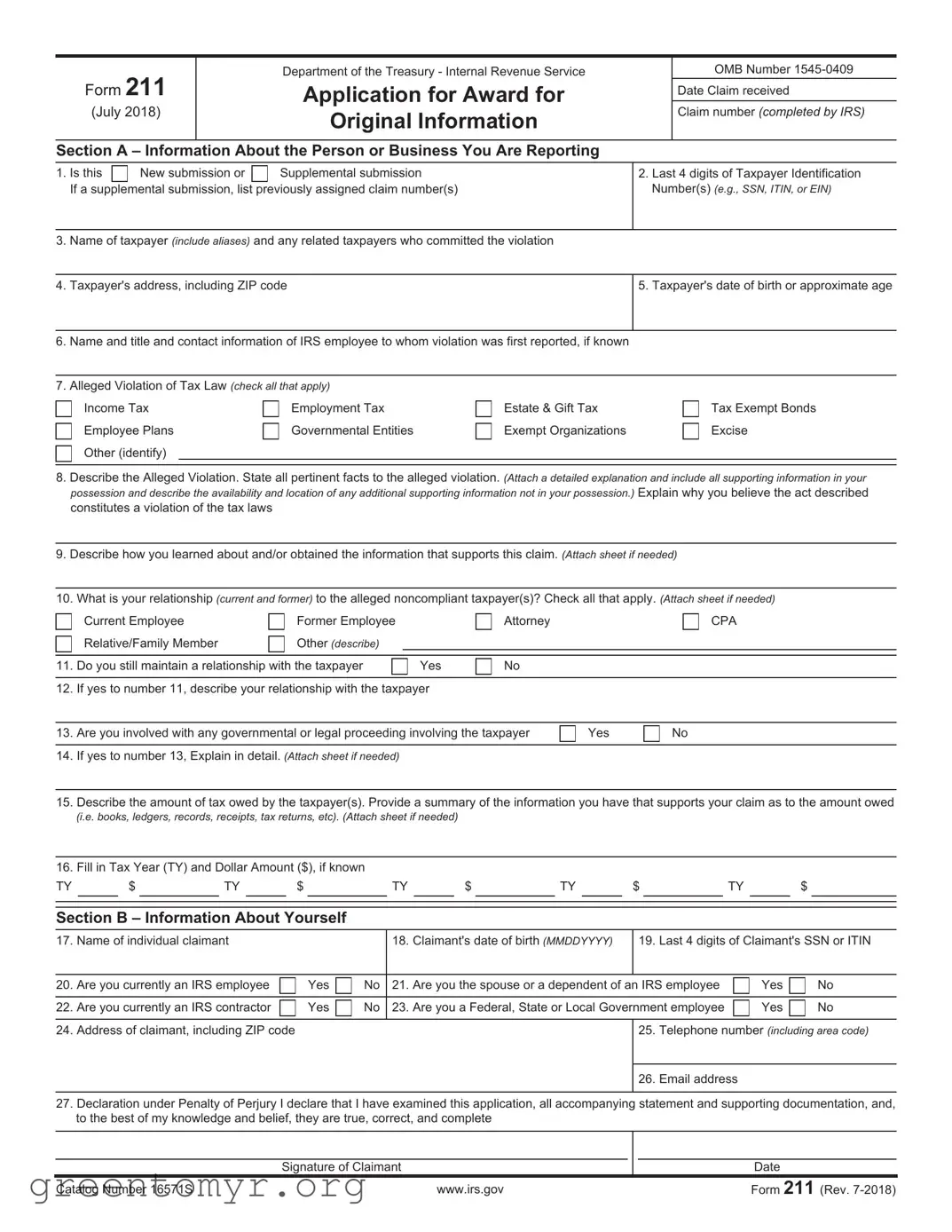
The IRS 211 form, officially known as the Application for a Certificate of Discharge of Property from Federal Tax Lien, plays a crucial role for individuals and businesses seeking to resolve tax lien issues with the Internal Revenue Service. When a taxpayer has paid their tax debts or is in a position to negotiate a settlement, this form serves as a formal request to have a federal tax lien removed from their property. The process involves providing detailed information about the taxpayer’s financial situation, including outstanding debts and assets. Understanding the eligibility requirements and the necessary documentation is essential for a successful application. Additionally, the IRS 211 form allows taxpayers to regain full control over their property, which can be vital for future financial endeavors. By following the correct procedures and submitting the appropriate information, individuals can navigate the complexities of tax liens and work towards a fresh financial start.
|
Form 211 |
|
Department of the Treasury - Internal Revenue Service |
|
OMB Number |
|
|
|
Application for Award for |
|
Date Claim received |
||
|
|
|
|
|
|
|
|
(July 2018) |
|
Original Information |
|
Claim number (completed by IRS) |
|
|
|
|
|
|
|
|
|
|
|
|
|||
Section A – Information About the Person or Business You Are Reporting |
|
|
||||
1. |
Is this |
New submission or |
Supplemental submission |
2. Last 4 digits of Taxpayer Identification |
||
|
If a supplemental submission, list previously assigned claim number(s) |
Number(s) (e.g., SSN, ITIN, or EIN) |
||||
|
|
|
|
|
||
3. |
Name of taxpayer (include aliases) and any related taxpayers who committed the violation |
|
|
|||
4. Taxpayer's address, including ZIP code
5. Taxpayer's date of birth or approximate age
6.Name and title and contact information of IRS employee to whom violation was first reported, if known
7.Alleged Violation of Tax Law (check all that apply)
Income Tax |
Employment Tax |
Estate & Gift Tax |
Tax Exempt Bonds |
Employee Plans |
Governmental Entities |
Exempt Organizations |
Excise |
Other (identify) |
|
|
|
|
|
|
|
8.Describe the Alleged Violation. State all pertinent facts to the alleged violation. (Attach a detailed explanation and include all supporting information in your possession and describe the availability and location of any additional supporting information not in your possession.) Explain why you believe the act described constitutes a violation of the tax laws
9.Describe how you learned about and/or obtained the information that supports this claim. (Attach sheet if needed)
10.What is your relationship (current and former) to the alleged noncompliant taxpayer(s)? Check all that apply. (Attach sheet if needed)
|
Current Employee |
Former Employee |
|
Attorney |
|
CPA |
|
Relative/Family Member |
Other (describe) |
|
|
|
|
|
|
|
|
|
|
|
11. |
Do you still maintain a relationship with the taxpayer |
Yes |
No |
|
|
|
|
|
|
|
|
||
12. |
If yes to number 11, describe your relationship with the taxpayer |
|
|
|
||
|
|
|
|
|||
13. |
Are you involved with any governmental or legal proceeding involving the taxpayer |
Yes |
No |
|||
14.If yes to number 13, Explain in detail. (Attach sheet if needed)
15.Describe the amount of tax owed by the taxpayer(s). Provide a summary of the information you have that supports your claim as to the amount owed
(i.e. books, ledgers, records, receipts, tax returns, etc). (Attach sheet if needed)
16.Fill in Tax Year (TY) and Dollar Amount ($), if known
TY $TY $TY $TY $TY $
Section B – Information About Yourself
17. |
Name of individual claimant |
|
|
18. |
Claimant's date of birth (MMDDYYYY) |
19. |
Last 4 digits of Claimant's SSN or ITIN |
||
|
|
|
|
|
|
|
|
|
|
20. |
Are you currently an IRS employee |
Yes |
No |
21. |
Are you the spouse or a dependent of an IRS employee |
Yes |
No |
||
|
|
|
|
|
|
|
|
||
22. |
Are you currently an IRS contractor |
Yes |
No |
23. |
Are you a Federal, State or Local Government employee |
Yes |
No |
||
|
|
|
|
|
|
|
|
||
24. |
Address of claimant, including ZIP code |
|
|
|
|
25. |
Telephone number (including area code) |
||
|
|
|
|
|
|
|
|
|
|
|
|
|
|
|
|
26. |
Email address |
|
|
|
|
|
|
|
|
|
|
|
|
27.Declaration under Penalty of Perjury I declare that I have examined this application, all accompanying statement and supporting documentation, and, to the best of my knowledge and belief, they are true, correct, and complete
Signature of Claimant
Date
Catalog Number 16571S |
www.irs.gov |
Form 211 (Rev. |

Page 2
Instructions for Form 211, Application for Award for Original Information
General Information: The Whistleblower Office has responsibility for the administration of the whistleblower award program under section 7623 of the Internal Revenue Code. Section 7623 authorizes the payment of awards from the proceeds of amounts the Government collects as a result of the information provided by the whistleblower. A claimant must file a formal claim for award by completing and sending Form 211, Application for Award for Original Information, to be considered for the Whistleblower Program.
Send completed form along with any supporting information to: Internal Revenue Service Whistleblower Office - ICE 1973 N. Rulon White Blvd. M/S 4110
Ogden, UT 84404
Instructions for Completion of Form 211:
Question 1 If you have not previously submitted a Form 211 regarding the same or similar
If you are providing additional information regarding the same or similar
Questions 2 – 5 Information about the Taxpayer – Provide the taxpayer’s name, address, taxpayer identification number – last 4 digits (if known), and the taxpayer’s date of birth or approximate age.
Question 6 If you reported the violation to an IRS employee; please provide the employee’s name, title and the date the violation was reported. If known, provide contact information.
Questions 7 - 8 Indicate the type of tax that has not been paid or the tax liability that has not been reported and describe the alleged violation. Explain why you believe the act described constitutes a violation of the tax laws. Attach all supporting documentation (for example, books and records) to substantiate the claim. If documents or supporting evidence are not in your possession, describe these documents and their location.
Questions 9 - 14 These questions ask how and when you learned of the alleged violation and what relationship, if any, you have to the taxpayer.
Questions 15 – 16 These questions are asking for an estimate of the tax owed and the years/periods that the tax applies.
Questions 17 – 26 Information about the claimant – Provide the claimant’s name, address, date of birth, SSN or ITIN (last 4 digits), email address, and telephone number.
Question 27 Information provided in connection with a claim under this provision of law must be made under an original signed Declaration under Penalty of Perjury. For joint or multiple claimants. Form 211 must be signed by each claimant.
Privacy Act and Paperwork Reduction Act Notice
We ask for the information on this form to carry out the internal revenue laws of the United States. Our authority to ask for this information is 26 USC 6109 and 7623. We collect this information for use in determining the correct amount of any award payable to you under 26 USC 7623. We may disclose this information as authorized by 26 USC 6103, including to the subject taxpayer(s) as needed in a tax compliance investigation and to the Department of Justice for civil and criminal litigation. You are not required to apply for an award. However, if you apply for an award you must provide as much of the requested information as possible. Failure to provide information may delay or prevent processing your request for an award; providing false information may subject you to penalties.
You are not required to provide the information requested on a form that is subject to the Paperwork Reduction Act unless the form displays a valid OMB control number. Books or records relating to a form or its instructions must be retained as long as their contents may become material in the administration of any internal revenue law. Generally, tax returns and return information are confidential, as required by 26 U.S.C. 6103.
The time needed to complete this form will vary depending on individual circumstances. The estimated average time is 45 minutes. If you have comments concerning the accuracy of these time estimates or suggestions for making this form simpler, we would be happy to hear from you. You can email us at *[email protected] (please type "Forms Comment" on the subject line) or write to the Internal Revenue Service, Tax Forms Coordinating Committee, SE: W: CAR: MP: T: T: SP, 1111 Constitution Ave. NW,
Send the completed Form 211 to the above Ogden address of the Whistleblower Office. Do NOT send the Form 211 to the Tax Forms Coordinating Committee.
Catalog Number 16571S |
www.irs.gov |
Form 211 (Rev. |
| Fact Name | Description |
|---|---|
| Purpose | The IRS Form 211 is used to report information about potential tax fraud or tax evasion. |
| Eligibility | Anyone can submit Form 211 if they have credible information regarding tax fraud. |
| Reward Potential | Individuals providing information may be eligible for a reward if the information leads to the collection of taxes, penalties, or interest. |
| Confidentiality | The IRS generally keeps the identity of the informant confidential, but there are exceptions. |
| Submission Method | Form 211 can be submitted by mail to the IRS Whistleblower Office or electronically through certain channels. |
| State-Specific Forms | Some states have their own forms for reporting tax fraud, governed by state tax laws such as California Revenue and Taxation Code Section 19542. |
Filling out the IRS 211 form is a straightforward process. Once completed, you will be ready to submit it to the IRS for processing. Follow these steps carefully to ensure accuracy and completeness.
The IRS Form 211, also known as the Application for Reward for Original Information, is used to report information about tax law violations. If you have knowledge of someone committing tax fraud or evading taxes, you can submit this form to potentially receive a reward. The information provided must be original and lead to the collection of taxes, penalties, or forfeitures.
Anyone can file Form 211 if they have original information regarding tax violations. This includes individuals, businesses, and organizations. However, it’s important to note that the information must be specific and credible. The IRS encourages those with knowledge of tax fraud to come forward, as it helps ensure compliance with tax laws.
When filling out Form 211, you will need to provide various details, including:
Be as detailed as possible. The more information you provide, the better the IRS can evaluate your claim.
The IRS determines the reward based on the amount of tax collected as a result of the information you provide. Generally, rewards can range from 15% to 30% of the amount collected. Factors such as the quality and usefulness of the information will also influence the reward amount. Keep in mind that the IRS has the final say on the reward and its distribution.
Once you submit Form 211, the IRS will review the information. This process can take time, as the IRS needs to verify the details and investigate the claim. You will receive a notification acknowledging your submission, but it may not provide updates on the investigation's progress. If the IRS acts on your information and collects taxes, you will be informed about your reward eligibility.
Filling out the IRS Form 211 can be a complex process, and errors can lead to delays or complications in receiving an award. One common mistake is failing to provide complete contact information. It is essential to include accurate phone numbers and addresses. Without this information, the IRS may have difficulty reaching the individual for follow-up questions or notifications.
Another frequent error is not signing the form. The IRS requires a signature to validate the submission. An unsigned form may be returned, which can significantly delay the review process. Ensuring that the form is signed and dated is crucial for its acceptance.
People often neglect to include all necessary documentation that supports their claim. The IRS Form 211 requires specific evidence to substantiate the claim for an award. Omitting this documentation can result in a denial of the request. It is advisable to review the requirements carefully and attach all relevant materials.
Some individuals make the mistake of providing inaccurate or misleading information. This can include inflated claims or misrepresentations of facts. Such inaccuracies can lead to serious consequences, including potential legal repercussions. Honesty and accuracy are vital when filling out the form.
Another common oversight is failing to meet the deadline for submission. The IRS has specific time frames within which claims must be filed. Missing these deadlines can result in the forfeiture of the opportunity to receive an award. Individuals should keep track of important dates and plan accordingly.
Inadequate explanations of the claim can also be problematic. The IRS Form 211 requires a detailed description of the information being reported. Vague or unclear descriptions may lead to confusion and could hinder the processing of the claim. Providing thorough and clear explanations is essential.
People sometimes forget to keep copies of their submissions. Retaining a copy of the completed form and any attached documents is important for personal records. This can be useful for future reference and in case of any inquiries from the IRS.
Another mistake involves not following up after submission. Individuals may assume that once the form is submitted, the process is complete. However, it is wise to monitor the status of the claim and respond promptly to any requests for additional information from the IRS.
Some filers fail to understand the eligibility criteria for an award. Misunderstanding these criteria can lead to submitting a claim that does not meet the necessary requirements. It is important to thoroughly review the guidelines provided by the IRS before completing the form.
Lastly, individuals may not seek assistance when needed. Filling out IRS forms can be complicated, and seeking help from a tax professional or legal advisor can help avoid mistakes. Utilizing available resources can lead to a more accurate and successful submission.
The IRS Form 211 is essential for individuals seeking a reward for information related to tax fraud. However, there are several other documents that are often used in conjunction with this form to ensure a smooth process. Below is a list of these documents, each playing a vital role in the submission and evaluation of claims.
Gathering these documents alongside the IRS Form 211 can help streamline your submission process. Ensure that all information is accurate and complete to avoid delays in processing your claim.
The IRS Form 211 is used to report information related to whistleblower claims. While it serves a specific purpose, there are several other documents that share similarities in function or intent. Here’s a look at six such documents:
When filling out the IRS Form 211, it’s important to approach the task with care and attention to detail. Here’s a list of five things you should and shouldn't do to ensure your submission is accurate and effective.
By following these guidelines, you can navigate the process of filling out the IRS Form 211 with greater confidence and clarity.
Understanding the IRS 211 form can be challenging, and several misconceptions often arise. Here are eight common misunderstandings about this form, along with clarifications to help set the record straight.
By addressing these misconceptions, individuals can approach the IRS 211 form with a clearer understanding, allowing for a more informed and confident filing experience.
Here are some key takeaways about filling out and using the IRS 211 form:
Completing the IRS 211 form accurately can help facilitate a smoother resolution to your tax issue.