When dealing with tax obligations, understanding the IRS 433-F form can be crucial for individuals facing financial difficulties. This form serves as a tool for taxpayers to provide the IRS with a comprehensive overview of their financial situation. It plays a significant role in negotiations for payment plans or offers in compromise. By detailing income, expenses, assets, and liabilities, the 433-F helps the IRS assess a taxpayer’s ability to pay their debts. Whether you’re looking to settle your tax liabilities or establish a manageable payment arrangement, completing this form accurately is essential. It’s not just a bureaucratic requirement; it’s a means to facilitate communication between you and the IRS, ensuring that your financial realities are clearly understood. As you navigate the complexities of tax obligations, knowing how to effectively use the IRS 433-F form can empower you to take control of your financial future.
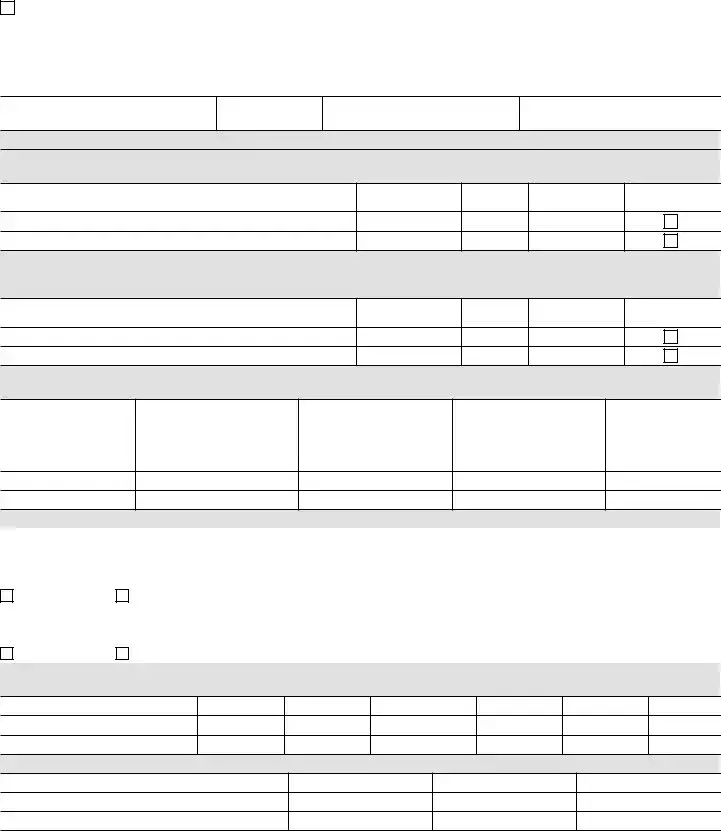
Form |
Department of the Treasury - Internal Revenue Service |
|
|
||||||
(July 2024) |
Collection Information Statement |
|
|
||||||
Name(s) and Address |
|
Your Social Security Number or Individual Taxpayer Identification Number |
|||||||
|
|
|
|
|
|
|
|
||
|
|
Your Spouse’s Social Security Number or Individual Taxpayer Identification Number |
|||||||
|
|
|
|
|
|
|
|
||
If address provided above is different than last return filed, |
Your telephone numbers |
|
Spouse’s telephone numbers |
||||||
please check here |
|
Home: |
|
Home: |
|
|
|||
County of Residence |
|
Work: |
|
|
Work: |
|
|
|
|
|
|
Cell: |
|
|
Cell: |
|
|
|
|
Enter the number of people in the household who can be claimed on this year’s tax return including you and your spouse. Under 65 |
65 and Over |
||||||||
|
|
|
|
|
|
|
|
|
|
If you or your spouse are self employed or have self employment income, provide the following information:
Name of Business
Business EIN
Type of Business
Number of Employees (not counting owner)
A. ACCOUNTS / LINES OF CREDIT
PERSONAL BANK ACCOUNTS Include checking, online, mobile (e.g., PayPal), savings accounts, money market accounts. (Use additional sheets if necessary.)
Name and Address of Institution
Account Number
Type of Account
Current
Balance/Value
Check if
Business Account
INVESTMENTS Include Certificates of Deposit, Trusts, Individual Retirement Accounts (IRAs), Keogh Plans, Simplified Employee Pensions, 401(k) Plans, Profit Sharing Plans, Mutual Funds, Stocks, Bonds, Commodities (Silver, Gold, etc.), and other investments. If applicable, include business accounts. (Use additional sheets if necessary.)
Name and Address of Institution
Account Number
Type of Account
Current
Balance/Value
Check if
Business Account
DIGITAL ASSETS (CRYPTOCURRENCY) List all digital assets you own or in which you have a financial interest (e.g., Bitcoin, Ethereum, Litecoin, Ripple, etc.). (Use additional sheets if necessary.)
Type of Digital Currency
Name of Digital Assets Wallet,
Exchange or Digital Currency
Exchange (DCE)
Email Address Used to
With the Digital Currency
Exchange or DCE
Location(s) of Digital Assets (Mobile Wallet, Online, and/or External Hardware storage)
Digital Assets Amount
and Value in US
dollars as of today (e.g., 10 Bitcoins $64,600 USD)
B. REAL ESTATE Include home, vacation property, timeshares, vacant land and other real estate. (Use additional sheets if necessary.)
Description/Location/County |
Monthly Payment(s) |
Financing |
Current Value |
Balance Owed |
Equity |
||
|
|
|
|
|
|
|
|
|
|
|
Year Purchased |
Purchase Price |
|
|
|
|
|
|
|
|
|
|
|
Primary Residence |
Other |
|
Year Refinanced |
Refinance Amount |
|
|
|
|
|
|
|
|
|
||
|
|
|
|
|
|
|
|
|
|
|
Year Purchased |
Purchase Price |
|
|
|
|
|
|
|
|
|
|
|
Primary Residence |
Other |
|
Year Refinanced |
Refinance Amount |
|
|
|
|
|
|
|
|
|
||
|
|
|
|
|
|
|
|
C. OTHER ASSETS Include cars, boats, recreational vehicles, whole life policies, etc. Include make, model and year of vehicles and name of Life Insurance company in Description. If applicable, include business assets such as tools, equipment, inventory, etc. (Use additional sheets if necessary.)
Description |
Monthly Payment Year Purchased Final Payment (mo/yr) Current Value |
Balance Owed |
Equity |
/
/
D. CREDIT CARDS (Visa, MasterCard, American Express, Department Stores, etc.)
Type
Credit Limit
Balance Owed
Minimum Monthly Payment
|
TURN PAGE TO CONTINUE |
|
|
|
|
Catalog Number 62053J |
www.irs.gov |
Form |
Page 2
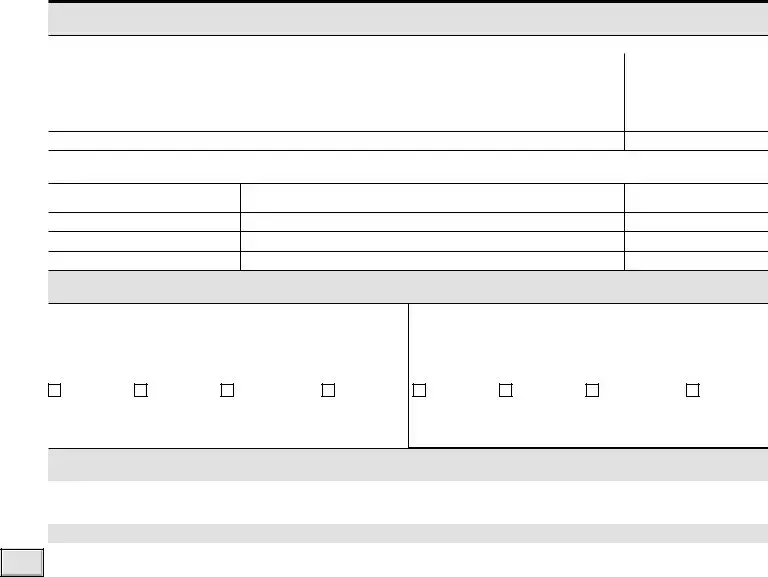
E. BUSINESS INFORMATION Complete E1 for Accounts Receivable owed to you or your business. (Use additional sheets if necessary.) Complete E2 if you or your business accepts credit card payments. Include digital assets wallet, exchange or digital currency exchange.
E1. Accounts Receivable owed to you or your business
Name |
Address |
Amount Owed |
|
|
|
|
|
|
|
|
|
List total amount owed from additional sheets
Total amount of accounts receivable available to pay to IRS now
E2. Name of individual or business on account
Credit Card
(Visa, Master Card, etc.)
Issuing Bank Name and Address
Merchant Account Number
F. EMPLOYMENT INFORMATION If you have more than one employer, include the information on another sheet of paper. (If attaching a copy of current pay stub, you do not need to complete this section.)
Your current Employer (name and address)
How often are you paid (check one) |
|
|
|
|
|
||||
Weekly |
Biweekly |
Monthly |
|||||||
Gross per pay period |
|
|
|
|
|
|
|
|
|
Taxes per pay period (Fed) |
|
|
|
(State) |
(Local) |
||||
How long at current employer |
|
|
|
|
|
|
|
||
|
|
|
|
|
|
|
|||
Spouse’s current Employer (name and address)
How often are you paid (check one)
Weekly |
Biweekly |
Monthly |
|||||||
Gross per pay period |
|
|
|
|
|
|
|
|
|
Taxes per pay period (Fed) |
|
|
|
(State) |
(Local) |
||||
How long at current employer |
|
|
|
|
|
|
|
||
|
|
|
|
|
|
|
|||
National
Standards
G.
Alimony Income |
|
Net Rental Income |
|
Interest/Dividends Income |
|
Child Support Income |
|
Unemployment Income |
|
Social Security Income |
|
Net Self Employment Income |
|
Pension Income |
|
Other: |
|
H. MONTHLY NECESSARY LIVING EXPENSES List monthly amounts. (For expenses paid other than monthly, see instructions.)
1. Food / Personal Care See instructions. If you do not spend more than |
4. Medical |
Actual Monthly |
IRS Allowed |
||
the standard allowable amount for your family size, fill in the Total amount |
Health Insurance |
Expenses |
|
||
only. |
|
|
|
|
|
Actual Monthly |
IRS Allowed |
|
|
||
|
Out of Pocket Health Care |
|
|
||
|
Expenses |
|
|
||
Food |
|
|
Expenses |
|
|
|
|
|
|
||
|
|
Total |
|
|
|
Housekeeping Supplies |
|
|
|
|
|
Clothing and Clothing Services |
|
|
5. Other |
Actual Monthly |
IRS Allowed |
Personal Care Products & Services |
|
|
Expenses |
||
|
|
|
|
||
Miscellaneous |
|
|
Child / Dependent Care |
|
|
Total |
|
|
Estimated Tax Payments |
|
|
2. Transportation |
Actual Monthly |
IRS Allowed |
Term Life Insurance |
|
|
|
Expenses |
Retirement (Employer Required) |
|
|
|
|
|
|
|
||
Gas / Insurance / Licenses / |
|
|
Retirement (Voluntary) |
|
|
Parking / Maintenance etc. |
|
|
Union Dues |
|
|
Public Transportation |
|
|
Delinquent State & Local Taxes |
|
|
Total |
|
|
(minimum payment) |
|
|
3. Housing & Utilities |
Actual Monthly |
IRS Allowed |
Student Loans (minimum |
|
|
|
Expenses |
payment) |
|
|
|
|
|
|
|
||
Rent |
|
|
Court Ordered Child Support |
|
|
Electric, Oil/Gas, Water/Trash |
|
|
Court Ordered Alimony |
|
|
Telephone/Cell/Cable/Internet |
|
|
Other Court Ordered Payments |
|
|
Real Estate Taxes and Insurance |
|
|
Other (specify) |
|
|
(if not included in B above) |
|
|
Other (specify) |
|
|
Maintenance and Repairs |
|
|
Other (specify) |
|
|
Total |
|
|
Total |
|
|
Under penalty of perjury, I declare to the best of my knowledge and belief this statement of assets, liabilities and other information is true, correct and complete.
Your signature |
Spouse’s signature |
|
Date |
|
|
|
|
Catalog Number 62053J |
www.irs.gov |
Form |
|

Page 3
Instructions for Form
What is the purpose of Form 433F?
Form
Note: You may be able to establish an Online Payment Agreement on the IRS web site. To apply online, go to https://www.irs.gov, click on “I need to pay my taxes,” and select “Installment Agreement” under the heading “What if I can't pay now?”
If you are requesting an Installment Agreement, you should submit Form 9465, Installment Agreement Request, along with Form
Please retain a copy of your completed form and supporting documentation. After we review your completed form, we may contact you for additional information. For example, we may ask you to send supporting documentation of your current income or substantiation of your stated expenditures.
If any section on this form is too small for the information you need to supply, please use a separate sheet.
Section A – Accounts / Lines of Credit
List all accounts, even if they currently have no balance. However, do not enter bank loans in this section. Include business accounts, if applicable. If you are entering information for a stock or bond, etc. and a question does not apply, enter N/A.
Section B – Real Estate
List all real estate you own or are purchasing including your home. Include insurance and taxes if they are included in your monthly payment. The county/description is needed if different than the address and county you listed above. To determine equity, subtract the amount owed for each piece of real estate from its current market value.
Section C – Other Assets
List all cars, boats and recreational vehicles with their make, model and year. If a vehicle is leased, write “lease” in the “year purchased” column. List whole life insurance policies with the name of the insurance company. List other assets with a description such as “paintings”, “coin collection”, or “antiques”. If applicable, include business assets, such as tools, equipment, inventory, and intangible assets such as domain names, patents, copyrights, etc. To determine equity, subtract the amount owed from its current market value. If you are entering information for an asset and a question does not apply, enter N/A.
Section D – Credit Cards
List all credit cards and lines of credit, even if there is no balance owed.
Section E – Business Information
Complete this section if you or your spouse are
E1: List all Accounts Receivable owed to you or your business. Include federal, state and local grants and contracts.
E2: Complete if you or your business accepts credit card payments (e.g., Visa, MasterCard, etc.) and/or digital assets wallet, exchange or digital currency exchange.
Section F – Employment Information
Complete this section if you or your spouse are wage earners.
If attaching a copy of current pay stub, you do not need to complete this section.
Section G –
List all
Net
spouse earns after you pay ordinary and necessary monthly business expenses. This figure should relate to the yearly net profit from Schedule C on your Form 1040 or your current year profit and loss statement. Please attach a copy of Schedule C or your current year profit and loss statement. If net income is a loss, enter “0”.
Net Rental Income is the amount you earn after you pay ordinary and necessary monthly rental expenses. This figure should relate to the amount reported on Schedule E of your Form 1040.
Do not include depreciation expenses. Depreciation is a
If net rental income is a loss, enter “0”.
Other Income includes distributions from partnerships and subchapter S corporations reported on Schedule
Section H – Monthly Necessary Living Expenses
Enter monthly amounts for expenses. For any expenses not paid monthly, convert as follows:
If a bill is paid … |
Calculate the monthly |
|
amount by … |
||
|
||
Quarterly |
Dividing by 3 |
|
|
|
|
Weekly |
Multiplying by 4.3 |
|
|
|
|
Biweekly (every two |
Multiplying by 2.17 |
|
weeks) |
||
|
||
Semimonthly (twice |
Multiplying by 2 |
|
each month) |
||
|
Catalog Number 62053J |
www.irs.gov |
Form |

Page 4
For expenses claimed in boxes 1 and 4, you should provide the IRS allowable standards, or the actual amount you pay if the amount exceeds the IRS allowable standards. IRS allowable standards can be found by accessing https://www.irs.gov/
Substantiation may be required for any expenses over the standard once the financial analysis is completed.
The amount claimed for Miscellaneous cannot exceed the standard amount for the number of people in your family. The miscellaneous allowance is for expenses incurred that are not included in any other allowable living expense items. Examples are credit card payments, bank fees and charges, reading material and school supplies.
If you do not have access to the IRS web site, itemize your actual expenses and we will ask you for additional proof, if required. Documentation may include pay statements, bank and investment statements, loan statements and bills for recurring expenses, etc.
Housing and Utilities – Includes expenses for your primary residence. You should only list amounts for utilities, taxes and insurance that are not included in your mortgage or rent payments.
Rent – Do not enter mortgage payment here. Mortgage payment is listed in Section B.
Transportation – Include the total of maintenance, repairs, insurance, fuel, registrations, licenses, inspections, parking, and tolls for one month.
Public Transportation – Include the total you spend for public transportation if you do not own a vehicle or if you have public transportation costs in addition to vehicle expenses.
Medical – You are allowed expenses for health insurance and
Health insurance – Enter the monthly amount you pay for yourself or your family.
covered by health insurance, and include:
•Medical services
•Prescription drugs
•Dental expenses
•Medical supplies, including eyeglasses and contact lenses. Medical procedures of a purely cosmetic nature, such as plastic surgery or elective dental work are generally not allowed.
Child / Dependent Care – Enter the monthly amount you pay for the care of dependents that can be claimed on your Form 1040.
Estimated Tax Payments – Calculate the monthly
amount you pay for estimated taxes by dividing the quarterly amount due on your Form 1040ES by 3.
Life Insurance – Enter the amount you pay for term life insurance only. Whole life insurance has cash value and should be listed in Section C.
Delinquent State & Local Taxes – Enter the minimum
amount you are required to pay monthly. Be prepared to provide a copy of the statement showing the amount you owe and if applicable, any agreement you have for monthly payments.
Student Loans – Minimum payments on student loans for the taxpayer’s
Court Ordered Payments – For any court ordered
payments, be prepared to submit a copy of the court order portion showing the amount you are ordered to pay, the signatures, and proof you are making the payments. Acceptable forms of proof are copies of cancelled checks or copies of bank or pay statements.
Other Expenses not listed above – We may allow
other expenses in certain circumstances. For example, if the expenses are necessary for the health and welfare of the taxpayer or family, or for the production of income. Specify the expense and list the minimum monthly payment you are billed.
Catalog Number 62053J |
www.irs.gov |
Form |
| Fact Name | Details |
|---|---|
| Purpose | The IRS 433-F form is used to collect financial information from individuals or businesses who owe taxes. |
| Who Uses It | Taxpayers who are under investigation for their ability to pay tax debts or those seeking to enter into a payment plan. |
| Information Required | The form requires details about income, expenses, assets, and liabilities. |
| Submission Method | Taxpayers can submit the form by mail or electronically, depending on their situation. |
| Governing Law | The IRS 433-F is governed by federal tax laws, specifically the Internal Revenue Code. |
| Impact on Payment Plans | Accurate completion of the form can lead to more favorable payment arrangements with the IRS. |
| State-Specific Forms | Some states have their own forms for financial disclosure, governed by state tax laws. |
| Confidentiality | The information provided on the form is kept confidential and used solely for tax collection purposes. |
| Deadline for Submission | While there is no specific deadline, timely submission is crucial to avoid penalties and interest. |
Filling out the IRS 433-F form requires careful attention to detail. This form is essential for providing the IRS with a comprehensive overview of your financial situation. Completing it accurately will help facilitate discussions about your tax obligations.
The IRS 433-F form is a financial statement used by the Internal Revenue Service (IRS) to assess a taxpayer's financial situation. It helps the IRS determine a taxpayer's ability to pay their tax liabilities. The form collects information about income, expenses, assets, and liabilities.
This form is typically required for individuals who owe back taxes and are seeking to set up a payment plan or settle their tax debt. If you have received a notice from the IRS requesting this form, it is important to complete it accurately to avoid further complications.
To complete the IRS 433-F form, follow these steps:
You will need to provide various details, including:
Once you submit the form, the IRS will review your financial information. They may contact you for additional information or clarification. Depending on your financial situation, they will determine whether you qualify for a payment plan, an offer in compromise, or other options to resolve your tax debt.
Yes, you can seek help from various sources. Tax professionals, such as accountants or tax attorneys, can provide guidance. Additionally, the IRS offers resources and assistance through their website and customer service lines. Make sure to ask for help if you find any part of the form confusing.
Yes, there is usually a deadline specified in the notice you received from the IRS. It is important to submit the form by this deadline to avoid penalties or further action from the IRS. If you need more time, consider contacting the IRS to request an extension.
If you realize you made a mistake after submitting the form, it is best to correct it as soon as possible. You can send a corrected version of the form to the IRS along with a brief explanation of the changes. Promptly addressing any errors can help prevent complications in your case.
Filling out the IRS 433-F form can be a daunting task for many individuals. This form is essential for those seeking to negotiate a payment plan or settle tax debts with the IRS. However, mistakes can lead to delays or even rejections of requests. Here are eight common errors people make when completing this form.
One frequent mistake is failing to provide accurate personal information. It’s crucial to double-check your name, address, and Social Security number. Any discrepancies can cause confusion and may result in the IRS being unable to process your request.
Another common error is underestimating income. Many individuals do not account for all sources of income, including side jobs or freelance work. The IRS expects a complete picture of your financial situation, and omitting income can lead to unfavorable outcomes.
Some people also neglect to include necessary documentation. The IRS may require additional proof of income or expenses, and not providing these documents can stall the process. Always attach copies of relevant financial statements or pay stubs to support your claims.
Additionally, individuals often miscalculate their monthly expenses. It’s essential to provide an accurate representation of your living costs. If expenses are understated, the IRS may determine that you can afford to pay more than you actually can, leading to a rejected offer.
People sometimes overlook the importance of signatures. Failing to sign the form can result in it being deemed incomplete. Always ensure that all required signatures are present before submitting the form.
Another mistake is submitting the form without reviewing it thoroughly. A quick glance may not catch errors or omissions. Take the time to read through the entire form to ensure everything is accurate and complete.
Some individuals may not understand the importance of timely submission. The IRS has specific deadlines, and missing these can complicate your situation further. Be aware of these timelines and plan accordingly to avoid unnecessary delays.
Lastly, many people do not follow up after submission. It’s essential to check the status of your request. If you haven’t received a response in a reasonable time, reach out to the IRS to ensure your form was received and is being processed.
Avoiding these common mistakes can make a significant difference in your dealings with the IRS. Taking the time to complete the IRS 433-F form accurately and thoroughly will help pave the way for a smoother resolution of your tax situation.
The IRS 433-F form is often used in situations where individuals or businesses need to provide financial information to the IRS, typically for matters related to payment plans or offers in compromise. Along with this form, several other documents may be necessary to support your case. Below are some commonly used forms and documents that complement the IRS 433-F.
Gathering these documents can streamline the process and help ensure that your financial information is presented clearly. Having everything organized will aid in your communication with the IRS and can lead to a more favorable outcome.
The IRS Form 433-F is used by individuals to provide the Internal Revenue Service with a comprehensive picture of their financial situation. Several other documents serve similar purposes in various contexts. Here’s a look at four such documents:
When filling out the IRS 433-F form, it is crucial to approach the process with care. This form is often used for financial disclosures, particularly in situations involving tax liabilities. Below is a list of dos and don'ts to guide you through completing the form effectively.
By following these guidelines, individuals can navigate the process of completing the IRS 433-F form with greater confidence and accuracy.
The IRS 433-F form is often misunderstood. Below are some common misconceptions about this form, along with clarifications to provide a clearer understanding.
The IRS 433-F form is an important tool for individuals dealing with tax issues. Understanding how to fill it out and use it effectively can make a significant difference in resolving tax debts. Here are some key takeaways to keep in mind:
By keeping these takeaways in mind, you can navigate the process of using the IRS 433-F form more effectively. Remember, being proactive and organized will help you manage your tax situation with confidence.