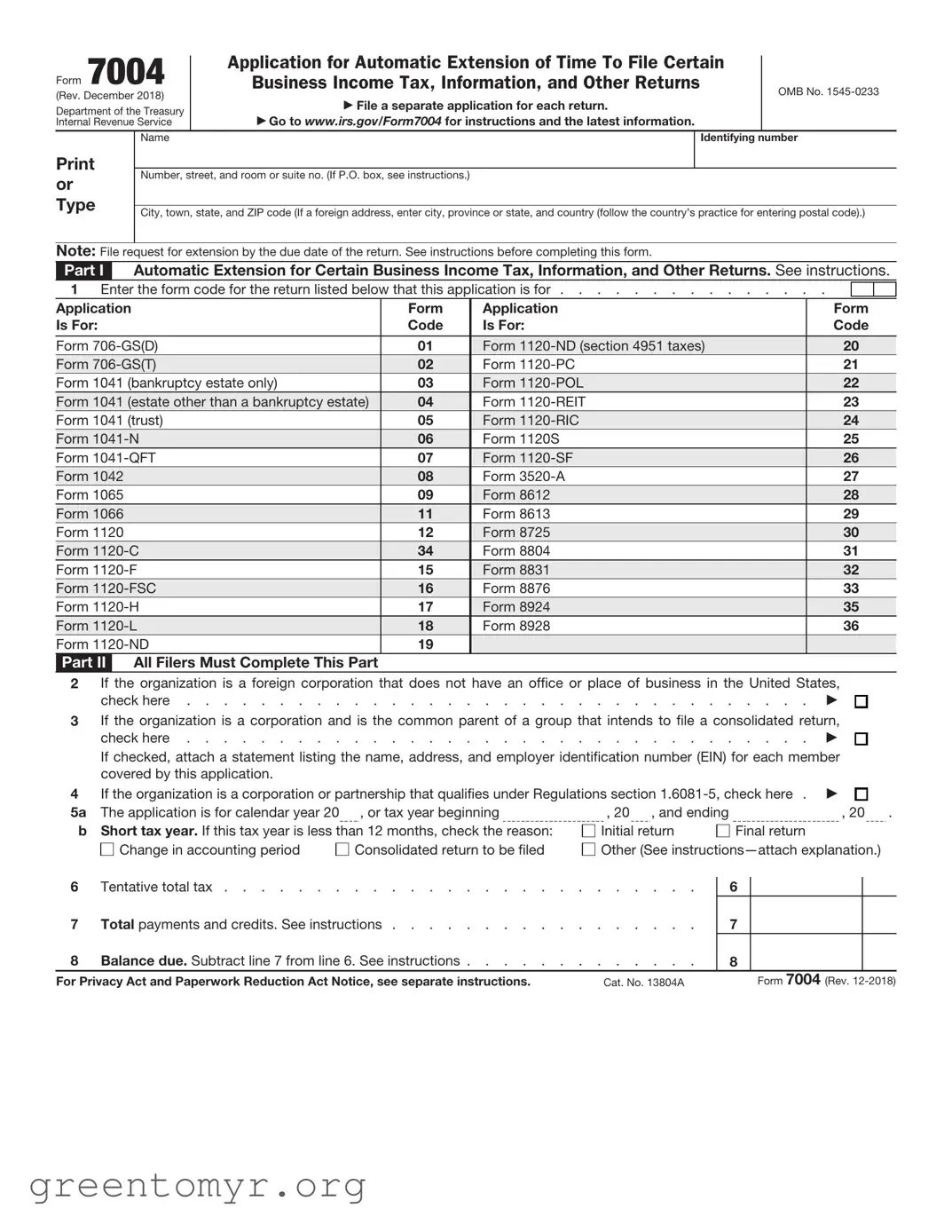
The IRS Form 7004 is a critical document for taxpayers seeking an extension on their business tax returns. This form allows partnerships, corporations, and certain other entities to request additional time to file their federal income tax returns. By submitting Form 7004, taxpayers can gain an automatic six-month extension, which is essential for ensuring that all financial information is accurately reported. It’s important to note that while this form extends the filing deadline, it does not extend the time to pay any taxes owed. Properly completing and submitting Form 7004 can help businesses avoid late filing penalties and maintain compliance with IRS regulations. Understanding the nuances of this form is vital for anyone involved in managing business finances, as timely action can significantly impact a company’s financial standing and legal obligations.
Form 7004 |
Application for Automatic Extension of Time To File Certain |
|
||||
Business Income Tax, Information, and Other Returns |
|
OMB No. |
||||
(Rev. December 2018) |
|
|
|
|||
File a separate application for each return. |
|
|
||||
Department of the Treasury |
|
|
||||
Go to www.irs.gov/Form7004 for instructions and the latest information. |
|
|
||||
Internal Revenue Service |
|
|
||||
|
Name |
|
|
Identifying number |
||
|
|
|
|
|
||
Number, street, and room or suite no. (If P.O. box, see instructions.) |
|
|
||||
or |
|
|
||||
|
|
|
|
|
||
Type |
|
|
|
|
|
|
City, town, state, and ZIP code (If a foreign address, enter city, province or state, and country (follow the country’s practice for entering postal code).) |
||||||
|
||||||
|
|
|
|
|
|
|
Note: File request for extension by the due date of the return. See instructions before completing this form.
Part I Automatic Extension for Certain Business Income Tax, Information, and Other Returns. See instructions.
1 Enter the form code for the return listed below that this application is for . . . . . . . . . . . . . . .
Application |
Form |
Application |
Is For: |
Code |
Is For: |
|
01 |
|
Form |
Form |
|
Form |
02 |
Form |
Form 1041 (bankruptcy estate only) |
03 |
Form |
Form 1041 (estate other than a bankruptcy estate) |
04 |
Form |
Form 1041 (trust) |
05 |
Form |
Form |
06 |
Form 1120S |
Form |
07 |
Form |
Form 1042 |
08 |
Form |
Form 1065 |
09 |
Form 8612 |
Form 1066 |
11 |
Form 8613 |
Form 1120 |
12 |
Form 8725 |
Form |
34 |
Form 8804 |
Form |
15 |
Form 8831 |
Form |
16 |
Form 8876 |
Form |
17 |
Form 8924 |
Form |
18 |
Form 8928 |
Form |
19 |
|
Form Code
20
21
22
23
24
25
26
27
28
29
30
31
32
33
35
36
Part II All Filers Must Complete This Part
2If the organization is a foreign corporation that does not have an office or place of business in the United States,
check here . . . . . . . . . . . . . . . . . . . . . . . . . . . . . . . . . .
3If the organization is a corporation and is the common parent of a group that intends to file a consolidated return,
|
check here |
|
|||
|
If checked, attach a statement listing the name, address, and employer identification number (EIN) for each member |
|
|||
|
covered by this application. |
|
|
|
|
4 |
If the organization is a corporation or partnership that qualifies under Regulations section |
|
|||
5a |
The application is for calendar year 20 |
, or tax year beginning |
, 20 , and ending |
, 20 |
. |
b |
Short tax year. If this tax year is less than 12 months, check the reason: |
Initial return |
Final return |
|
|
|
Change in accounting period |
Consolidated return to be filed |
Other (See |
|
|
6 Tentative total tax . . . . . . . . . . . . . . . . . . . . . . . . . .
6
7 Total payments and credits. See instructions . . . . . . . . . . . . . . . . .
7
8 Balance due. Subtract line 7 from line 6. See instructions . . . . . . . . . . . . .
8
For Privacy Act and Paperwork Reduction Act Notice, see separate instructions. |
Cat. No. 13804A |
Form 7004 (Rev. |
| Fact Name | Description |
|---|---|
| Purpose | The IRS Form 7004 is used to apply for an automatic extension of time to file certain business tax returns. |
| Eligibility | This form is applicable to various business entities, including partnerships, corporations, and certain trusts. |
| Filing Deadline | The form must be filed by the original due date of the tax return for which the extension is requested. |
| Automatic Extension | Filing Form 7004 grants an automatic extension of up to six months for most entities. |
| State-Specific Forms | Some states require their own extension forms. For example, California has Form 3519 for business entities. |
| Governing Law | Federal tax law governs the use of Form 7004, while state-specific forms are subject to state tax regulations. |
| Payment Requirement | Filing Form 7004 does not extend the time to pay any taxes owed; payment is still required by the original due date. |
| Electronic Filing | The form can be filed electronically through various tax software programs approved by the IRS. |
| Signature Requirement | A signature is not required on Form 7004 when filed electronically, but it is required if filed on paper. |
Filling out the IRS Form 7004 is an important step for businesses seeking an extension on their tax return filing deadline. After completing the form, you will need to submit it to the IRS to ensure you have additional time to prepare your tax documents.
Once you have submitted Form 7004, keep a copy for your records. This will help you track your extension and ensure compliance with future filing requirements.
IRS Form 7004 is an application for an automatic extension of time to file certain business tax returns. It is primarily used by corporations and partnerships that need additional time beyond the standard filing deadline. By submitting this form, taxpayers can receive an extension of up to six months to file their tax returns, allowing them more time to gather necessary documentation and ensure accuracy.
Various entities must consider filing Form 7004, including:
If you fall into one of these categories and anticipate needing more time to prepare your return, Form 7004 is the appropriate choice.
Filing Form 7004 can be done in several ways:
Regardless of the method chosen, ensure that the form is submitted by the original due date of your tax return to avoid penalties.
If you fail to file Form 7004 and miss the original deadline for your tax return, you may face penalties. These can include:
It's crucial to file Form 7004 on time if you anticipate needing more time to file your return to avoid these consequences.
No, there is no fee associated with filing Form 7004 itself. However, keep in mind that while the form allows for an extension of time to file, it does not extend the time to pay any taxes owed. If taxes are due, they should be paid by the original deadline to avoid penalties and interest.
Filling out the IRS Form 7004, which is used to request an automatic extension of time to file certain business tax returns, can be straightforward. However, many individuals and businesses make common mistakes that can lead to complications. One frequent error is failing to provide the correct taxpayer identification number (TIN). This number is essential for the IRS to process the form. If the TIN is incorrect or missing, it can result in delays or even rejection of the extension request.
Another mistake often seen is neglecting to check the appropriate box for the type of return for which the extension is being requested. The form has specific boxes for different types of returns, and selecting the wrong one can cause confusion. This oversight can lead to the IRS not recognizing the request, which could leave taxpayers unprotected from penalties for late filing.
People also sometimes underestimate the importance of submitting the form on time. The IRS requires that Form 7004 be filed by the original due date of the tax return. Missing this deadline can mean that the extension will not be granted, and taxpayers may face penalties. It’s crucial to mark the calendar and ensure that the form is submitted promptly.
Lastly, many individuals forget to include any required payment with their extension request. While Form 7004 allows for an extension to file, it does not extend the time to pay any taxes owed. If payment is not included, the IRS may impose penalties and interest on the unpaid amount. Being aware of this requirement can save taxpayers from unnecessary financial burdens.
The IRS Form 7004 is used to request an automatic extension of time to file certain business tax returns. When completing this form, you may also need to consider other documents that are often used in conjunction with it. Here’s a list of forms and documents that can help ensure you meet all necessary requirements.
Using the right forms alongside the IRS Form 7004 can help streamline your tax filing process. Make sure to gather all necessary documents to avoid any delays or complications with your tax obligations.
The IRS Form 7004 is a valuable tool for taxpayers seeking an extension for filing certain business tax returns. It’s not the only form designed for similar purposes. Here are nine other forms that share similarities with Form 7004:
Understanding these forms can help you navigate the complexities of tax filing and ensure compliance with IRS requirements.
When filling out the IRS Form 7004, there are important guidelines to follow. Here’s a list of things you should and shouldn't do:
The IRS Form 7004 is used to request an automatic extension of time to file certain business tax returns. However, several misconceptions surround this form. Below are six common misunderstandings:
The IRS Form 7004 is an important document for businesses seeking an extension on their tax return filing. Here are some key takeaways regarding its use: