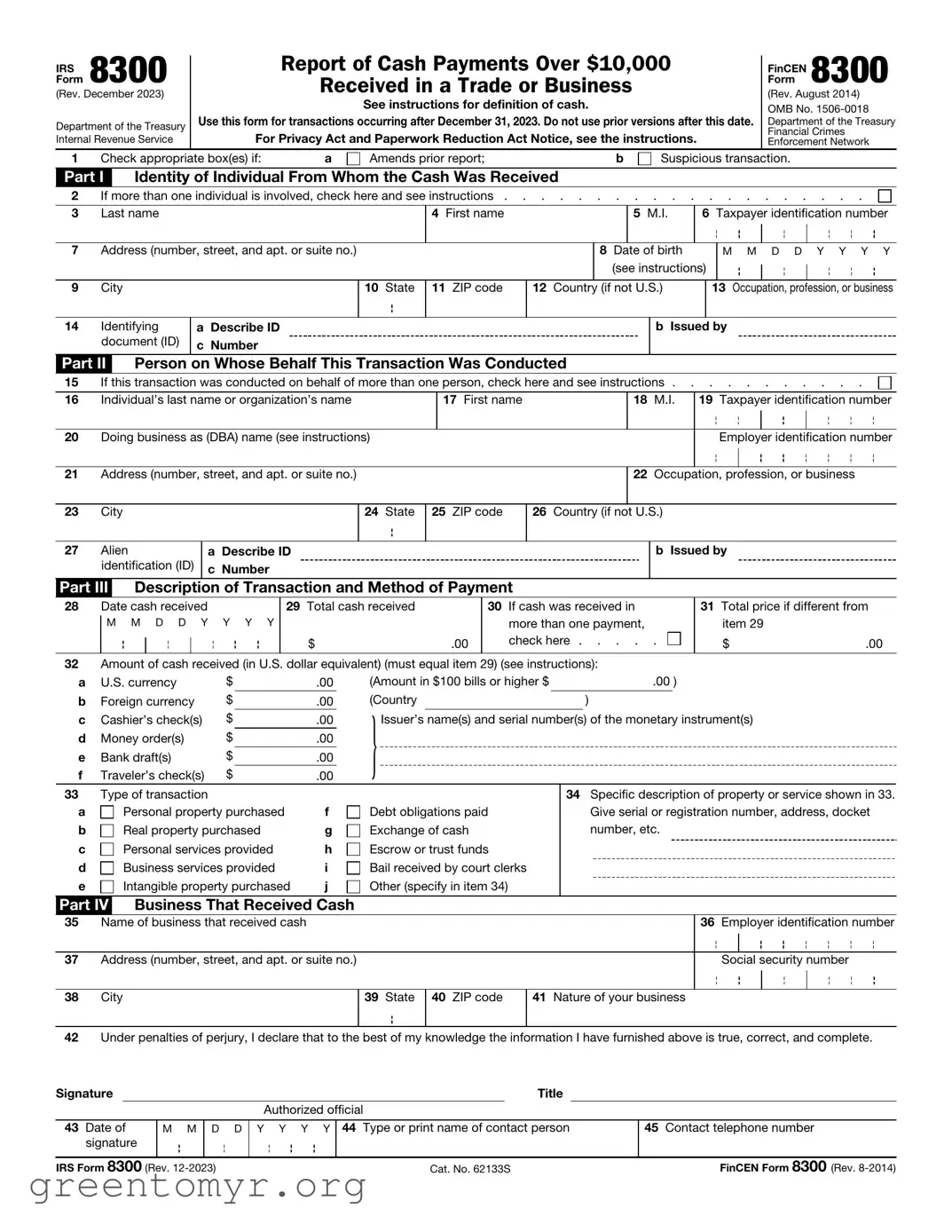
The IRS 8300 form plays a crucial role in the realm of financial transactions, particularly when it comes to reporting cash payments. Businesses and individuals alike must be aware of its significance, as it is designed to help the Internal Revenue Service track large cash transactions that may pose a risk for money laundering and tax evasion. When a person or entity receives more than $10,000 in cash in a single transaction, or in related transactions, they are required to file this form. The information collected includes the identity of the payer, the amount received, and the nature of the transaction. Timely and accurate filing is essential, as failure to comply can lead to penalties. Understanding the nuances of the IRS 8300 form is important for anyone involved in cash-intensive businesses, ensuring they remain in good standing with tax regulations while promoting transparency in financial dealings.
IRS 8300
Form
(Rev. December 2023)
Department of the Treasury Internal Revenue Service
Report of Cash Payments Over $10,000
Received in a Trade or Business
See instructions for definition of cash.
Use this form for transactions occurring after December 31, 2023. Do not use prior versions after this date.
For Privacy Act and Paperwork Reduction Act Notice, see the instructions.
FinCEN 8300 Form
(Rev. August 2014)
OMB No.
Department of the Treasury
Financial Crimes
Enforcement Network
1 Check appropriate box(es) if: |
a |
Amends prior report; |
b |
Part I Identity of Individual From Whom the Cash Was Received
Suspicious transaction.
2 |
If more than one individual is involved, check here and see instructions |
||||||||||
|
|
|
|
|
|
|
|
|
|
|
|
3 |
Last name |
|
4 First name |
|
|
5 M.I. |
6 Taxpayer identification number |
||||
|
|
|
|
|
|
|
|
|
|
|
|
|
|
|
|
|
|
|
|
|
|
|
|
7 |
Address (number, street, and apt. or suite no.) |
|
|
|
8 Date of birth |
|
|
M M D D Y Y Y Y |
|||
|
|
|
|
|
(see instructions) |
|
|||||
|
|
|
|
|
|
|
|
||||
|
|
|
|
|
|
|
|
|
|
||
9 |
City |
10 State |
11 ZIP code |
12 Country |
(if not U.S.) |
|
13 Occupation, profession, or business |
||||
|
|
|
|
|
|
|
|
|
|
|
|
14 Identifying |
a |
Describe ID |
document (ID) |
c |
Number |
Part II Person on Whose Behalf This Transaction Was Conducted
b Issued by
15 |
If this transaction was conducted on behalf of more than one person, check here and see instructions |
|||
|
|
|
|
|
16 |
Individual’s last name or organization’s name |
17 First name |
18 M.I. |
19 Taxpayer identification number |
20Doing business as (DBA) name (see instructions)
Employer identification number
21Address (number, street, and apt. or suite no.)
22Occupation, profession, or business
23City
24State
25ZIP code
26Country (if not U.S.)
27 Alien |
a |
Describe ID |
identification (ID) |
c |
Number |
Part III Description of Transaction and Method of Payment
b Issued by
28Date cash received
M M D D Y Y Y Y
29Total cash received
$.00
30If cash was received in more than one payment, check here . . . . .
31Total price if different from item 29
$.00
32Amount of cash received (in U.S. dollar equivalent) (must equal item 29) (see instructions):
a |
U.S. currency |
$ |
.00 |
(Amount in $100 bills or higher $ |
.00 ) |
||||
b |
Foreign currency |
$ |
.00 |
(Country |
) |
|
|||
|
|
$ |
|
} |
|
|
|
||
c |
Cashier’s check(s) |
.00 |
Issuer’s name(s) and serial number(s) of the monetary instrument(s) |
||||||
d |
Money order(s) |
$ |
.00 |
|
|
|
|
|
|
e |
Bank draft(s) |
$ |
.00 |
|
|
|
|
|
|
f |
Traveler’s check(s) |
$ |
.00 |
|
|
|
|
|
|
33Type of transaction
a |
Personal property purchased |
f |
b |
Real property purchased |
g |
c |
Personal services provided |
h |
d |
Business services provided |
i |
e |
Intangible property purchased |
j |
Part IV |
Business That Received Cash |
|
Debt obligations paid Exchange of cash Escrow or trust funds
Bail received by court clerks Other (specify in item 34)
34Specific description of property or service shown in 33. Give serial or registration number, address, docket number, etc.
35Name of business that received cash
36Employer identification number
37Address (number, street, and apt. or suite no.)
Social security number
38City
39State
40ZIP code
41Nature of your business
42Under penalties of perjury, I declare that to the best of my knowledge the information I have furnished above is true, correct, and complete.
Signature |
|
|
|
|
|
Title |
|
|
|
|
|
|
Authorized official |
|
|
||
|
|
|
|
|
|
|
||
43 Date of |
M M |
D D |
Y Y Y Y |
44 Type or print name of contact person |
|
45 Contact telephone number |
||
signature |
|
|
|
|
|
|
|
|
|
|
|
|
|
|
|
||
IRS Form 8300 (Rev. |
|
Cat. No. 62133S |
|
FinCEN Form 8300 (Rev. |
||||
IRS Form 8300 (Rev. |
Page 2 |
FinCEN Form 8300 (Rev. |
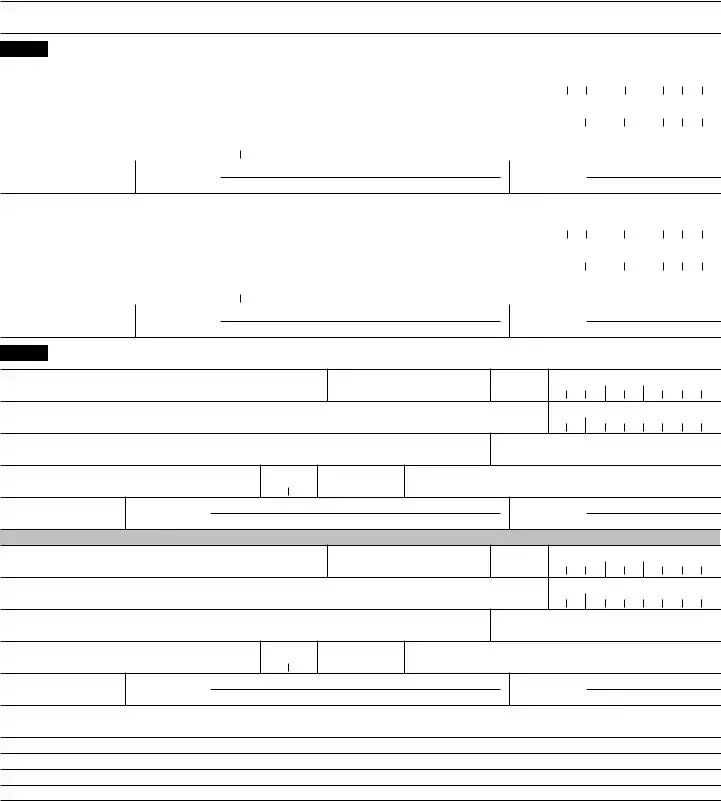
Multiple Parties
(Complete applicable parts below if box 2 or 15 on page 1 is checked.)
Part I
3 |
Last name |
|
|
4 First name |
|
5 M.I. |
6 Taxpayer identification number |
|||||
|
|
|
|
|
|
|
|
|
|
|
|
|
|
|
|
|
|
|
|
|
|
|
|
|
|
7 |
Address (number, street, and apt. or suite no.) |
|
|
8 |
Date of birth |
|
M M D D Y Y Y Y |
|||||
|
|
|
|
|
|
|
(see instructions) |
|
|
|
||
|
|
|
|
|
|
|
|
|
|
|||
|
|
|
|
|
|
|
|
|
|
|
|
|
9 |
City |
10 State |
11 ZIP code |
|
12 Country (if not U.S.) |
|
13 Occupation, profession, or business |
|||||
|
|
|
|
|
|
|
|
|
|
|
|
|
14Identifying document (ID)
aDescribe ID c Number
b Issued by
|
|
|
|
|
|
|
|
|
|
|
|
|
3 |
Last name |
|
|
4 First name |
|
5 M.I. |
6 Taxpayer identification number |
|||||
|
|
|
|
|
|
|
|
|
|
|
|
|
|
|
|
|
|
|
|
|
|
|
|
|
|
7 |
Address (number, street, and apt. or suite no.) |
|
|
8 |
Date of birth |
|
M M D D Y Y Y Y |
|||||
|
|
|
|
|
|
|
(see instructions) |
|
||||
|
|
|
|
|
|
|
|
|
|
|||
|
|
|
|
|
|
|
|
|
|
|
|
|
9 |
City |
10 State |
11 ZIP code |
|
12 Country (if not U.S.) |
|
13 Occupation, profession, or business |
|||||
|
|
|
|
|
|
|
|
|
|
|
|
|
14Identifying document (ID)
aDescribe ID c Number
b Issued by
Part II
16Individual’s last name or organization’s name
17First name
18M.I.
19Taxpayer identification number
20Doing business as (DBA) name (see instructions)
Employer identification number
21Address (number, street, and apt. or suite no.)
22Occupation, profession, or business
23City
24State
25ZIP code
26Country (if not U.S.)
27Alien identification (ID)
aDescribe ID c Number
b Issued by
16Individual’s last name or organization’s name
17First name
18M.I.
19Taxpayer identification number
20Doing business as (DBA) name (see instructions)
Employer identification number
21Address (number, street, and apt. or suite no.)
22Occupation, profession, or business
23City
24State
25ZIP code
26Country (if not U.S.)
27Alien identification (ID)
aDescribe ID c Number
b Issued by
Comments – Please use the lines provided below to comment on or clarify any information you entered on any line in Parts I, II, III, and IV
IRS Form 8300 (Rev. |
FinCEN Form 8300 (Rev. |
| Fact Name | Description |
|---|---|
| Purpose | The IRS Form 8300 is used to report cash payments exceeding $10,000 received in a trade or business. |
| Filing Deadline | This form must be filed within 15 days after the cash transaction occurs. |
| Who Must File | Any business that receives more than $10,000 in cash must file this form, regardless of the industry. |
| Penalties for Non-Compliance | Failure to file Form 8300 can result in significant penalties, including fines up to $25,000 for willful neglect. |
| State-Specific Requirements | Some states may have additional reporting requirements. For example, California requires compliance with the California Revenue and Taxation Code Section 19542. |
| Confidentiality | Information provided on Form 8300 is confidential and protected under federal law, although it may be shared with other government agencies. |
Completing the IRS Form 8300 is an important step for reporting cash transactions exceeding $10,000. After filling out the form, ensure that it is submitted to the IRS in a timely manner to avoid any penalties.
The IRS 8300 form is a document that businesses must file to report cash transactions exceeding $10,000. This form helps the IRS track large cash transactions to prevent money laundering and tax evasion. It must be submitted within 15 days of the transaction.
Any business or individual that receives more than $10,000 in cash in a single transaction or related transactions must file this form. This includes various types of businesses, such as retail stores, car dealerships, and real estate companies.
The form must be filed for cash transactions that exceed $10,000. Cash includes currency and negotiable instruments, like checks or money orders. Related transactions that total more than $10,000 must also be reported, even if no single transaction exceeds that amount.
The IRS 8300 form can be filed online through the IRS website or by mailing a paper form. To file online, you will need to create an account with the IRS. If you choose to mail the form, ensure it is sent to the correct address provided in the form instructions.
When completing the form, you will need to provide:
Failing to file the IRS 8300 form can lead to significant penalties. The IRS may impose fines ranging from $100 to $50,000, depending on the severity and frequency of the violations. In some cases, criminal charges may also apply for willful neglect.
While the IRS 8300 form is specifically for transactions over $10,000, businesses may still choose to report transactions under this amount voluntarily. However, it is not a requirement unless the cash exceeds the threshold.
If you realize that you made an error after submitting the form, you should correct it as soon as possible. You can do this by filing a corrected form with the accurate information. Be sure to indicate that it is a correction on the new form.
It is essential to keep records of cash transactions and the filed IRS 8300 forms for at least five years. This timeframe aligns with the IRS's recommendation for retaining records for tax purposes, ensuring you have documentation if needed for audits or inquiries.
For more detailed information about the IRS 8300 form, you can visit the IRS website. The site offers instructions, FAQs, and additional resources to help you understand the requirements and filing process.
Filling out the IRS 8300 form can be a straightforward process, but many people make common mistakes that can lead to complications. One frequent error is not providing complete information. Every section of the form must be filled out accurately. Missing details can delay processing and lead to potential penalties.
Another mistake is incorrect identification of the person or entity making the cash transaction. It's crucial to ensure that the name and identification numbers match official records. Any discrepancies can raise red flags and complicate matters further.
Many individuals also overlook the importance of reporting the correct amount of cash received. Reporting less than what was actually received can result in serious consequences. Always double-check the figures before submitting.
Some filers fail to submit the form within the required timeframe. The IRS mandates that the 8300 form be filed within 15 days of receiving more than $10,000 in cash. Missing this deadline can lead to fines.
Another common error is not providing the required signatures. The form must be signed by the person completing it or an authorized representative. An unsigned form is considered incomplete and may be rejected.
Additionally, many people do not keep copies of their submitted forms. It's essential to maintain a record for your files. This can be useful for future reference or in case of an audit.
Some filers also neglect to check for updates or changes to the form or IRS regulations. Tax laws can change, and staying informed is vital to ensure compliance.
Another mistake is failing to understand the purpose of the form. The IRS 8300 is designed to help combat money laundering and other illegal activities. Misunderstanding its significance can lead to improper completion.
Lastly, many individuals do not seek help when needed. If there is uncertainty about how to fill out the form correctly, consulting a tax professional can save time and prevent costly errors.
The IRS Form 8300 is crucial for reporting cash payments exceeding $10,000 received in a trade or business. While this form is essential for compliance, it often accompanies other documents that help ensure proper reporting and record-keeping. Below is a list of related forms and documents that may be used alongside Form 8300.
Utilizing these forms and documents alongside IRS Form 8300 can significantly enhance transparency and compliance. Maintaining organized records not only fulfills legal obligations but also supports business integrity and trust with clients and partners.
The IRS Form 8300 is used to report cash payments over $10,000 received in a trade or business. Several other documents serve similar purposes in various contexts. Here’s a list of eight forms that share similarities with Form 8300:
Each of these forms plays a role in maintaining transparency and compliance with IRS regulations, helping to track substantial financial activities.
When filling out the IRS 8300 form, it's essential to approach the task carefully. This form is used to report cash payments over $10,000 received in a trade or business. Here are some important do's and don'ts to keep in mind.
The IRS 8300 form is often misunderstood, leading to confusion among taxpayers and businesses. Here are four common misconceptions about this form:
Understanding these misconceptions can help ensure compliance and avoid potential issues with the IRS.
When dealing with large cash transactions, it's important to understand the IRS Form 8300. Here are some key takeaways to keep in mind:
Understanding these points can help ensure compliance and avoid potential issues with the IRS.