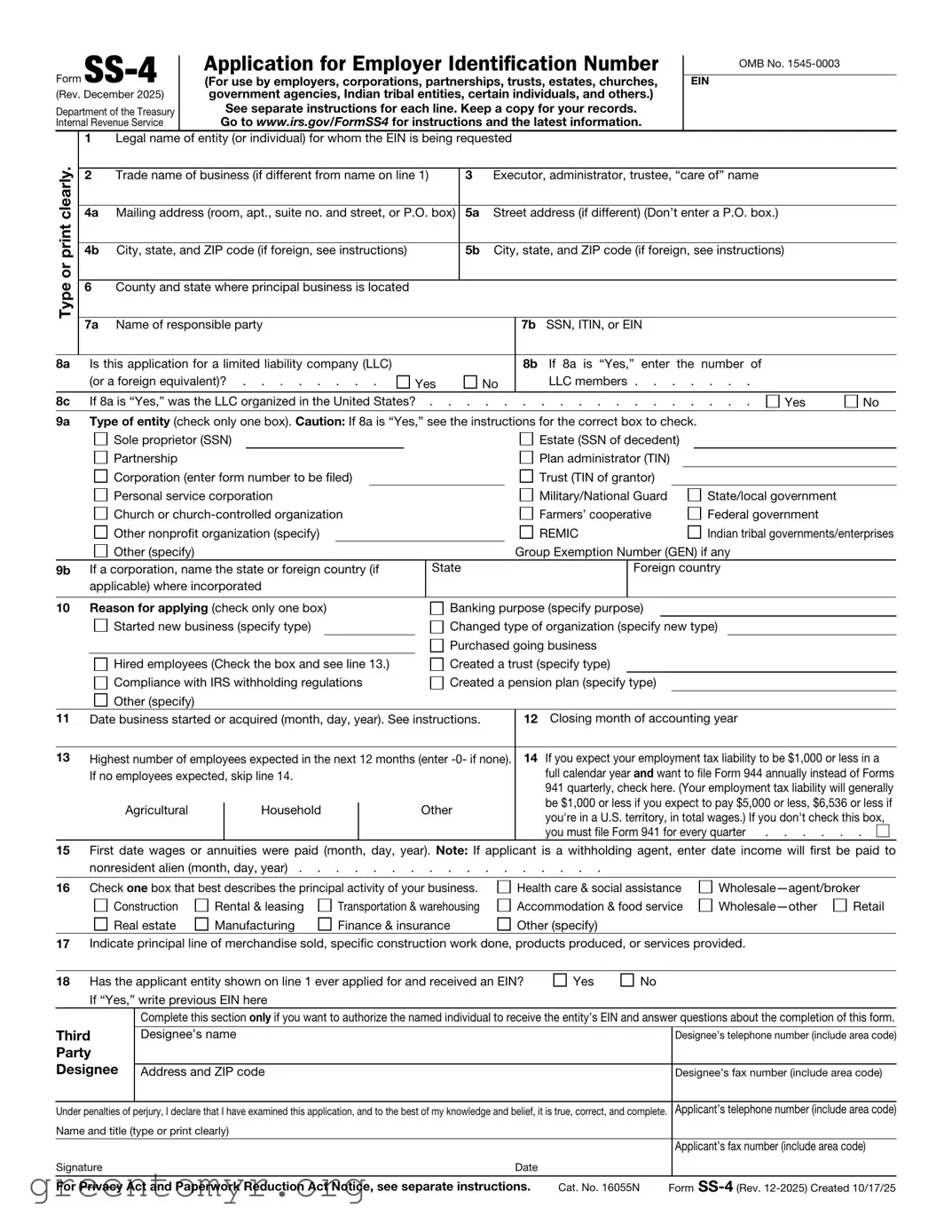
The IRS SS-4 form plays a crucial role in the establishment of a business entity in the United States. When starting a new business, one of the first steps an entrepreneur must take is to obtain an Employer Identification Number (EIN), and this is where the SS-4 form comes into play. This application form is designed to collect essential information about the business, including its legal structure, the reason for applying for an EIN, and details about the responsible party. Whether you are a sole proprietor, a partnership, or a corporation, filling out the SS-4 form accurately is vital, as it not only facilitates the identification of your business for tax purposes but also helps in opening bank accounts and applying for licenses. Understanding the nuances of this form can save time and prevent potential headaches down the road. With the right guidance, completing the SS-4 form can be a straightforward process, paving the way for your business to thrive.

Form |
Application for Employer Identification Number |
OMB No. |
(For use by employers, corporations, partnerships, trusts, estates, churches, |
EIN |
|
(Rev. December 2025) |
government agencies, Indian tribal entities, certain individuals, and others.) |
|
Department of the Treasury |
See separate instructions for each line. Keep a copy for your records. |
|
Internal Revenue Service |
Go to www.irs.gov/FormSS4 for instructions and the latest information. |
|
1Legal name of entity (or individual) for whom the EIN is being requested
clearly. |
4a |
Mailing address (room, apt., suite no. and street, or P.O. box) |
5a |
Street address (if different) (Don’t enter a P.O. box.) |
|
||||||||||||||||||||
|
2 |
Trade name of business (if different from name on line 1) |
|
3 |
Executor, administrator, trustee, “care of” name |
|
|||||||||||||||||||
|
|
|
|
|
|
|
|
|
|
|
|
|
|
|
|
|
|
|
|
||||||
|
|
|
|
|
|
|
|
|
|
|
|
|
|
|
|
|
|
|
|
||||||
4b City, state, and ZIP code (if foreign, see instructions) |
|
|
|
5b City, state, and ZIP code (if foreign, see instructions) |
|
||||||||||||||||||||
or |
|
|
|
|
|
|
|
|
|
|
|
|
|
|
|
|
|
|
|
|
|
|
|
|
|
Type |
6 |
County and state where principal business is located |
|
|
|
|
|
|
|
|
|
|
|
|
|
|
|
|
|
||||||
|
|
|
|
|
|
|
|
|
|
|
|
|
|
|
|
|
|
|
|
|
|
|
|
|
|
|
7a Name of responsible party |
|
|
|
|
|
|
7b SSN, ITIN, or EIN |
|
|
|
|
|||||||||||||
|
|
|
|
|
|
|
|
|
|
|
|
|
|
|
|
|
|
|
|
|
|
|
|
||
8a Is this application for a limited liability company (LLC) |
|
|
|
|
|
|
8b |
If 8a is “Yes,” enter the |
number |
of |
|
||||||||||||||
|
|
(or a foreign equivalent)? |
Yes |
|
|
No |
|
LLC members |
|
|
|||||||||||||||
8c |
|
If 8a is “Yes,” was the LLC organized in the United States? . |
. . |
. . . . . . . . . . . . |
. . . |
Yes |
No |
||||||||||||||||||
9a Type of entity (check only one box). Caution: If 8a is “Yes,” see the instructions for the correct box to check. |
|
|
|
|
|||||||||||||||||||||
|
|
|
Sole proprietor (SSN) |
|
|
|
|
|
|
|
|
|
Estate (SSN of decedent) |
|
|
|
|
|
|||||||
|
|
|
Partnership |
|
|
|
|
|
|
|
Plan administrator (TIN) |
|
|
|
|
|
|||||||||
|
|
|
Corporation (enter form number to be filed) |
|
|
|
|
|
|
|
|
Trust (TIN of grantor) |
|
|
|
|
|
||||||||
|
|
|
Personal service corporation |
|
|
|
|
|
|
|
Military/National Guard |
State/local government |
|
||||||||||||
|
|
|
Church or |
|
|
|
|
|
|
|
Farmers’ cooperative |
Federal government |
|
||||||||||||
|
|
|
Other nonprofit organization (specify) |
|
|
|
|
|
|
|
|
REMIC |
Indian tribal governments/enterprises |
||||||||||||
|
|
|
Other (specify) |
|
|
|
|
|
|
Group Exemption Number (GEN) if any |
|
|
|||||||||||||
9b |
|
If a corporation, name the state or foreign country (if |
|
State |
|
|
|
|
Foreign country |
|
|
||||||||||||||
|
|
applicable) where incorporated |
|
|
|
|
|
|
|
|
|
|
|
|
|
|
|
|
|
||||||
|
|
|
|
|
|
|
|
|
|
|
|
||||||||||||||
10 Reason for applying (check only one box) |
|
|
Banking purpose (specify purpose) |
|
|
|
|
|
|||||||||||||||||
|
|
|
Started new business (specify type) |
|
|
Changed type of organization (specify new type) |
|
|
|||||||||||||||||
|
|
|
|
|
|
|
|
|
|
|
Purchased going business |
|
|
|
|
||||||||||
|
|
|
Hired employees (Check the box and see line 13.) |
|
|
Created a trust (specify type) |
|
|
|
|
|
||||||||||||||
|
|
|
Compliance with IRS withholding regulations |
|
|
Created a pension plan (specify type) |
|
|
|
|
|||||||||||||||
|
|
|
Other (specify) |
|
|
|
|
|
|
|
|
|
|
|
|
|
|
|
|
|
|||||
11 Date business started or acquired (month, day, year). See instructions. |
|
|
12 Closing month of accounting year |
|
|
||||||||||||||||||||
13Highest number of employees expected in the next 12 months (enter
If no employees expected, skip line 14. |
|
|
full calendar year and want to file Form 944 annually instead of Forms |
|||
|
|
|
|
|
941 quarterly, check here. (Your employment tax liability will generally |
|
Agricultural |
|
Household |
|
Other |
be $1,000 or less if you expect to pay $5,000 or less, $6,536 or less if |
|
|
|
|||||
|
|
you're in a U.S. territory, in total wages.) If you don't check this box, |
||||
|
|
|
|
|
||
|
|
|
|
|
you must file Form 941 for every quarter |
. . . . . . |
15First date wages or annuities were paid (month, day, year). Note: If applicant is a withholding agent, enter date income will first be paid to
nonresident alien (month, day, year) . . . . . . . . . . . . . . . . .
16 Check one box that best describes the principal activity of your business. |
Health care & social assistance |
||||
Construction |
Rental & leasing |
Transportation & warehousing |
Accommodation & food service |
Retail |
|
Real estate |
Manufacturing |
Finance & insurance |
Other (specify) |
|
|
17Indicate principal line of merchandise sold, specific construction work done, products produced, or services provided.
18 Has the applicant entity shown on line 1 ever applied for and received an EIN? |
Yes |
No |
|||
If “Yes,” write previous EIN here |
|
|
|
|
|
|
Complete this section only if you want to authorize the named individual to receive the entity’s EIN and answer questions about the completion of this form. |
||||
|
|
|
|
|
|
Third |
Designee’s name |
|
|
Designee’s telephone number (include area code) |
|
Party |
|
|
|
|
|
Designee |
|
|
|
|
|
Address and ZIP code |
|
|
Designee’s fax number (include area code) |
||
|
|
|
|||
Under penalties of |
perjury, I declare that I have examined this application, and to the best of my knowledge and belief, it is true, correct, and complete. |
Applicant’s telephone number (include area code) |
|
||
Name and title (type or print clearly) |
|
|
|
|
|
|
|
|
|
Applicant’s fax number (include area code) |
|
Signature |
Date |
|
|
|
|
For Privacy Act and Paperwork Reduction Act Notice, see separate instructions. |
Cat. No. 16055N |
|
Form |
|
|

Form |
Page 2 |
See below to determine whether you need an EIN. However, for further information on applying for an EIN, including how to submit an EIN application, see the separate instructions at www.irs.gov/FormSS4.
Do I Need an EIN?
File Form
IF the applicant... |
AND... |
THEN... |
|
|
|
started a new business |
doesn’t currently have (nor expect to have) |
complete lines 1, 2, |
|
employees |
9b (if applicable), |
|
|
|
hired (or will hire) employees, |
doesn’t already have an EIN |
complete lines 1, 2, |
including household employees |
|
|
|
|
|
opened a bank account |
needs an EIN for banking purposes only |
complete lines |
|
|
(if applicable), 9a, 9b (if applicable), 10, and 18. |
|
|
|
changed type of organization |
either the legal character of the organization or its |
complete lines |
|
ownership changed (for example, you incorporate a |
|
|
sole proprietorship or form a partnership)2 |
|
|
|
|
purchased a going business3 |
doesn’t already have an EIN |
complete lines |
created a trust |
the trust is other than a grantor trust or an IRA |
complete lines |
|
trust4 |
|
created a pension plan as a |
needs an EIN for reporting purposes |
complete lines 1, 3, |
plan administrator5 |
|
|
is a foreign person needing an |
needs an EIN to complete a Form |
complete lines |
EIN to comply with IRS |
Form |
8a, |
withholding regulations |
or claim tax treaty benefits6 |
and 18. |
|
|
|
is administering an estate |
needs an EIN to report estate income on Form 1041 |
complete lines |
|
|
and 18. |
|
|
|
is a withholding agent for |
is an agent, broker, fiduciary, manager, tenant, or |
complete lines 1, 2, 3 (if applicable), |
taxes on nonwage income |
spouse who is required to file Form 1042, Annual |
|
paid to an alien (that is, |
Withholding Tax Return for U.S. Source Income of |
|
individual, corporation, or |
Foreign Persons |
|
partnership, etc.) |
|
|
|
|
|
is a state or local agency |
serves as a tax reporting agent for public assistance |
complete lines 1, 2, |
|
recipients under Rev. Proc. |
|
|
|
|
is a |
needs an EIN to file Form 8832, Entity Classification |
complete lines |
similar |
Election, for filing employment tax returns and excise |
|
|
tax returns, or for state reporting purposes8, or is a |
|
|
|
|
|
EIN to file Form 5472, Information Return of a 25% |
|
|
|
|
|
Corporation Engaged in a U.S. Trade or Business |
|
|
|
|
is an S corporation |
needs an EIN to file Form 2553, Election by a Small |
complete lines |
|
Business Corporation9 |
|
1For example, a sole proprietorship or
2However, don’t apply for a new EIN if the existing entity only (a) changed its business name, (b) elected on Form 8832 to change the way it is taxed (or is covered by the default rules), or (c) terminated its partnership status because at least 50% of the total interests in partnership capital and profits were sold or exchanged within a 12- month period. The EIN of the terminated partnership should continue to be used. See Regulations section
3Don’t use the EIN of the prior business unless you became the “owner” of a corporation by acquiring its stock.
4However, grantor trusts that don’t file using Optional Method 1 and IRA trusts that are required to file Form
5A plan administrator is the person or group of persons specified as the administrator by the instrument under which the plan is operated.
6Entities applying to be a Qualified Intermediary (QI) need a
7See also Household employer agent in the instructions. Note: State or local agencies may need an EIN for other reasons, for example, hired employees.
8See Disregarded entities in the instructions for details on completing Form
9An existing corporation that is electing or revoking S corporation status should use its previously assigned EIN.
| Fact Name | Description |
|---|---|
| Purpose | The IRS SS-4 form is used to apply for an Employer Identification Number (EIN), which is necessary for businesses to identify themselves for tax purposes. |
| Who Needs It | Any business entity, including sole proprietorships, partnerships, corporations, and non-profits, may need to obtain an EIN using this form. |
| Filing Method | The form can be submitted online, by mail, or by fax. Online applications are processed immediately, while other methods may take longer. |
| State-Specific Forms | Some states may require additional forms or registrations. For example, California requires the Statement of Information (California Corporations Code Section 1502). |
| Deadline | There is no specific deadline for filing the SS-4 form, but businesses should apply for an EIN before starting operations or hiring employees. |
Once you've gathered the necessary information, you're ready to fill out the IRS SS-4 form. This form is crucial for obtaining an Employer Identification Number (EIN), which is essential for various business activities. Follow these steps carefully to ensure accuracy.
After completing the form, review it for any errors or omissions. Once verified, you can submit it to the IRS either online, by mail, or by fax, depending on your preference and urgency. Keep a copy for your records, as this will be important for future reference.
The IRS SS-4 form is an application used to apply for an Employer Identification Number (EIN). This number is essential for businesses and organizations, as it serves as a unique identifier for tax purposes. The EIN is similar to a Social Security number, but it is specifically for business entities.
Various entities may need to complete the SS-4 form, including:
If you plan to hire employees or operate as a business entity, obtaining an EIN through the SS-4 form is typically necessary.
Applying for an EIN can be done in several ways:
When completing the SS-4 form, you will need to provide various pieces of information, including:
Having accurate information readily available will help streamline the application process.
No, there is no fee associated with applying for an EIN using the SS-4 form. The IRS provides this service free of charge. Be cautious of third-party services that may charge a fee to assist with the application process.
The time it takes to receive your EIN depends on the method of application:
Planning ahead is essential, especially if you need the EIN for tax filings or hiring employees.
Yes, if you need to make changes to your EIN information, you can do so. However, certain changes may require you to submit a new SS-4 form. For instance, if you change the structure of your business (e.g., from a sole proprietorship to a corporation), you will need a new EIN. For minor changes, such as an address update, you can simply notify the IRS.
If you lose your EIN, you can retrieve it in several ways:
Keeping a secure record of your EIN is advisable to avoid any complications in the future.
The SS-4 form is available on the IRS website. You can download it for free in PDF format. Additionally, the IRS website provides instructions and guidance on how to fill out the form correctly, which can be helpful for first-time applicants.
Filling out the IRS SS-4 form can be a straightforward process, but mistakes are common. One frequent error occurs when applicants fail to provide a complete legal name for their business. The IRS requires the exact name as registered with the state. Omitting or misspelling this name can lead to delays in processing.
Another mistake is selecting the wrong type of entity. Many individuals do not fully understand the distinctions between different business structures, such as sole proprietorships, partnerships, and corporations. Choosing the incorrect entity type can result in complications with tax obligations and reporting requirements.
Inaccurate taxpayer identification numbers are also a common issue. Applicants sometimes enter a Social Security Number (SSN) or Employer Identification Number (EIN) that does not match IRS records. This inconsistency can cause significant delays in receiving the EIN, which is crucial for business operations.
Additionally, some individuals overlook the importance of providing a valid mailing address. The IRS uses this address for all correspondence. If the address is incorrect or incomplete, important documents may not reach the applicant, leading to missed deadlines and potential penalties.
Another frequent oversight involves failing to sign and date the form. The IRS requires a signature to validate the application. Without this, the form may be considered incomplete, and processing can be stalled.
Lastly, many people do not double-check their information before submission. Simple typographical errors can lead to significant issues down the line. Taking a moment to review the entire form can help ensure that all information is accurate and complete, ultimately facilitating a smoother application process.
The IRS SS-4 form is essential for obtaining an Employer Identification Number (EIN), which is necessary for various business activities. In addition to the SS-4 form, several other documents may be required or helpful during the application process or for related business needs. Below is a list of forms and documents that are often used alongside the SS-4.
Understanding these forms and their purposes can facilitate smoother interactions with the IRS and help ensure compliance with tax obligations. Each document plays a specific role in the overall process of business administration and tax reporting.
The IRS SS-4 form is used to apply for an Employer Identification Number (EIN). This form is similar to several other documents used in various business and tax contexts. Here are four documents that share similarities with the SS-4 form:
When completing the IRS SS-4 form, it’s essential to follow certain guidelines to ensure accuracy and avoid delays. Here’s a list of five things you should and shouldn’t do:
By adhering to these guidelines, you can help ensure a smoother application process for your Employer Identification Number (EIN).
The IRS SS-4 form is an important document for anyone looking to obtain an Employer Identification Number (EIN). However, several misconceptions surround this form. Here are eight common misunderstandings:
Understanding these misconceptions can help you navigate the process of obtaining an EIN more effectively.
Filling out the IRS SS-4 form is an important step for businesses and organizations seeking an Employer Identification Number (EIN). Here are key takeaways to keep in mind:
By following these takeaways, you can navigate the process of completing the SS-4 form with confidence and ease.