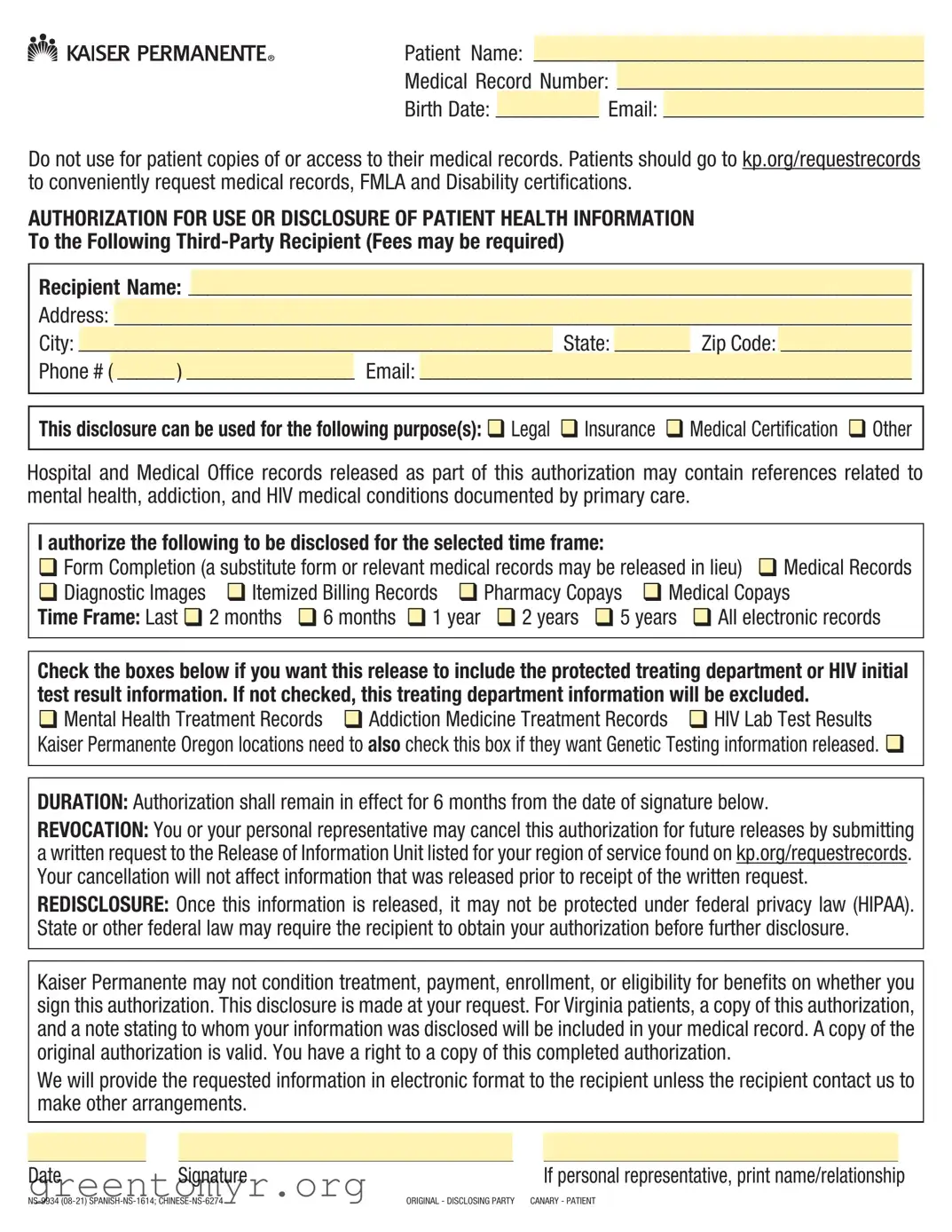
The Kaiser Records Request form serves as a vital tool for individuals seeking to authorize the release of their health information to a third party. This form requires essential patient identification details, including the patient's name, medical record number, birth date, and email address. It is important to note that this form is not intended for patients to access their own medical records; instead, they should visit kp.org/requestrecords for direct requests. The form outlines the authorization for the use or disclosure of patient health information, specifying the recipient's name and contact details, along with the purpose for the disclosure, which may include legal, insurance, or medical certification needs. Patients can select various types of information to be disclosed, such as medical records, diagnostic images, and billing records, and they must indicate a specific time frame for the requested information. Additionally, there are options to include sensitive information related to mental health, addiction, or HIV testing, if desired. The authorization remains valid for six months and can be revoked at any time by submitting a written request. Furthermore, it is essential to understand that once the information is released, it may no longer be protected under federal privacy laws. Overall, the Kaiser Records Request form is structured to facilitate the secure and informed transfer of medical information while maintaining compliance with privacy regulations.

Patient Name: __________________________________________
Medical Record Number: _________________________________
Birth Date: ___________ Email: ____________________________
Do not use for patient copies of or access to their medical records. Patients should go to kp.org/requestrecords to conveniently request medical records, FMLA and Disability certifications.
AUTHORIZATION FOR USE OR DISCLOSURE OF PATIENT HEALTH INFORMATION
To the Following
Recipient Name: ______________________________________________________________________________
Address: ______________________________________________________________________________________
City: ___________________________________________________ State: ________ Zip Code: ______________
Phone # ( ______ ) __________________ Email: _____________________________________________________
This disclosure can be used for the following purpose(s): Legal Insurance Medical Certification Other
Hospital and Medical Office records released as part of this authorization may contain references related to mental health, addiction, and HIV medical conditions documented by primary care.
I authorize the following to be disclosed for the selected time frame:
Form Completion (a substitute form or relevant medical records may be released in lieu) Medical Records
|
Diagnostic Images |
|
|
Itemized Billing Records |
|
Pharmacy Copays |
|
Medical Copays |
||||||||||
|
|
|
||||||||||||||||
|
|
|
|
|||||||||||||||
Time Frame: Last |
|
2 months |
|
6 months |
|
1 year |
2 years |
|
5 years |
|
All electronic records |
|||||||
|
|
|
|
|||||||||||||||
|
|
|
|
|
|
|||||||||||||
Check the boxes below if you want this release to include the protected treating department or HIV initial test result information. If not checked, this treating department information will be excluded.
Mental Health Treatment Records Addiction Medicine Treatment Records HIV Lab Test Results Kaiser Permanente Oregon locations need to also check this box if they want Genetic Testing information released.
DURATION: Authorization shall remain in effect for 6 months from the date of signature below.
REVOCATION: You or your personal representative may cancel this authorization for future releases by submitting a written request to the Release of Information Unit listed for your region of service found on kp.org/requestrecords. Your cancellation will not affect information that was released prior to receipt of the written request.
REDISCLOSURE: Once this information is released, it may not be protected under federal privacy law (HIPAA). State or other federal law may require the recipient to obtain your authorization before further disclosure.
Kaiser Permanente may not condition treatment, payment, enrollment, or eligibility for benefits on whether you sign this authorization. This disclosure is made at your request. For Virginia patients, a copy of this authorization, and a note stating to whom your information was disclosed will be included in your medical record. A copy of the original authorization is valid. You have a right to a copy of this completed authorization.
We will provide the requested information in electronic format to the recipient unless the recipient contact us to make other arrangements.
|
|
|
|
|
|
|
Date |
|
Signature |
|
|
If personal representative, print name/relationship |
|
ORIGINAL - DISCLOSING PARTY CANARY - PATIENT |
||||||
Instructions:
1)Complete the patient identification information on the top
2)Complete all required information for the recipient including a valid email address
3)Check the box for purpose of disclosure
4)Check the box(es) for the type of information to be disclosed and also check the box for a timeframe
5)If you want specially protected information to be included, check the appropriate box(es)
6)Enter the date you are signing the authorization
7)Sign the form
8)If you are a personal representative, print your name and relationship. We may reach out for you to provide additional documentation if needed.
9)Submit this form to the third party you are authorizing to obtain records
10)Keep a copy for your records
“Kaiser Permanente” means both your insurance company (a Kaiser Permanente health plan) and your doctors (a Permanente medical or dental group). It also includes different groups depending on where you live.
To find contact information go to kp.org and search locations for your region/market listed below or alternatively go to kp.org/requestrecords and indicate your region/market.
All states where we do business:
•Kaiser Foundation Hospitals
•Kaiser Permanente Insurance Company
Colorado:
•Kaiser Foundation Health Plan of Colorado
•Colorado Permanente Medical Group, P.C.
Georgia:
•Kaiser Foundation Health Plan of Georgia, Inc.
•The Southeast Permanente Medical Group, Inc.
•Kaiser Foundation Health Plan of the
•
Washington:
•Kaiser Foundation Health Plan of Washington
•Washington Permanente Medical Group, P.C.
Hawaii:
•Kaiser Foundation Health Plan, Inc., Hawaii Region
•Hawaii Permanente Medical Group, Inc.
•Maui Health Systems
Northwest (Oregon/SW Washington):
•Kaiser Foundation Health Plan of the Northwest
•Northwest Permanente, P.C.
•Permanente Dental Associates, P.C.
California - North:
•Kaiser Foundation Health Plan, Inc., Northern California Region
•The Permanente Medical Group, Inc.
California - South:
•Kaiser Foundation Health Plan, Inc., Southern California Region
•Southern California Permanente Medical Group

Patient Name: __________________________________________
Medical Record Number: _________________________________
Birth Date: ___________ Email: ____________________________
Do not use for patient copies of or access to their medical records. Patients should go to kp.org/requestrecords to conveniently request medical records, FMLA and Disability certifications.
AUTHORIZATION FOR USE OR DISCLOSURE OF PATIENT HEALTH INFORMATION
To the Following
Recipient Name: ______________________________________________________________________________
Address: ______________________________________________________________________________________
City: ___________________________________________________ State: ________ Zip Code: ______________
Phone # ( ______ ) __________________ Email: _____________________________________________________
This disclosure can be used for the following purpose(s): Legal Insurance Medical Certification Other
Hospital and Medical Office records released as part of this authorization may contain references related to mental health, addiction, and HIV medical conditions documented by primary care.
I authorize the following to be disclosed for the selected time frame:
Form Completion (a substitute form or relevant medical records may be released in lieu) Medical Records
Diagnostic Images |
Itemized Billing Records Pharmacy Copays Medical Copays |
Time Frame: Last |
2 months 6 months 1 year 2 years 5 years All electronic records |
Check the boxes below if you want this release to include the protected treating department or HIV initial test result information. If not checked, this treating department information will be excluded.
Mental Health Treatment Records Addiction Medicine Treatment Records HIV Lab Test Results Kaiser Permanente Oregon locations need to also check this box if they want Genetic Testing information released.
DURATION: Authorization shall remain in effect for 6 months from the date of signature below.
REVOCATION: You or your personal representative may cancel this authorization for future releases by submitting a written request to the Release of Information Unit listed for your region of service found on kp.org/requestrecords. Your cancellation will not affect information that was released prior to receipt of the written request.
REDISCLOSURE: Once this information is released, it may not be protected under federal privacy law (HIPAA). State or other federal law may require the recipient to obtain your authorization before further disclosure.
Kaiser Permanente may not condition treatment, payment, enrollment, or eligibility for benefits on whether you sign this authorization. This disclosure is made at your request. For Virginia patients, a copy of this authorization, and a note stating to whom your information was disclosed will be included in your medical record. A copy of the original authorization is valid. You have a right to a copy of this completed authorization.
We will provide the requested information in electronic format to the recipient unless the recipient contact us to make other arrangements.
|
|
|
|
|
|
|
Date |
Signature |
|
|
If personal representative, print name/relationship |
||
ORIGINAL - DISCLOSING PARTY CANARY - PATIENT |
||||||
| Fact Name | Details |
|---|---|
| Patient Identification | The form requires the patient's name, medical record number, birth date, and email address for identification purposes. |
| Third-Party Disclosure | Patients can authorize the release of their medical information to a designated third party, which may incur fees. |
| Purpose of Disclosure | The form allows for various purposes, including legal, insurance, and medical certification. |
| Duration of Authorization | This authorization remains effective for six months from the date of signing. |
| Revocation Process | Patients can cancel the authorization by submitting a written request to the Release of Information Unit. |
| State-Specific Regulations | For Virginia patients, a copy of the authorization and disclosure details will be included in their medical record, as per state law. |
After completing the Kaiser Records Request form, the next step involves submitting it to the designated third party. This ensures that your request for medical records is processed efficiently. Be sure to keep a copy for your own records.
The Kaiser Records Request form is designed to authorize the release of a patient’s health information to a third party. This could include medical records, billing information, or diagnostic images. Patients cannot use this form to access their own medical records directly; they should visit kp.org/requestrecords for that purpose.
You can authorize any third-party recipient, such as a lawyer, insurance company, or another healthcare provider, to receive your medical records. It is essential to provide accurate information about the recipient, including their name, address, and email, to ensure the records are sent to the correct location.
The form allows you to request various types of information, including:
You can also specify if you want to include sensitive information such as mental health treatment records, addiction medicine treatment records, or HIV lab test results.
The authorization remains in effect for six months from the date you sign the form. After this period, a new authorization will be necessary to release any further information.
Yes, you can revoke your authorization at any time by submitting a written request to the Release of Information Unit for your region. However, this revocation will not affect any information that was released before the request was received.
If you wish to include sensitive information, such as mental health records or HIV test results, you must check the appropriate boxes on the form. If these boxes are not checked, that information will be excluded from the disclosure.
Yes, you have the right to a copy of the completed authorization. It is advisable to keep a copy for your records after signing and submitting the form.
If you need help completing the Kaiser Records Request form, you can reach out to Kaiser Permanente's customer service or visit kp.org/requestrecords for additional guidance. They may also contact you for further documentation if necessary.
Filling out the Kaiser Records Request form can be straightforward, but many people make common mistakes that can delay the process. One frequent error is failing to provide complete patient identification information. Omitting the patient’s name, medical record number, or birth date can lead to confusion and hinder the request.
Another mistake involves the recipient's information. People often neglect to fill out the recipient's name or address fully. Incomplete or incorrect details can prevent the records from reaching the intended person or organization. It's essential to double-check that all required fields are filled out accurately.
Many individuals also forget to specify the purpose of the disclosure. This step is crucial, as it helps Kaiser understand why the records are needed. Without selecting a purpose, the request may be delayed or rejected altogether.
Choosing the right time frame for the requested records is another area where mistakes commonly occur. Some individuals may not check the appropriate box or select a time frame that does not align with their needs. This oversight can result in receiving records that are not relevant to the request.
Additionally, people often overlook the need to check boxes for specially protected information, such as mental health or HIV records. If these boxes are not checked, the relevant information will be excluded from the request, potentially leaving out critical details.
Another common error is forgetting to sign and date the authorization. Without a signature, the form is incomplete and cannot be processed. Similarly, if someone is acting as a personal representative, they may forget to print their name and relationship, which can complicate the authorization.
Some individuals submit the form without keeping a copy for their records. Having a copy is important for tracking the request and confirming what information was authorized for release.
Additionally, people sometimes fail to understand the implications of redisclosure. Once the information is released, it may not be protected under federal privacy laws. This misunderstanding can lead to concerns about privacy and confidentiality.
Finally, a common mistake is not following up after submitting the form. Individuals may assume that the request will be processed without any further action. Checking in can help ensure that the request is being handled and that any issues are addressed promptly.
By being aware of these common pitfalls, individuals can improve their chances of successfully obtaining their medical records without unnecessary delays.
When requesting medical records from Kaiser Permanente, several other forms and documents may be needed alongside the Kaiser Records Request form. Each of these documents serves a specific purpose and helps ensure that the request process is smooth and compliant with regulations.
Understanding these forms and their purposes can facilitate a more efficient process when requesting medical records. Always ensure that all required information is complete to avoid delays in obtaining the necessary documentation.
When filling out the Kaiser Records Request form, it's important to follow specific guidelines to ensure a smooth process. Here are some dos and don'ts to keep in mind:
Misconception 1: The Kaiser Records Request form is for patients to access their own medical records.
This form is actually intended for authorizing the release of health information to third parties. Patients should visit kp.org/requestrecords to request their own medical records directly.
Misconception 2: Completing the form guarantees that all requested information will be released.
While the form allows for specific types of information to be requested, the release of certain details, especially sensitive information, may be subject to additional restrictions. It's important to check the appropriate boxes to ensure desired information is included.
Misconception 3: There are no fees associated with using the Kaiser Records Request form.
Fees may apply when disclosing records to third parties. It's advisable to inquire about any potential costs before submitting the request.
Misconception 4: The authorization remains valid indefinitely.
The authorization is only valid for six months from the date of signature. After this period, a new request must be submitted for further disclosures.
Misconception 5: Patients can revoke their authorization at any time without consequences.
While patients can revoke their authorization, the revocation only applies to future releases. Any information that has already been released prior to the revocation will not be affected.
When navigating the Kaiser Records Request form, understanding the process is crucial for a smooth experience. Here are some key takeaways to keep in mind:
Following these guidelines will help ensure that your request for medical records is processed efficiently and accurately.