In the state of Kansas, the Do Not Resuscitate (DNR) Order form plays a crucial role in ensuring that individuals can express their wishes regarding medical treatment at the end of life. This document empowers patients to make informed choices about their care, particularly in situations where they may be unable to communicate their preferences. The form is designed for use in various healthcare settings, including hospitals, nursing homes, and home care environments. It outlines specific instructions indicating that if a patient’s heart stops or they stop breathing, medical personnel should refrain from performing cardiopulmonary resuscitation (CPR) or other life-saving measures. Importantly, the DNR Order must be signed by both the patient and a physician, reinforcing the need for clear communication and mutual understanding between the patient and their healthcare provider. Additionally, it is essential for individuals to discuss their wishes with family members and caregivers, ensuring that everyone involved is aware of and respects these important decisions. By taking the time to complete a DNR Order, individuals can find peace of mind, knowing that their healthcare preferences will be honored during critical moments.
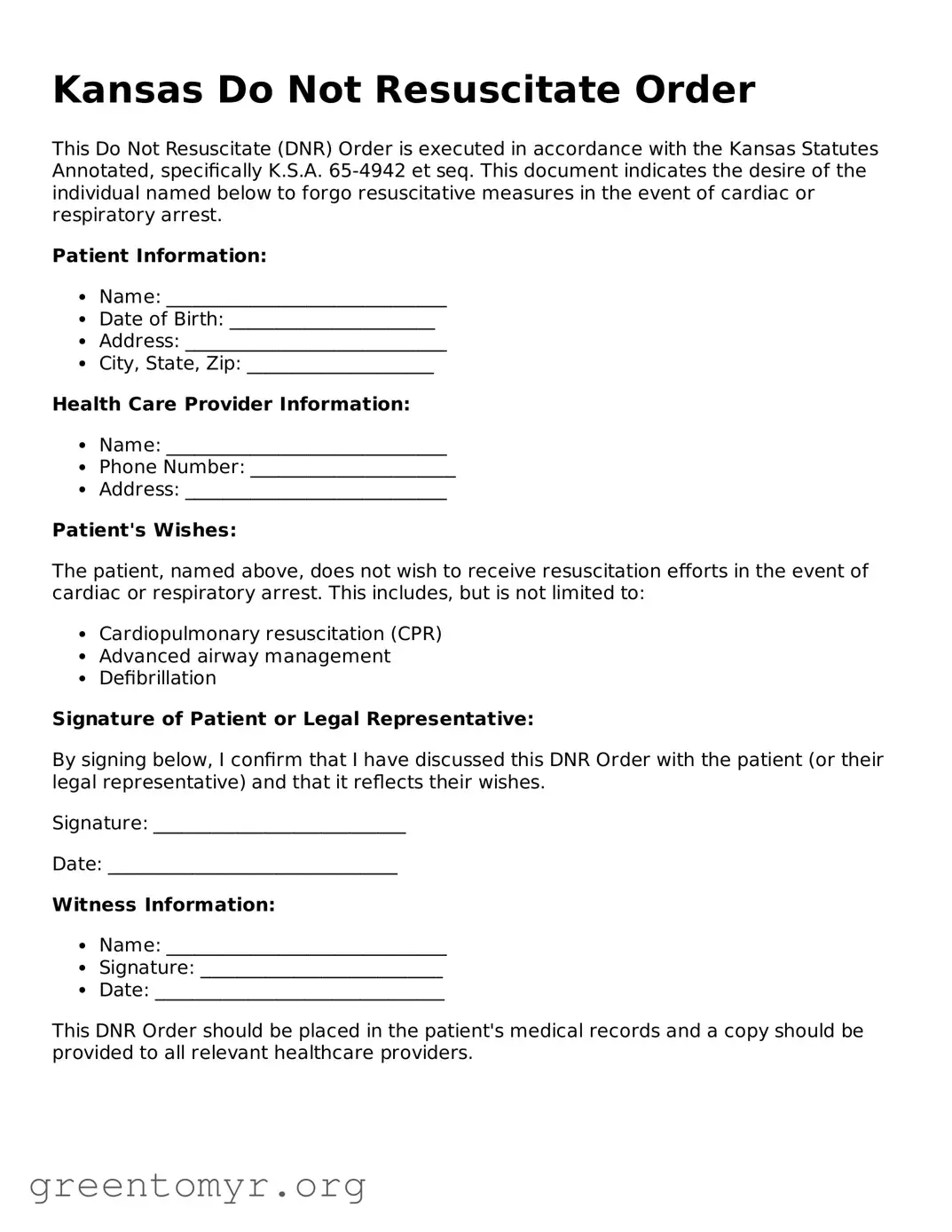
Kansas Do Not Resuscitate Order
This Do Not Resuscitate (DNR) Order is executed in accordance with the Kansas Statutes Annotated, specifically K.S.A. 65-4942 et seq. This document indicates the desire of the individual named below to forgo resuscitative measures in the event of cardiac or respiratory arrest.
Patient Information:
Health Care Provider Information:
Patient's Wishes:
The patient, named above, does not wish to receive resuscitation efforts in the event of cardiac or respiratory arrest. This includes, but is not limited to:
Signature of Patient or Legal Representative:
By signing below, I confirm that I have discussed this DNR Order with the patient (or their legal representative) and that it reflects their wishes.
Signature: ___________________________
Date: _______________________________
Witness Information:
This DNR Order should be placed in the patient's medical records and a copy should be provided to all relevant healthcare providers.
| Fact Name | Description |
|---|---|
| Definition | A Kansas Do Not Resuscitate (DNR) Order is a legal document that informs medical personnel not to perform CPR if a person's heart stops beating or they stop breathing. |
| Governing Law | The Kansas DNR Order is governed by K.S.A. 65-4941 through K.S.A. 65-4944. |
| Eligibility | Any adult can complete a DNR Order. Minors require parental or guardian consent. |
| Form Requirements | The form must be signed by a physician and the patient or their legal representative. |
| Validity | A DNR Order is valid in all healthcare settings within Kansas, including hospitals and nursing homes. |
| Revocation | Patients can revoke a DNR Order at any time, verbally or in writing. |
| Importance | This order ensures that patients receive care aligned with their wishes regarding end-of-life treatment. |
Filling out the Kansas Do Not Resuscitate Order form is an important step in ensuring that your healthcare wishes are respected. This document allows individuals to communicate their preferences regarding resuscitation in a clear and legally recognized manner. Below are the steps to guide you through the process of completing this form.
Once the form is filled out and properly signed, it is advisable to discuss your decisions with your healthcare provider and loved ones. This ensures that everyone is aware of your wishes and can support you in upholding them.
A Kansas Do Not Resuscitate Order (DNR) is a legal document that allows individuals to express their wishes regarding resuscitation efforts in the event of a medical emergency. Specifically, it instructs healthcare providers not to perform cardiopulmonary resuscitation (CPR) if the individual's heart stops beating or they stop breathing.
In Kansas, any adult who is capable of making informed decisions about their healthcare can create a DNR. This includes individuals diagnosed with a terminal illness or those who wish to avoid aggressive medical interventions at the end of life. Additionally, a legally appointed guardian or healthcare proxy can also establish a DNR on behalf of someone who is unable to do so.
The DNR form can be obtained from various sources, including:
Once you have the form, it is important to fill it out completely and accurately.
The Kansas DNR form typically requires the following information:
Ensure that all required fields are completed to validate the order.
Yes, a properly completed and signed DNR order is legally binding in Kansas. Healthcare providers are required to honor the DNR wishes outlined in the document, provided it is clear and meets the state's legal requirements.
Absolutely. You have the right to change or revoke your DNR order at any time. To do so, simply create a new DNR form or write a statement indicating your desire to revoke the previous order. It is advisable to inform your healthcare providers and family members of any changes you make.
Once you have completed your DNR form, it is essential to keep it in an accessible location. You should provide copies to:
Consider carrying a wallet card that indicates you have a DNR order in place.
Having a DNR order does not mean you will receive less medical care. It only indicates your preferences regarding resuscitation efforts. Healthcare providers will still provide all other necessary treatments and interventions to manage your health and comfort.
Yes, discussing your DNR wishes with family members is encouraged. Open communication can help ensure that your loved ones understand your preferences and can support your decisions in a medical crisis. It can also alleviate confusion or conflict during difficult times.
For more information about DNR orders in Kansas, you can visit the Kansas Department of Health and Environment (KDHE) website. Additionally, healthcare providers and legal professionals can offer guidance tailored to your specific situation.
Filling out the Kansas Do Not Resuscitate Order form is an important step in ensuring that your healthcare wishes are respected. However, many people make mistakes that can lead to confusion or invalid orders. One common mistake is failing to clearly indicate the patient's wishes. It's crucial to be explicit about the decision to forgo resuscitation. If the form is ambiguous, healthcare providers may not be able to follow the intended directive.
Another frequent error involves not signing the form properly. The Kansas DNR form requires signatures from both the patient and the attending physician. Omitting one of these signatures can render the document ineffective. Always double-check that all necessary parties have signed before considering the form complete.
Some individuals overlook the importance of including the date on the form. Without a date, it may be unclear when the DNR order was established. This can lead to complications, especially in emergency situations. Make sure to date the form to provide clarity about when the decision was made.
People often forget to discuss their wishes with family members. While the form is a legal document, having conversations about your choices can prevent misunderstandings during critical moments. Family members should be aware of your decision and support it, ensuring that everyone is on the same page.
Lastly, not reviewing the form regularly can be a significant mistake. Life circumstances change, and so can your healthcare preferences. It's advisable to revisit the DNR order periodically to ensure it still reflects your wishes. If changes are needed, make sure to complete a new form and communicate those changes to your healthcare provider and loved ones.
The Kansas Do Not Resuscitate (DNR) Order form is a critical document for individuals who wish to outline their preferences regarding resuscitation in the event of a medical emergency. Alongside this form, several other documents are commonly utilized to ensure that an individual's healthcare wishes are honored. Below is a list of these documents, each serving a unique purpose in the realm of healthcare decision-making.
Understanding these documents is essential for individuals and their families as they navigate healthcare decisions. Each document plays a significant role in ensuring that a person's wishes are respected and followed during critical medical situations.
A Do Not Resuscitate (DNR) Order form is an important document that outlines a person's wishes regarding resuscitation efforts in the event of a medical emergency. Several other documents serve similar purposes in expressing healthcare preferences. Here are five such documents:
When filling out the Kansas Do Not Resuscitate Order form, it is essential to approach the task with care and attention to detail. Here are some important guidelines to consider:
There are several misconceptions regarding the Kansas Do Not Resuscitate (DNR) Order form. Understanding these can help clarify the purpose and implications of the document.
When considering a Do Not Resuscitate (DNR) Order in Kansas, it's essential to understand the implications and the process. Here are some key takeaways: