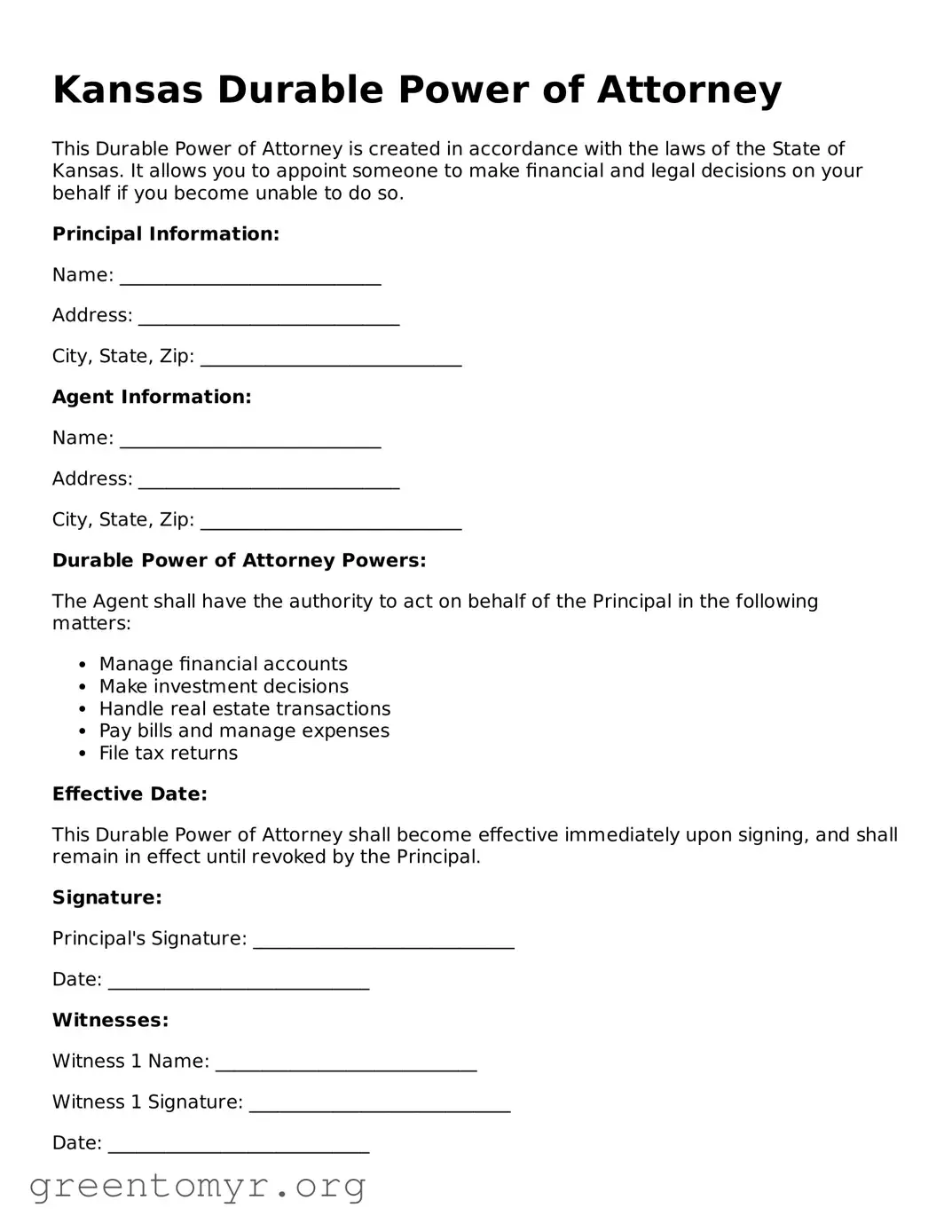
The Kansas Durable Power of Attorney form is an essential legal document that empowers individuals to designate a trusted person, known as an agent, to make decisions on their behalf in the event they become incapacitated. This form provides clarity and guidance in times of uncertainty, ensuring that financial and medical decisions align with the individual’s wishes. It covers a wide range of responsibilities, from managing bank accounts and real estate transactions to making healthcare choices. By establishing a durable power of attorney, individuals can maintain control over their affairs even when they are unable to communicate their preferences. The form is designed to be straightforward, allowing for customization to fit specific needs and circumstances. Understanding the nuances of this document can help individuals navigate the complexities of life’s unexpected challenges, providing peace of mind that their interests will be protected by someone they trust.
Kansas Durable Power of Attorney
This Durable Power of Attorney is created in accordance with the laws of the State of Kansas. It allows you to appoint someone to make financial and legal decisions on your behalf if you become unable to do so.
Principal Information:
Name: ____________________________
Address: ____________________________
City, State, Zip: ____________________________
Agent Information:
Name: ____________________________
Address: ____________________________
City, State, Zip: ____________________________
Durable Power of Attorney Powers:
The Agent shall have the authority to act on behalf of the Principal in the following matters:
Effective Date:
This Durable Power of Attorney shall become effective immediately upon signing, and shall remain in effect until revoked by the Principal.
Signature:
Principal's Signature: ____________________________
Date: ____________________________
Witnesses:
Witness 1 Name: ____________________________
Witness 1 Signature: ____________________________
Date: ____________________________
Witness 2 Name: ____________________________
Witness 2 Signature: ____________________________
Date: ____________________________
This document must be signed in the presence of two witnesses who are not related to the Principal or the Agent.
| Fact Name | Details |
|---|---|
| Definition | A Kansas Durable Power of Attorney allows an individual to appoint someone else to make decisions on their behalf, even if they become incapacitated. |
| Governing Law | This form is governed by the Kansas Statutes Annotated, specifically K.S.A. 58-6501 through 58-6510. |
| Durability | The "durable" aspect means that the authority granted remains effective even if the principal becomes mentally incompetent. |
| Agent Authority | The agent can be given broad powers, including managing financial affairs, real estate transactions, and healthcare decisions. |
| Revocation | The principal can revoke the Durable Power of Attorney at any time, as long as they are mentally competent to do so. |
| Witness Requirements | The form must be signed by the principal in the presence of two witnesses or a notary public to be valid. |
Filling out the Kansas Durable Power of Attorney form is a straightforward process. Once completed, this document allows you to appoint someone to make decisions on your behalf regarding financial matters. Follow these steps to ensure the form is filled out correctly.
A Kansas Durable Power of Attorney is a legal document that allows you to appoint someone to make decisions on your behalf if you become unable to do so. This can include decisions related to financial matters, healthcare, and other personal affairs. The "durable" aspect means that the authority granted to your agent remains in effect even if you become incapacitated.
You can appoint any competent adult as your agent, including a family member, friend, or trusted advisor. It’s essential to choose someone you trust, as they will have significant control over your financial and personal decisions. You may also want to consider appointing a successor agent in case your primary agent is unable or unwilling to serve.
The powers granted to your agent can be broad or limited based on your preferences. Common powers include:
It is crucial to clearly specify the powers you wish to grant to ensure your agent can act effectively on your behalf.
To create a Durable Power of Attorney in Kansas, follow these steps:
Once completed, provide copies to your agent and any relevant institutions or individuals.
Yes, you can revoke a Durable Power of Attorney at any time as long as you are competent. To do so, you should create a written revocation document and notify your agent and any institutions that had a copy of the original Durable Power of Attorney. This ensures that your previous agent no longer has authority to act on your behalf.
If you do not have a Durable Power of Attorney and become incapacitated, the court may appoint a guardian or conservator to make decisions for you. This process can be lengthy and costly, and it may not reflect your wishes. Having a Durable Power of Attorney in place helps ensure that your preferences are honored and can simplify decision-making for your loved ones.
Filling out a Kansas Durable Power of Attorney form is an important step in planning for the future. However, many individuals make mistakes that can lead to complications later on. Understanding these common errors can help ensure that the document serves its intended purpose effectively.
One frequent mistake is not clearly identifying the agent. The agent is the person you choose to make decisions on your behalf. If the agent's name is misspelled or if there is any ambiguity about who they are, it could create confusion. Always double-check the spelling and ensure that you provide any necessary identifying information, such as their address or relationship to you.
Another common error is failing to specify the powers granted to the agent. The form allows you to define what decisions your agent can make on your behalf. If these powers are not clearly outlined, your agent may not have the authority to act in certain situations. It's essential to review and understand the powers you wish to grant, ensuring they align with your wishes.
People often forget to date and sign the document properly. A Durable Power of Attorney is not valid unless it is signed and dated by the principal, which is the person granting the authority. If the form is unsigned or undated, it could be challenged in the future, making it ineffective. Always ensure that you sign and date the document in the appropriate places.
Additionally, some individuals neglect to have the form notarized or witnessed, which can be a requirement in Kansas. Although notarization is not always mandatory, having the document notarized adds an extra layer of authenticity. If witnesses are required, failing to have them present during the signing can invalidate the document.
Another mistake is not discussing the Durable Power of Attorney with the chosen agent. It is crucial to have an open conversation with the person you designate as your agent. They should understand your wishes and be willing to take on this responsibility. Failing to communicate can lead to misunderstandings and conflict when the time comes to act on your behalf.
Lastly, people often overlook updating the form when their circumstances change. Life events such as marriage, divorce, or the passing of a loved one can impact your choices. Regularly reviewing and updating your Durable Power of Attorney ensures that it reflects your current wishes and circumstances. Keeping the document current can prevent potential disputes or confusion down the line.
A Kansas Durable Power of Attorney form allows an individual to appoint someone else to make decisions on their behalf. This document is often accompanied by other forms that can help clarify or support the authority granted. Below is a list of additional documents commonly used with the Durable Power of Attorney.
These documents can provide additional clarity and support to the Durable Power of Attorney, ensuring that an individual's wishes are respected in various situations.
The Durable Power of Attorney (DPOA) form shares similarities with several other legal documents. Each serves a specific purpose in managing an individual’s affairs. Here are four documents that are similar to the DPOA:
When filling out the Kansas Durable Power of Attorney form, it is important to follow specific guidelines to ensure the document is valid and effective. Below is a list of recommended actions and pitfalls to avoid.
By adhering to these guidelines, individuals can help ensure that their Durable Power of Attorney is executed correctly and serves its intended purpose.
Understanding the Kansas Durable Power of Attorney (DPOA) form can be challenging. Here are eight common misconceptions that people often have about this important legal document.
Many people believe that a lawyer is necessary to create a DPOA. In Kansas, individuals can fill out the form themselves as long as they understand the requirements and implications.
While a DPOA often covers financial decisions, it can also grant authority over healthcare decisions. This dual capability is crucial for comprehensive planning.
In Kansas, a DPOA can be set up to take effect immediately upon signing, or it can be designated to activate only upon incapacitation, depending on the principal's wishes.
This is not true. The principal can revoke the DPOA at any time as long as they are mentally competent, allowing for flexibility as circumstances change.
Each state has its own requirements and forms. Kansas has specific guidelines that must be followed for the DPOA to be valid, so using a form from another state may not work.
While many choose family members, Kansas law allows anyone to serve as an agent, as long as they are trustworthy and capable of managing the responsibilities.
A DPOA remains effective until the principal revokes it or passes away. It does not have a built-in expiration date unless specified.
Agents have a fiduciary duty to act in the best interest of the principal. They must keep accurate records and can be held accountable for their actions.
Understanding these misconceptions can help individuals make informed decisions about their legal planning in Kansas.
When filling out and using the Kansas Durable Power of Attorney form, consider these key takeaways: