Content Navigation

In Kansas, the Firearm Bill of Sale form serves as a crucial document for individuals engaging in the sale or transfer of firearms. This form not only provides a record of the transaction but also helps protect both the buyer and seller by outlining essential details of the sale. Typically, it includes information such as the names and addresses of both parties, the date of the transaction, and a description of the firearm being sold, including its make, model, and serial number. Additionally, the form often requires both parties to affirm that they are legally allowed to buy and sell firearms, which can help prevent illegal transactions. By using this form, individuals can ensure that their firearm sales are conducted in a transparent and responsible manner, fostering a safer community while complying with state regulations. Understanding the importance of this document can empower both buyers and sellers to navigate the process with confidence and clarity.

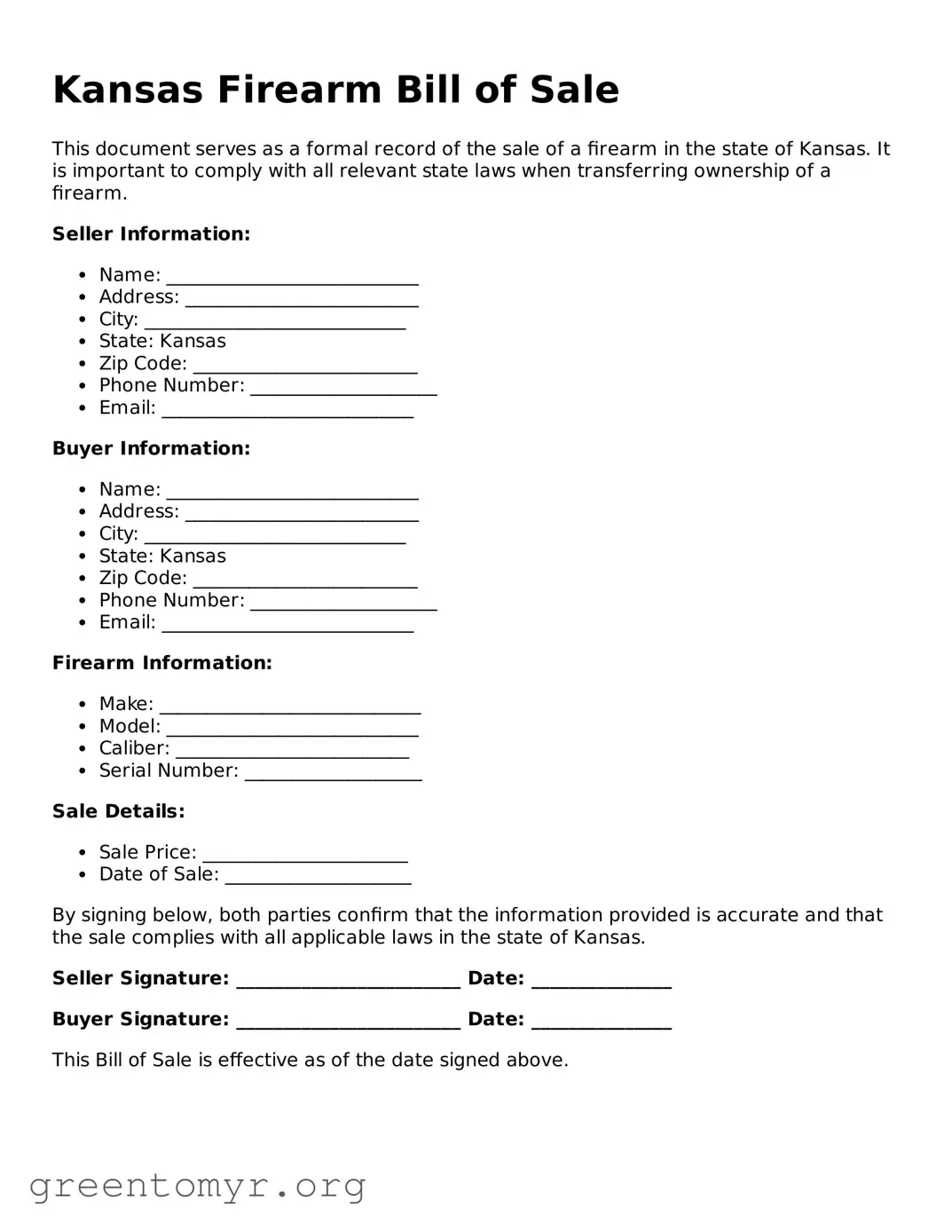
Kansas Firearm Bill of Sale Example

Kansas Firearm Bill of Sale

This document serves as a formal record of the sale of a firearm in the state of Kansas. It is important to comply with all relevant state laws when transferring ownership of a firearm.

Seller Information:

  • Name: ___________________________
  • Address: _________________________
  • City: ____________________________
  • State: Kansas
  • Zip Code: ________________________
  • Phone Number: ____________________
  • Email: ___________________________

Buyer Information:

  • Name: ___________________________
  • Address: _________________________
  • City: ____________________________
  • State: Kansas
  • Zip Code: ________________________
  • Phone Number: ____________________
  • Email: ___________________________

Firearm Information:

  • Make: ____________________________
  • Model: ___________________________
  • Caliber: _________________________
  • Serial Number: ___________________

Sale Details:

  • Sale Price: ______________________
  • Date of Sale: ____________________

By signing below, both parties confirm that the information provided is accurate and that the sale complies with all applicable laws in the state of Kansas.

Seller Signature: ________________________ Date: _______________

Buyer Signature: ________________________ Date: _______________

This Bill of Sale is effective as of the date signed above.

PDF Form Features

Fact Name Details
Purpose The Kansas Firearm Bill of Sale form is used to document the sale or transfer of a firearm between private parties.
Governing Law This form is governed by Kansas Statutes Annotated (K.S.A.) 21-6301 et seq.
Parties Involved The form requires information from both the seller and the buyer, including names and addresses.
Firearm Description Details about the firearm, such as make, model, and serial number, must be included to ensure proper identification.
Notarization While notarization is not required, it is recommended to add an extra layer of authenticity to the transaction.
Legal Age Both the seller and buyer must be at least 18 years old to legally complete the transaction.
Background Checks Kansas does not require background checks for private sales, but buyers should be aware of federal laws.
Record Keeping It is advisable for both parties to keep a copy of the completed Bill of Sale for their records.
Transfer of Ownership The form serves as proof of the transfer of ownership, which can be important for future legal matters.
State-Specific This form is specific to Kansas and may differ from firearm sale forms in other states.

Guide to Using Kansas Firearm Bill of Sale

Completing the Kansas Firearm Bill of Sale form is an important step in ensuring that the transfer of ownership is documented properly. This form helps protect both the seller and the buyer by providing a clear record of the transaction. Once the form is filled out, both parties should retain a copy for their records.

  1. Obtain the Kansas Firearm Bill of Sale form. This can typically be found online or at local law enforcement agencies.
  2. Begin by entering the date of the transaction at the top of the form.
  3. Fill in the seller's information. This includes the seller's full name, address, and contact information.
  4. Provide the buyer's information in the designated section. Include the buyer's full name, address, and contact information.
  5. Describe the firearm being sold. Include details such as the make, model, caliber, and serial number.
  6. Indicate the purchase price of the firearm clearly.
  7. Both the seller and buyer should sign and date the form at the bottom. Ensure that signatures are legible.
  8. Make copies of the completed form for both parties to keep for their records.

Get Answers on Kansas Firearm Bill of Sale

What is a Kansas Firearm Bill of Sale?

A Kansas Firearm Bill of Sale is a legal document that records the transfer of ownership of a firearm from one individual to another. This form serves as proof of the transaction and includes essential details about the buyer, seller, and the firearm being sold. It is important for both parties to retain a copy for their records.

What information is required on the form?

The Kansas Firearm Bill of Sale typically requires the following information:

  • Full names and addresses of both the buyer and seller
  • Description of the firearm, including make, model, caliber, and serial number
  • Date of the transaction
  • Signatures of both parties

Including this information helps ensure clarity and legal compliance in the transfer process.

Is a Bill of Sale required for private firearm sales in Kansas?

While Kansas law does not mandate a Bill of Sale for private firearm sales, it is highly recommended. Having a Bill of Sale can provide legal protection and serve as evidence of the transaction. It may also help prevent potential disputes regarding ownership in the future.

Do I need to have the Bill of Sale notarized?

Notarization is not a requirement for a Kansas Firearm Bill of Sale. However, having the document notarized can add an extra layer of authenticity and may be beneficial if any legal issues arise later. It is advisable to check local laws or consult with a legal professional for specific guidance.

Where can I obtain a Kansas Firearm Bill of Sale form?

A Kansas Firearm Bill of Sale form can be obtained from various sources, including:

  1. Online legal document providers
  2. Local gun shops or firearm dealers
  3. State or local law enforcement agencies

Ensure that the form you use complies with state laws and contains all necessary information for a valid transaction.

Common mistakes

When filling out the Kansas Firearm Bill of Sale form, many individuals make common mistakes that can lead to complications down the line. One frequent error is failing to provide accurate information about the firearm. This includes details such as the make, model, and serial number. Inaccurate descriptions can create confusion and may even lead to legal issues if the firearm is ever questioned.

Another mistake is neglecting to include both the seller's and buyer's signatures. The form requires both parties to acknowledge the transaction. Without these signatures, the document may not be considered valid. This oversight can undermine the legitimacy of the sale and complicate any future disputes regarding ownership.

People often overlook the importance of including the date of the transaction. This detail is crucial for record-keeping and can be essential in establishing a timeline should any legal questions arise later. A missing date can lead to ambiguity about when the sale occurred, which may complicate matters if the firearm is involved in a legal case.

Lastly, individuals sometimes forget to keep a copy of the completed form for their records. A Bill of Sale serves as proof of the transaction and can be vital for both the buyer and seller. Without a copy, one might find themselves without essential documentation in the event of a dispute or inquiry about the firearm.

Documents used along the form

When engaging in the sale or transfer of firearms in Kansas, it is essential to have the appropriate documentation to ensure compliance with state laws. Alongside the Kansas Firearm Bill of Sale form, several other forms and documents are often utilized to facilitate a smooth and lawful transaction. Below is a list of these documents, along with brief descriptions of each.

  • Background Check Authorization Form: This form allows the seller to initiate a background check on the buyer. It helps ensure that the buyer is legally eligible to purchase a firearm, thereby promoting responsible gun ownership.
  • Transfer of Ownership Form: This document serves as a formal record of the transfer of ownership from the seller to the buyer. It typically includes details such as the firearm's make, model, and serial number.
  • Federal Firearms License (FFL) Verification: If the transaction involves a licensed dealer, this form verifies that the dealer holds a valid FFL. It confirms that they are authorized to conduct firearm sales and transfers.
  • Affidavit of Non-Restricted Status: This affidavit may be used to confirm that the buyer is not prohibited from owning a firearm due to criminal history or other disqualifying factors.
  • Identification Documents: Buyers may need to provide valid identification, such as a driver’s license or state-issued ID, to verify their identity and residency during the transaction.

Having these documents prepared and properly filled out can help ensure that the sale or transfer of a firearm is conducted legally and smoothly. Always consult with a knowledgeable professional if you have questions about the necessary paperwork or legal requirements involved in firearm transactions.

Similar forms

  • Vehicle Bill of Sale: This document serves as proof of the transfer of ownership for a vehicle. Like the Firearm Bill of Sale, it includes details about the buyer, seller, and the item being sold.
  • Boat Bill of Sale: Similar to the Vehicle Bill of Sale, this document outlines the sale of a boat. It records the transaction and includes necessary information about both parties and the boat.
  • Personal Property Bill of Sale: This form is used for various personal items, such as furniture or electronics. It functions like the Firearm Bill of Sale by documenting the sale and transfer of ownership.
  • Real Estate Purchase Agreement: This document details the sale of real property. While it is more complex, it shares similarities in that it records the buyer and seller's information and the terms of the sale.
  • Lease Agreement: Although primarily for rental situations, a lease agreement outlines the terms between a landlord and tenant. It similarly documents the agreement and the responsibilities of both parties.
  • Gift Receipt: This document acknowledges the transfer of an item as a gift. Like the Firearm Bill of Sale, it includes details about the item and the parties involved, though it does not involve a sale.

Dos and Don'ts

When filling out the Kansas Firearm Bill of Sale form, it’s essential to follow certain guidelines to ensure the process goes smoothly. Here are five things you should and shouldn't do:

  • Do provide accurate information about the firearm, including make, model, and serial number.
  • Do include the full names and addresses of both the buyer and seller.
  • Do keep a copy of the completed form for your records.
  • Don't rush through the form; take your time to avoid mistakes.
  • Don't forget to sign and date the form to make it legally binding.

Misconceptions

Misconceptions about the Kansas Firearm Bill of Sale form can lead to confusion for both buyers and sellers. Here are five common misconceptions explained:

  • The form is only necessary for licensed dealers. Many people believe that only licensed firearm dealers need to use a Bill of Sale. In reality, private sales also require documentation to protect both parties involved.
  • A Bill of Sale is not legally binding. Some individuals think that a Bill of Sale holds no legal weight. However, this document serves as proof of the transaction and can be used in court if disputes arise.
  • The Bill of Sale must be notarized. There is a misconception that the Bill of Sale must be notarized to be valid. While notarization can add an extra layer of authenticity, it is not a legal requirement in Kansas.
  • All firearms require a Bill of Sale. Many believe that every type of firearm must have a Bill of Sale. However, certain firearms, like those classified as antiques, may not require this documentation.
  • Filling out the form is complicated. Some think that completing the Bill of Sale form is a complex process. In fact, it typically involves basic information about the buyer, seller, and firearm, making it straightforward to fill out.

Key takeaways

When engaging in the sale or transfer of a firearm in Kansas, it is essential to understand the importance of the Firearm Bill of Sale form. Here are some key takeaways to consider:

  1. Purpose of the Form: The Kansas Firearm Bill of Sale serves as a legal document that records the transfer of ownership from the seller to the buyer.
  2. Identification Requirements: Both parties should provide valid identification, such as a driver's license or state ID, to verify their identity and age.
  3. Details of the Firearm: The form must include specific information about the firearm, including make, model, caliber, and serial number.
  4. Condition of the Firearm: It is advisable to describe the condition of the firearm accurately to prevent disputes later on.
  5. Signatures Required: Both the seller and the buyer must sign the form to acknowledge the transfer of ownership.
  6. Record Keeping: Each party should retain a copy of the completed form for their records, as it may be necessary for future reference.
  7. No Registration Requirement: Kansas does not require firearm registration, but having a Bill of Sale can provide proof of ownership.
  8. Legal Protections: The form can offer legal protections in case of disputes regarding the sale or transfer of the firearm.
  9. Consultation Recommended: It may be beneficial to consult with a legal professional if there are any uncertainties about the process or the form.

By following these guidelines, individuals can ensure a smoother transaction while complying with Kansas law regarding firearm sales.