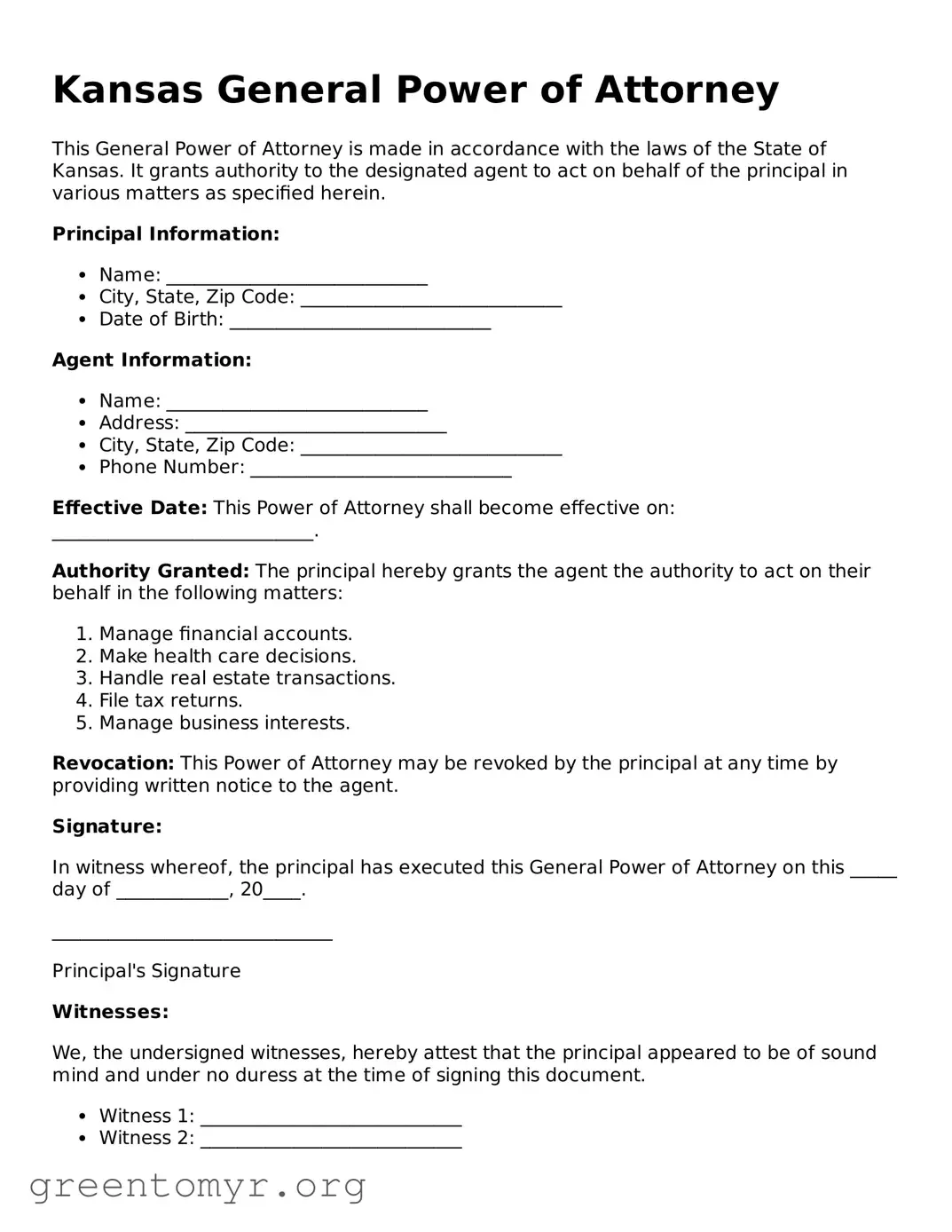
The Kansas General Power of Attorney form is an important legal document that grants an individual, known as the agent or attorney-in-fact, the authority to act on behalf of another person, referred to as the principal. This form is particularly useful for managing financial matters, making decisions about property, and handling various transactions when the principal is unable to do so themselves. It allows the agent to perform a wide range of tasks, from paying bills and managing bank accounts to buying or selling real estate. Importantly, the Kansas General Power of Attorney can be customized to fit the principal's specific needs, including limiting the agent's powers or setting an expiration date for the authority granted. The form must be signed and notarized to ensure its validity, providing peace of mind that the principal's wishes will be respected and upheld. Understanding the nuances of this document is crucial for anyone considering appointing an agent to manage their affairs.
Kansas General Power of Attorney
This General Power of Attorney is made in accordance with the laws of the State of Kansas. It grants authority to the designated agent to act on behalf of the principal in various matters as specified herein.
Principal Information:
Agent Information:
Effective Date: This Power of Attorney shall become effective on: ____________________________.
Authority Granted: The principal hereby grants the agent the authority to act on their behalf in the following matters:
Revocation: This Power of Attorney may be revoked by the principal at any time by providing written notice to the agent.
Signature:
In witness whereof, the principal has executed this General Power of Attorney on this _____ day of ____________, 20____.
______________________________
Principal's Signature
Witnesses:
We, the undersigned witnesses, hereby attest that the principal appeared to be of sound mind and under no duress at the time of signing this document.
Notarization:
State of Kansas, County of ____________________________.
Subscribed and sworn to before me this _____ day of ____________, 20____.
______________________________
Notary Public Signature
My commission expires: ____________________________.
| Fact Name | Description |
|---|---|
| Definition | A General Power of Attorney allows an individual to appoint someone else to manage their financial and legal affairs. |
| Governing Law | The Kansas General Power of Attorney is governed by the Kansas Uniform Power of Attorney Act, K.S.A. 58-650 et seq. |
| Durability | This form can be made durable, meaning it remains effective even if the principal becomes incapacitated. |
| Agent's Authority | The agent can perform a wide range of actions, including managing bank accounts, signing checks, and handling real estate transactions. |
| Revocation | The principal can revoke the General Power of Attorney at any time, as long as they are competent to do so. |
| Signing Requirements | The form must be signed by the principal and acknowledged before a notary public to be valid. |
| Limitations | Some actions, like making medical decisions, typically require a separate medical power of attorney. |
| Agent's Duties | The agent must act in the best interest of the principal and keep accurate records of all transactions. |
| Expiration | The General Power of Attorney does not automatically expire unless specified in the document or revoked by the principal. |
| Accessibility | The form can be obtained from various sources, including legal websites and local government offices. |
Completing the Kansas General Power of Attorney form is an important task that requires careful attention to detail. After filling out the form, you will need to ensure that it is signed and witnessed according to Kansas law. This will help ensure that the document is valid and can be used as intended.
Once you have completed these steps, review the form for any errors or omissions. It is crucial to ensure that everything is correct before finalizing the document.
A Kansas General Power of Attorney is a legal document that allows you to appoint someone else, known as your agent or attorney-in-fact, to make decisions on your behalf. This can include financial matters, property transactions, and other important decisions if you are unable to do so yourself.
The powers granted can be quite broad. Generally, a General Power of Attorney allows your agent to:
It is essential to clearly define what powers you wish to grant to ensure your wishes are respected.
Creating a General Power of Attorney in Kansas involves a few straightforward steps:
Once completed, provide copies to your agent and any relevant institutions, such as banks or healthcare providers.
Yes, you can revoke a General Power of Attorney at any time as long as you are mentally competent. To do so, you must create a written revocation document and notify your agent and any institutions that have a copy of the original document. This ensures that your wishes are clear and legally recognized.
If you become incapacitated and have a General Power of Attorney in place, your agent can step in to make decisions on your behalf. This is one of the primary purposes of the document. However, it is crucial to ensure that the document is properly executed and that your agent is aware of your preferences.
No, they are not the same. A General Power of Attorney may become ineffective if you become incapacitated, while a Durable Power of Attorney remains in effect even if you lose the ability to make decisions. If you want your agent to have authority during periods of incapacity, it is advisable to create a Durable Power of Attorney.
Absolutely. You can specify the exact powers you want to grant your agent. For instance, you might allow them to manage your finances but not make healthcare decisions. Clearly outlining these limitations in the document is crucial to ensure your intentions are followed.
Filling out the Kansas General Power of Attorney form can be a straightforward process, but several common mistakes can lead to complications. One significant error is not clearly identifying the principal and agent. The principal is the person granting authority, while the agent is the individual receiving it. Omitting full names or using nicknames can create confusion and potentially invalidate the document.
Another frequent mistake is failing to specify the powers granted to the agent. While the form allows for broad or limited authority, being vague can lead to misunderstandings. It’s essential to detail the specific powers the agent will have, whether it’s handling financial matters, making healthcare decisions, or managing property. Without this clarity, the agent may not have the authority to act in critical situations.
People often overlook the importance of signatures and dates. The Kansas General Power of Attorney form requires the principal’s signature, and in some cases, the agent's signature as well. Not signing or dating the document can render it ineffective. Additionally, witnesses or notarization may be necessary, depending on the situation. Failing to include these elements can lead to legal challenges later on.
Lastly, many individuals neglect to review the form after completing it. Mistakes in the details, such as incorrect dates or misspelled names, can significantly impact the power of attorney's effectiveness. It’s advisable to double-check all entries and ensure that the document reflects the principal's intentions accurately. Taking the time to review can prevent future complications and ensure that the power of attorney serves its intended purpose.
When creating a Kansas General Power of Attorney, it’s often helpful to consider other related forms and documents that can enhance your estate planning or legal arrangements. Each of these documents serves a unique purpose and can provide additional clarity and security in managing your affairs.
Incorporating these documents into your estate planning can provide peace of mind and ensure your wishes are honored. Each form plays a vital role in managing your affairs, both during your lifetime and after, making it essential to consider them alongside the Kansas General Power of Attorney.
A General Power of Attorney (GPA) is a vital document that allows one person to act on behalf of another in various matters. There are other documents that serve similar purposes, each with its own specific focus. Here are four documents that are similar to a General Power of Attorney:
Filling out a Kansas General Power of Attorney form can be a significant step in ensuring that your financial and legal matters are handled according to your wishes. Here are ten important things to keep in mind while completing this form.
By following these guidelines, you can create a General Power of Attorney that reflects your intentions and provides peace of mind for you and your loved ones.
The Kansas General Power of Attorney form is a powerful legal document, but several misconceptions surround its use and implications. Understanding these misconceptions can help individuals make informed decisions about their legal affairs.
While many people associate a General Power of Attorney with financial decisions, it can also grant authority over various personal matters. This includes healthcare decisions, property management, and other legal affairs. The scope of authority can be tailored to meet specific needs.
Many believe that only licensed professionals can serve as agents under a General Power of Attorney. In reality, any competent adult can act as an agent. This means that friends, family members, or trusted individuals can be appointed to manage affairs.
It is a common belief that the authority granted under a General Power of Attorney continues indefinitely. However, this document typically becomes invalid if the principal becomes incapacitated, unless it is specifically designed to be durable. A durable power of attorney explicitly states that it remains effective even in the event of the principal's incapacitation.
Some individuals think that an agent has unlimited power over the principal’s assets. However, the agent must act in the best interest of the principal and follow any specific instructions outlined in the document. Misuse of authority can lead to legal consequences for the agent.
Filling out and using the Kansas General Power of Attorney form can be straightforward if you keep a few key points in mind. Here are some important takeaways:
By keeping these points in mind, you can effectively utilize the Kansas General Power of Attorney form to manage your affairs and ensure your wishes are honored.