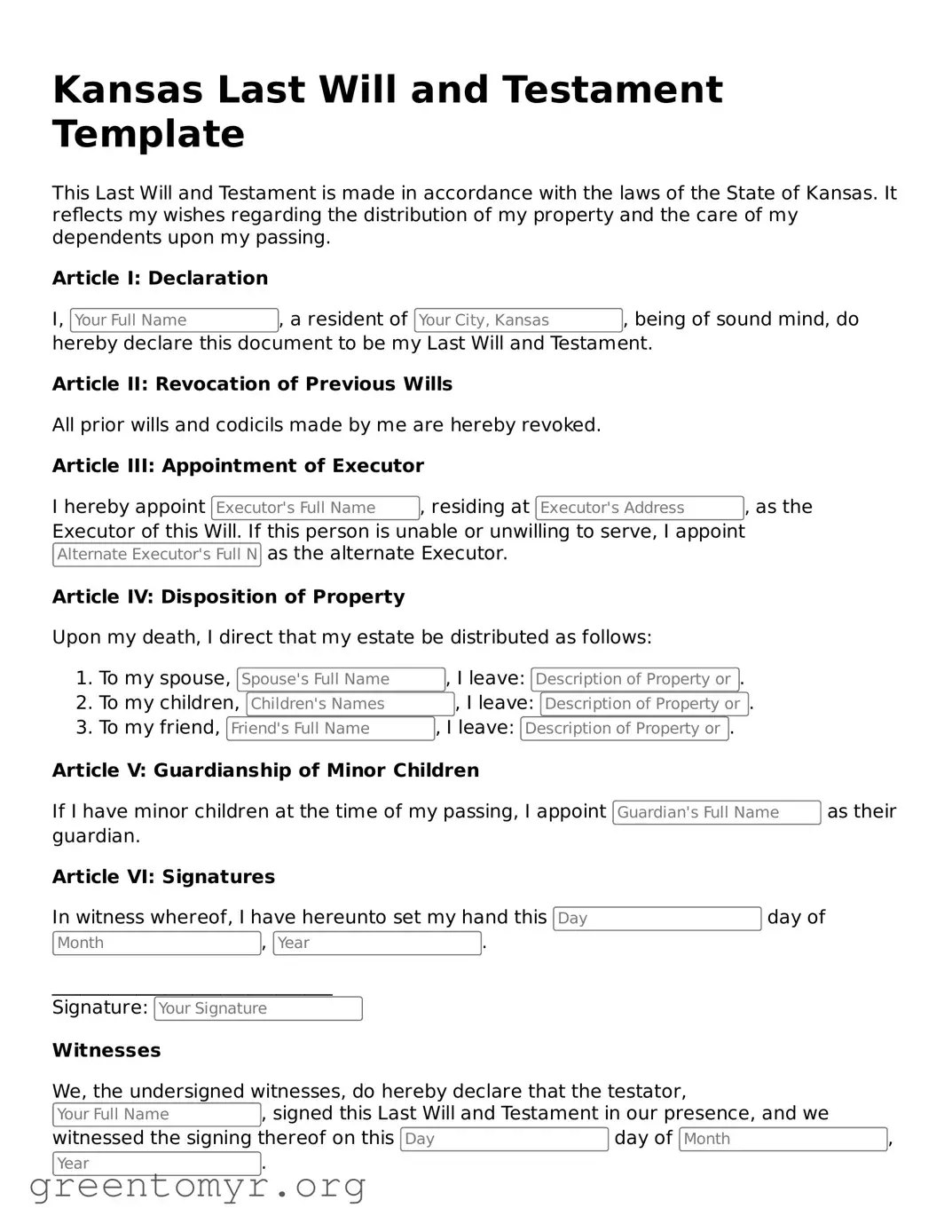
Creating a Last Will and Testament is an essential step in ensuring that your wishes are honored after your passing. In Kansas, this legal document outlines how your assets will be distributed and provides guidance on guardianship for any minor children. The Kansas Last Will and Testament form is designed to be straightforward, allowing individuals to specify beneficiaries, designate an executor, and articulate any specific bequests. Additionally, it addresses the appointment of a guardian, which is particularly important for parents who want to ensure their children's care is entrusted to someone they trust. By completing this form, you not only clarify your intentions but also help to minimize potential disputes among family members during a challenging time. Understanding the components of this form is crucial, as it empowers you to take control of your estate planning and provides peace of mind for both you and your loved ones.
Kansas Last Will and Testament Template
This Last Will and Testament is made in accordance with the laws of the State of Kansas. It reflects my wishes regarding the distribution of my property and the care of my dependents upon my passing.
Article I: Declaration
I, , a resident of , being of sound mind, do hereby declare this document to be my Last Will and Testament.
Article II: Revocation of Previous Wills
All prior wills and codicils made by me are hereby revoked.
Article III: Appointment of Executor
I hereby appoint , residing at , as the Executor of this Will. If this person is unable or unwilling to serve, I appoint as the alternate Executor.
Article IV: Disposition of Property
Upon my death, I direct that my estate be distributed as follows:
Article V: Guardianship of Minor Children
If I have minor children at the time of my passing, I appoint as their guardian.
Article VI: Signatures
In witness whereof, I have hereunto set my hand this day of , .
______________________________
Signature:
Witnesses
We, the undersigned witnesses, do hereby declare that the testator, , signed this Last Will and Testament in our presence, and we witnessed the signing thereof on this day of , .
| Fact Name | Description |
|---|---|
| Definition | A Last Will and Testament is a legal document that outlines how a person's assets will be distributed after their death. |
| Governing Law | The Kansas Last Will and Testament is governed by Kansas Statutes Annotated (K.S.A.) Chapter 59. |
| Age Requirement | In Kansas, individuals must be at least 18 years old to create a valid will. |
| Signature Requirement | The will must be signed by the testator (the person creating the will) in the presence of two witnesses. |
| Witnesses | Witnesses must be at least 18 years old and cannot be beneficiaries of the will. |
| Revocation | A will can be revoked by creating a new will or by physically destroying the existing one. |
| Holographic Wills | Kansas recognizes holographic wills, which are handwritten and do not require witnesses, if they meet certain criteria. |
Once you have the Kansas Last Will and Testament form in hand, it's important to fill it out carefully. This document will guide your wishes regarding the distribution of your assets and care of any dependents after your passing. Follow these steps to ensure the form is completed accurately.
A Last Will and Testament is a legal document that outlines how a person's assets and property will be distributed after their death. In Kansas, this document also allows individuals to name guardians for minor children and specify funeral arrangements. It is important to ensure that the will complies with state laws to be considered valid.
In Kansas, any person who is at least 18 years old and of sound mind can create a Last Will and Testament. This means the individual must understand the nature of the document and the effects of their decisions. Additionally, the will must be signed by the testator (the person making the will) and witnessed by at least two individuals who are not beneficiaries of the will.
To ensure that your Last Will and Testament is valid in Kansas, follow these steps:
It is advisable to keep the original will in a safe place and provide copies to your executor or trusted family members.
If a person dies without a Last Will and Testament in Kansas, they are considered to have died "intestate." This means that the state laws will dictate how their assets are distributed. Generally, the estate will go to the closest relatives, such as a spouse, children, or parents. However, this process may not align with the deceased's wishes, which is why having a will is important.
Filling out a Kansas Last Will and Testament form can be a straightforward process, but many people make mistakes that can lead to complications later. One common error is not being specific enough about the distribution of assets. It’s essential to clearly outline who receives what to avoid confusion or disputes among heirs.
Another mistake is failing to sign the will in front of the required witnesses. Kansas law mandates that a will must be signed by at least two witnesses who are not beneficiaries. If this step is overlooked, the will may not be considered valid.
People often forget to date their will. A date is crucial because it helps establish the most recent version of the document. Without a date, it can be challenging to determine which will is valid if multiple versions exist.
Using vague language can also create problems. Terms like "my belongings" or "my estate" can lead to misunderstandings. It’s best to use precise descriptions to ensure that your intentions are clear.
Another mistake is neglecting to update the will after major life events, such as marriage, divorce, or the birth of a child. Failing to make these updates can result in unintended consequences, such as an ex-spouse inheriting assets.
Some individuals do not consider the need for alternate beneficiaries. In the event that a primary beneficiary passes away before the testator, having alternatives can prevent complications in asset distribution.
Additionally, people sometimes forget to include a guardian for minor children. This decision is crucial for their care and should not be overlooked. A will can provide peace of mind by ensuring that children are placed in the hands of someone trusted.
Another frequent error is not keeping the will in a safe yet accessible location. If the will is lost or difficult to find, it can lead to delays and additional stress for loved ones during an already challenging time.
Lastly, some individuals may not seek legal advice when necessary. While it is possible to create a will without assistance, consulting with a legal professional can help ensure that all requirements are met and that the document reflects your wishes accurately.
The Kansas Last Will and Testament form is an essential document for individuals wishing to outline their wishes regarding the distribution of their assets after death. However, several other forms and documents are often utilized alongside this will to ensure a comprehensive estate plan. Below is a list of these commonly used documents, each serving a unique purpose in the estate planning process.
Utilizing these documents in conjunction with the Kansas Last Will and Testament can create a more robust estate plan. Each document plays a vital role in ensuring that an individual's wishes are honored and that their loved ones are supported during difficult times.
The Last Will and Testament is a crucial document for individuals planning their estate. Several other documents serve similar purposes in estate planning and asset distribution. Below is a list of ten documents that share similarities with a Last Will and Testament:
Each of these documents plays a vital role in ensuring that your wishes are honored and that your loved ones are taken care of according to your preferences.
Creating a Last Will and Testament is an important step in ensuring that your wishes are honored after your passing. When filling out the Kansas Last Will and Testament form, there are several best practices to follow, as well as some common pitfalls to avoid. Here’s a helpful list of things to do and not to do.
By following these guidelines, you can create a clear and effective Last Will and Testament that reflects your wishes and provides peace of mind for your loved ones.
Understanding the Kansas Last Will and Testament form is essential for anyone looking to create a valid will. However, several misconceptions can lead to confusion. Here are ten common misunderstandings about this important legal document:
Clarifying these misconceptions can help individuals navigate the process of creating a Last Will and Testament in Kansas more effectively.
When filling out and using the Kansas Last Will and Testament form, there are several important points to keep in mind. Here are some key takeaways:
Taking these steps can help ensure that your wishes are respected and that your loved ones are taken care of after your passing.