In the state of Kansas, the Living Will form serves as a crucial document that allows individuals to articulate their preferences regarding medical treatment in situations where they may be unable to communicate their wishes. This form is particularly significant in end-of-life scenarios, where decisions about life-sustaining treatments can become complex and emotionally charged. By completing a Living Will, individuals can specify their desires concerning resuscitation efforts, mechanical ventilation, and other medical interventions, ensuring that their values and preferences are honored even when they cannot voice them. Moreover, the Kansas Living Will form is designed to be straightforward, making it accessible for anyone wishing to take control of their healthcare decisions. It is important to note that this document must be signed in the presence of witnesses or a notary public to be legally valid, emphasizing the importance of proper execution. Understanding the nuances of this form empowers individuals to navigate difficult healthcare choices with clarity and confidence, ultimately fostering peace of mind for both the individual and their loved ones.
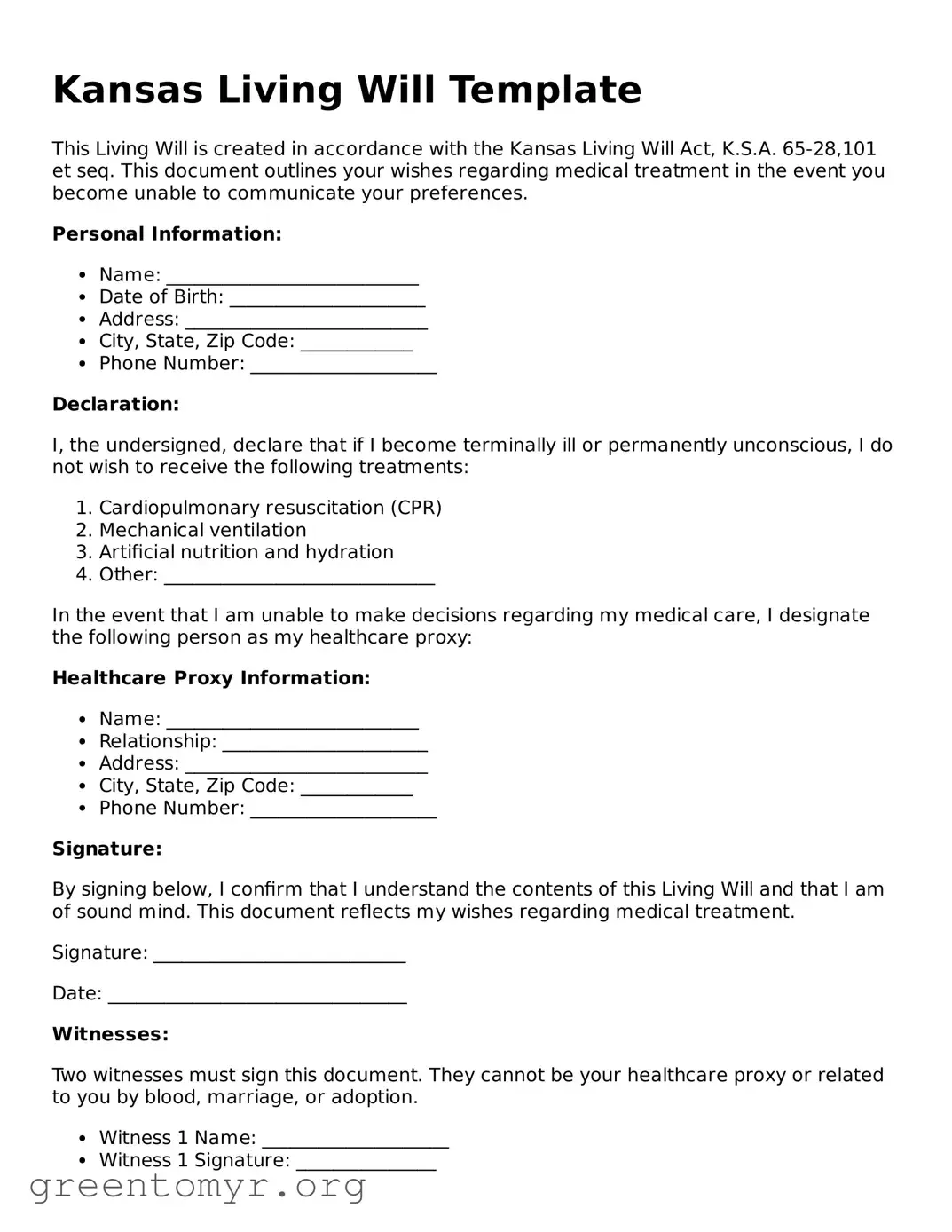
Kansas Living Will Template
This Living Will is created in accordance with the Kansas Living Will Act, K.S.A. 65-28,101 et seq. This document outlines your wishes regarding medical treatment in the event you become unable to communicate your preferences.
Personal Information:
Declaration:
I, the undersigned, declare that if I become terminally ill or permanently unconscious, I do not wish to receive the following treatments:
In the event that I am unable to make decisions regarding my medical care, I designate the following person as my healthcare proxy:
Healthcare Proxy Information:
Signature:
By signing below, I confirm that I understand the contents of this Living Will and that I am of sound mind. This document reflects my wishes regarding medical treatment.
Signature: ___________________________
Date: ________________________________
Witnesses:
Two witnesses must sign this document. They cannot be your healthcare proxy or related to you by blood, marriage, or adoption.
| Fact Name | Details |
|---|---|
| Purpose | A Kansas Living Will allows individuals to express their wishes regarding medical treatment in case they become unable to communicate. |
| Governing Law | The Kansas Living Will is governed by the Kansas Statutes Annotated, specifically K.S.A. 65-28,101 et seq. |
| Eligibility | Any adult who is of sound mind can create a Living Will in Kansas. |
| Witness Requirements | The document must be signed in the presence of two witnesses who are at least 18 years old. |
| Notarization | While notarization is not required, it can add an extra layer of validity to the Living Will. |
| Revocation | A Living Will can be revoked at any time by the person who created it, as long as they are competent. |
| Healthcare Proxy | A Living Will does not appoint a healthcare proxy; a separate document is needed for that purpose. |
| Medical Decisions | The Living Will can specify preferences for treatments such as resuscitation, tube feeding, and pain management. |
| Storage | It is advisable to keep the Living Will in an easily accessible location and share copies with family and healthcare providers. |
Filling out the Kansas Living Will form is an important step in ensuring that your healthcare wishes are respected in the event you cannot communicate them yourself. By completing this form, you can outline your preferences regarding medical treatment and end-of-life care. Below are the steps to guide you through the process of filling out the form.
A Kansas Living Will is a legal document that allows individuals to outline their preferences regarding medical treatment in the event they become unable to communicate their wishes. It specifically addresses situations where a person is terminally ill or in a persistent vegetative state, ensuring that their healthcare decisions align with their values and desires.
Any adult who is at least 18 years old and of sound mind can create a Kansas Living Will. This includes individuals who wish to express their medical treatment preferences in advance. It is advisable to consult with a healthcare provider or legal expert when drafting this document to ensure that it accurately reflects personal wishes.
A Kansas Living Will should clearly state your preferences regarding:
Additionally, it may be beneficial to include personal values or beliefs that guide your healthcare decisions.
To create a Kansas Living Will, follow these steps:
Once completed, it is advisable to provide copies to your healthcare providers and family members to ensure your wishes are known.
Yes, you can change or revoke your Kansas Living Will at any time, as long as you are of sound mind. To revoke it, simply destroy the document or create a new Living Will that clearly states your updated preferences. Inform your healthcare providers and family members about any changes to ensure they are aware of your current wishes.
No, a Kansas Living Will and a Durable Power of Attorney for Healthcare are different documents. While a Living Will specifies your medical treatment preferences, a Durable Power of Attorney for Healthcare designates an individual to make healthcare decisions on your behalf if you are unable to do so. Both documents can work together to provide comprehensive guidance for your healthcare needs.
If you do not have a Kansas Living Will, healthcare providers will make decisions based on your best interests and the input of family members or legal representatives. This may lead to decisions that do not align with your personal values or preferences. Having a Living Will ensures that your specific wishes regarding medical treatment are respected, reducing potential conflicts and confusion during critical moments.
Filling out a Kansas Living Will form can be a straightforward process, but there are common mistakes that people often make. One frequent error is not providing clear and specific instructions regarding medical treatment preferences. Vague language can lead to confusion and may not accurately reflect the individual’s wishes.
Another mistake is failing to sign the document in the presence of a witness. In Kansas, the law requires that the Living Will be signed by the individual and witnessed by at least one person. Not adhering to this requirement can render the document invalid.
Many individuals overlook the importance of updating their Living Will. Life circumstances and personal beliefs can change over time. It is crucial to review and revise the document periodically to ensure it aligns with current wishes.
Some people neglect to discuss their Living Will with family members or healthcare providers. Open communication can help avoid misunderstandings and ensure that everyone is aware of the individual’s preferences. This step is essential for ensuring that the wishes outlined in the document are honored.
Another common error involves not considering the implications of the decisions made in the Living Will. Individuals should take time to understand the medical treatments they are agreeing to accept or refuse. Misunderstandings about these treatments can lead to unintended consequences.
Inaccurate personal information can also be a significant mistake. It is important to ensure that all details, such as name, address, and date of birth, are correct. Errors in personal information can create complications when the document is needed.
Lastly, some people forget to keep copies of their Living Will. It is advisable to store the document in a safe place and share copies with family members and healthcare providers. This ensures that the document is accessible when needed and can be easily referenced by those involved in the individual’s care.
When preparing a Kansas Living Will, several other forms and documents may be necessary to ensure that your healthcare wishes are clearly communicated and legally recognized. Below is a list of commonly used documents that complement the Living Will.
Having these documents in place can provide peace of mind for you and your loved ones. It ensures that your healthcare preferences are respected and followed, allowing for a smoother process during challenging times.
A Living Will is an important document that outlines your preferences for medical treatment in the event that you cannot communicate your wishes. There are several other documents that serve similar purposes, each with its own focus. Here are five documents that share similarities with a Living Will:
When preparing to fill out the Kansas Living Will form, it’s essential to approach the process with care and consideration. Here are some important do's and don'ts to keep in mind:
By following these guidelines, you can ensure that your Living Will accurately reflects your desires and provides clear guidance for your loved ones and healthcare providers during difficult times.
Understanding the Kansas Living Will form is crucial for making informed decisions about end-of-life care. However, several misconceptions can lead to confusion. Here are six common misunderstandings:
Many people believe that living wills are only necessary for older adults. In reality, anyone over the age of 18 can benefit from having a living will, as unexpected medical situations can arise at any age.
This misconception can be misleading. While both documents relate to healthcare decisions, a living will specifically outlines your wishes regarding medical treatment, whereas a power of attorney designates someone to make decisions on your behalf.
Some individuals think that signing a living will is a permanent commitment. In fact, you can modify or revoke your living will at any time, as long as you are mentally competent to do so.
While living wills are designed to guide medical decisions, healthcare providers may not always be legally bound to follow them. It's essential to communicate your wishes with your medical team and ensure they are aware of your living will.
People often think living wills only cover situations involving life support. However, they can also address other medical treatments, such as pain management and comfort care options.
This belief overlooks the broader application of living wills. They can be relevant in various healthcare settings, including nursing homes and during emergency situations outside of a hospital.
By dispelling these misconceptions, individuals can better prepare for their healthcare decisions and ensure their wishes are respected. Understanding the true nature of a living will is a vital step in planning for the future.
Here are key takeaways about filling out and using the Kansas Living Will form: