In the state of Kansas, the Medical Power of Attorney (MPOA) form serves as a crucial legal document that empowers individuals to make healthcare decisions on behalf of another person in the event they become incapacitated. This form is particularly important for ensuring that a person's medical preferences are honored when they cannot communicate their wishes. The MPOA allows the designated agent to make decisions about medical treatments, procedures, and interventions, reflecting the principal's values and desires. It is essential to choose a trustworthy and responsible agent, as this person will have the authority to navigate complex medical situations and communicate with healthcare providers. Additionally, the form must be completed in accordance with Kansas law, which includes proper signing and witnessing requirements to ensure its validity. Understanding the nuances of the MPOA can help individuals prepare for unforeseen medical circumstances, providing peace of mind for both the principal and their loved ones.
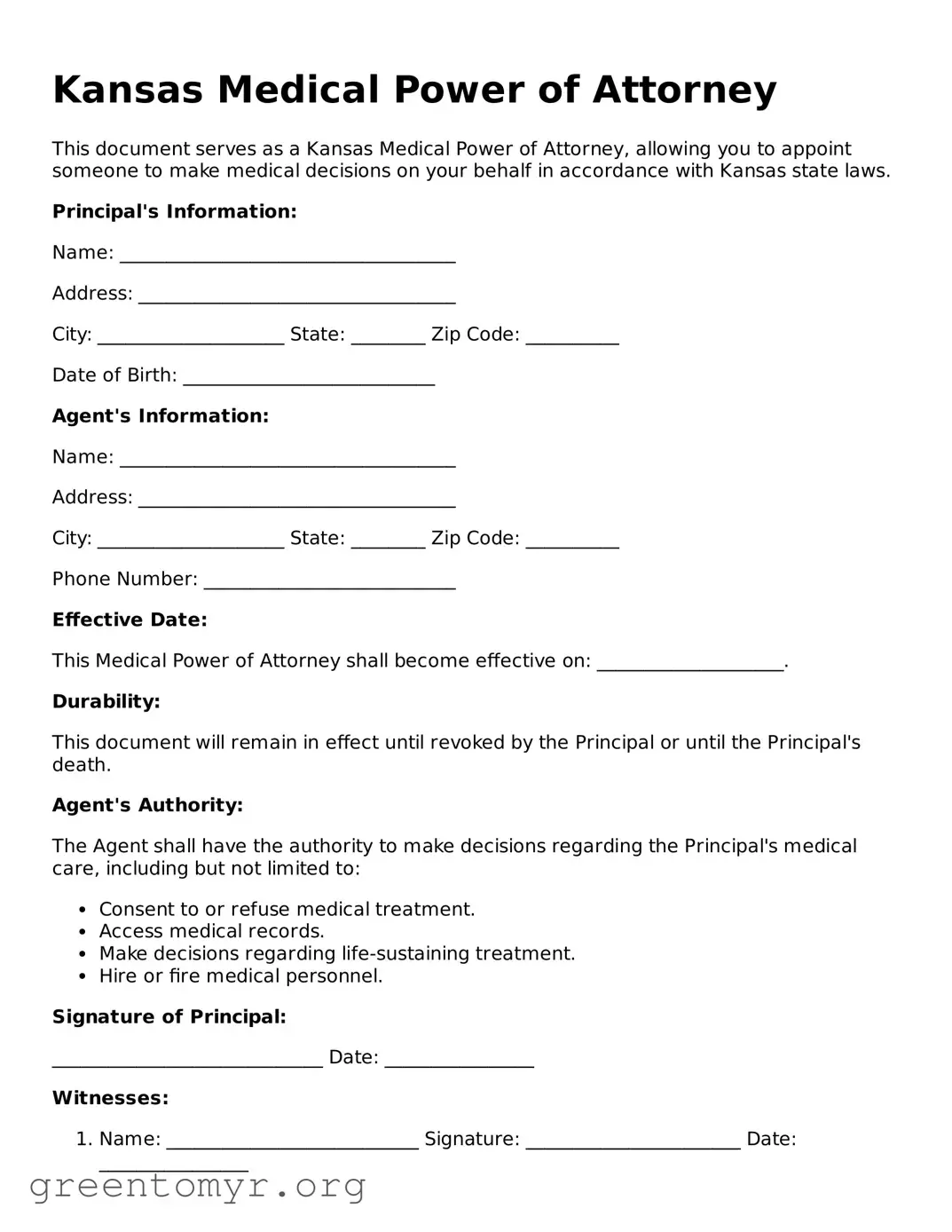
Kansas Medical Power of Attorney
This document serves as a Kansas Medical Power of Attorney, allowing you to appoint someone to make medical decisions on your behalf in accordance with Kansas state laws.
Principal's Information:
Name: ____________________________________
Address: __________________________________
City: ____________________ State: ________ Zip Code: __________
Date of Birth: ___________________________
Agent's Information:
Name: ____________________________________
Address: __________________________________
City: ____________________ State: ________ Zip Code: __________
Phone Number: ___________________________
Effective Date:
This Medical Power of Attorney shall become effective on: ____________________.
Durability:
This document will remain in effect until revoked by the Principal or until the Principal's death.
Agent's Authority:
The Agent shall have the authority to make decisions regarding the Principal's medical care, including but not limited to:
Signature of Principal:
_____________________________ Date: ________________
Witnesses:
Notary Public:
State of Kansas
County of ______________________
Subscribed and sworn before me this _____ day of ____________, 20__.
_____________________________ (Notary Public Signature)
My commission expires: ________________
| Fact Name | Description |
|---|---|
| Definition | A Kansas Medical Power of Attorney allows an individual to designate someone to make healthcare decisions on their behalf if they become incapacitated. |
| Governing Law | This form is governed by the Kansas Statutes Annotated, specifically K.S.A. 65-28,100 et seq. |
| Eligibility | Any adult resident of Kansas can create a Medical Power of Attorney. |
| Agent Responsibilities | The appointed agent must act in the best interests of the principal, making decisions based on their known wishes. |
| Signing Requirements | The form must be signed by the principal and witnessed by two individuals or notarized. |
| Durability | This power of attorney remains effective even if the principal becomes incapacitated. |
| Revocation | The principal can revoke the Medical Power of Attorney at any time, as long as they are mentally competent. |
| Limitations | The agent cannot make decisions about the principal's body after death, including organ donation or autopsy. |
Completing the Kansas Medical Power of Attorney form is an important step in ensuring that your healthcare wishes are honored. This document allows you to designate someone to make medical decisions on your behalf in case you become unable to do so. The following steps will guide you through the process of filling out the form correctly.
A Kansas Medical Power of Attorney is a legal document that allows an individual, known as the principal, to appoint someone else, called an agent, to make medical decisions on their behalf if they become unable to do so. This document ensures that the principal's healthcare preferences are respected and followed when they cannot communicate their wishes.
In Kansas, any competent adult can be appointed as an agent. This includes family members, friends, or other trusted individuals. However, certain individuals, such as healthcare providers or employees of healthcare facilities, may not serve as agents unless they are related to the principal by blood, marriage, or adoption.
To create a Kansas Medical Power of Attorney, follow these steps:
Yes, you can revoke your Kansas Medical Power of Attorney at any time as long as you are mentally competent. To revoke the document, you should create a written revocation and notify your agent and any healthcare providers who have a copy of the original document. It is also advisable to destroy any copies of the original Medical Power of Attorney to avoid confusion.
If you do not have a Medical Power of Attorney and become unable to make your own medical decisions, healthcare providers will typically follow the hierarchy of surrogate decision-makers established by Kansas law. This hierarchy includes your spouse, adult children, parents, and siblings. However, this process can lead to disputes among family members and may not reflect your personal wishes. Having a Medical Power of Attorney can help avoid such situations and ensure your preferences are honored.
Filling out the Kansas Medical Power of Attorney form can be straightforward, but there are common mistakes that people often make. One frequent error is not clearly identifying the person designated as the agent. It is essential to provide the full name and contact information of the agent to avoid any confusion during critical moments.
Another mistake involves failing to specify the scope of authority granted to the agent. Some individuals leave this section blank or write vague descriptions. It is important to outline what medical decisions the agent can make on your behalf, ensuring that your wishes are respected.
Many people overlook the importance of signing the document in the presence of a witness or a notary public. Kansas law requires that the Medical Power of Attorney be properly witnessed or notarized to be valid. Neglecting this step can render the document ineffective when it is needed most.
Additionally, individuals sometimes forget to date the form. A date is crucial as it indicates when the document was executed. Without a date, there may be questions about the validity of the document, especially if there are changes in circumstances later on.
Some people may also make the mistake of not reviewing the completed form for errors. Typos or incorrect information can lead to misunderstandings. Taking the time to double-check all entries ensures that the document accurately reflects your intentions.
Moreover, individuals might not discuss their choices with their designated agent. It is vital to communicate your wishes and preferences clearly. This conversation helps ensure that your agent understands your desires and can act accordingly when the time comes.
People sometimes forget to keep a copy of the completed form. After filling it out, it is important to store the document in a safe place and share copies with relevant parties, such as family members and healthcare providers. This practice ensures that your agent has access to the document when needed.
Lastly, failing to update the form when circumstances change can be a significant oversight. Life events such as a change in health status, a move, or a change in relationships may necessitate updates to your Medical Power of Attorney. Regularly reviewing and revising the document helps keep your wishes current and valid.
The Kansas Medical Power of Attorney form is a crucial document that allows individuals to designate someone to make healthcare decisions on their behalf if they become unable to do so. This form often works in conjunction with several other documents that help ensure a person's medical wishes are respected and followed. Below are five important forms and documents commonly used alongside the Kansas Medical Power of Attorney.
These documents collectively support an individual's healthcare preferences and decision-making process. Utilizing them alongside the Kansas Medical Power of Attorney can provide comprehensive guidance to healthcare providers and family members during critical times.
The Medical Power of Attorney form is an important document that allows a person to designate someone else to make healthcare decisions on their behalf. Several other documents serve similar purposes in different contexts. Here are seven documents that are comparable to the Medical Power of Attorney:
When filling out the Kansas Medical Power of Attorney form, it is essential to approach the process carefully. Here are some important dos and don'ts to keep in mind.
By following these guidelines, you can ensure that your Medical Power of Attorney reflects your wishes and provides clarity in difficult situations.
Understanding the Kansas Medical Power of Attorney form is crucial for ensuring that your healthcare wishes are respected. However, several misconceptions can cloud this important document. Below are five common misunderstandings:
Many people believe that a Medical Power of Attorney is only relevant in dire situations. In reality, this document can be activated whenever you are unable to make your own medical decisions, not just during emergencies.
While it is true that you can choose someone to act on your behalf, there are specific requirements. The person you select must be at least 18 years old and capable of making informed decisions.
This is a common misconception. A Medical Power of Attorney works in conjunction with other documents, such as a living will. It does not negate your previously stated wishes if they are clearly outlined in another directive.
In Kansas, notarization is not a requirement for the Medical Power of Attorney to be effective. However, having it notarized can provide an extra layer of authenticity, which may be beneficial in certain situations.
This is simply not true. You have the right to revoke or modify your Medical Power of Attorney at any time, as long as you are of sound mind. Regular reviews of this document are advisable to ensure it reflects your current wishes.
By dispelling these misconceptions, individuals can better understand the importance and functionality of the Kansas Medical Power of Attorney form in planning for their healthcare decisions.
Filling out and using the Kansas Medical Power of Attorney form is an important step in ensuring that your healthcare preferences are respected. Here are five key takeaways to consider: